
August 31, 2026
10 min read

Key takeaways:
- Mentorship and peer support are invaluable when presenting at live conferences.
- Preparation is essential for overcoming fears at the podium.
Take a look at the Healio | OSN calendar page, and you will find more than three dozen meetings, symposia and summits that make up a year of ophthalmology gatherings.
Whether they are one-room, single-day conferences, such as Clinical Trials at the Summit, or they take up full convention centers, such as the American Academy of Ophthalmology annual meeting, they all give physicians a chance to stand in front of their peers to present research, discuss hot topics and celebrate their profession.

Image:
Courtesy of Nandini Venkateswaran, MD
Speaking at these conferences is a shared experience for many ophthalmologists. Nandini Venkateswaran, MD, was a first-year ophthalmology resident when she gave her first two presentations at a national conference at the 2017 American Society of Cataract and Refractive Surgery annual meeting in Los Angeles.
“These were my first opportunities to present research that I had done with mentors, one from my residency program and one from outside my residency program,” she said. “It was just a special opportunity to have visibility at those paper sessions as a trainee in front of doctors who I looked up to and are leaders in the field.”
Venkateswaran said a physician who moderated one of those sessions, Liliana Werner, MD, PhD, still brings up that paper session every time they see each other.
“I was presenting a paper about the impact of IOL glistenings on vision quality that I had prepared with Dr. Kenneth Rosenthal, and I was all nerves to be presenting as a first-time resident about a topic that I did not feel I was an expert in,” she said. “But I ensured I knew all the details of my presentation, was prepared to answer any potential questions and ran through my talk several times. To this day, Dr. Werner will come up to me and say, ‘I remember when you were a first-year resident presenting that great paper on IOL glistenings and now look how far you have come!’ We always connect about that memory when we see each other at various meetings. It’s so memorable to me to have had that opportunity to present at the ASCRS meeting back then as a first-year resident, and now ASCRS has grown into one of my favorite and most important meetings to present at annually.”
Start Small
If young physicians want to present at a conference, they can start with research that is easily available to them, said Healio | OSN Associate Medical Editor William B. Trattler, MD.
“What keyed my early success was just doing clinical research in my own practice that led to data that I could present at meetings,” he said. “Look at your outcomes from cataract surgery or refractive surgery.”

William B. Trattler
Trattler said starting out as a speaker can be as easy as presenting a complication and management. His first presentation was related to his practice outcomes for PRK in patients with a history of LASIK. Previous research had recommended against PRK after LASIK due to potential for corneal haze. Using data from his own practice, as well as outcomes reported by colleagues, Trattler came to a different conclusion.
“I looked at my own results but then also reached out to other doctors and made a spreadsheet with all the results,” he said. “I was able to present that at various meetings, showing that it was safe to perform PRK over LASIK with the use of mitomycin C and other advances at the time.”
Overcoming nerves
Healio/OSN Board Member Laura M. Periman, MD, started presenting before she was even in medical school. When she was an undergraduate, she presented her summer research on proopiomelanocortin expression in primate hypothalami at the Oregon National Primate Research Center.

Laura M. Periman
“That ended up forming the basis for my expert knowledge on medications like melanocortins that we use in medicine,” she said. “No matter how esoteric something may seem from a basic science perspective, there are clinical applications. You can build on that knowledge base, share it with your colleagues and say, ‘This is how I’ve come to understand it.’”
Periman said she did a lot of preparation before her first presentation, but she was still “terrified.”
“I still get nervous, especially in front of big venues, but it gets better with time,” she said.
For people who might struggle with that fear factor, Periman said there are ways to work on the issue. She recommended working on projects with passion behind them and submitting them as much as possible for practice.
“The opportunity to present your work many times is powerful,” she said. “You don’t necessarily have to become a clinician scientist, but it’s good practice and skill building. Every time you do it, you’ve built more skills, more experience, more knowledge and more know-how.”
Periman suggested starting at smaller conferences, whether that means a regional meeting or a niche national meeting such as Women in Ophthalmology.
“Something less intense than ASCRS or AAO can help you get your feet wet,” she said. “I think it’s a great strategy to get started.”
Periman said some people never actually overcome their fears; they just learn strategies to manage them. Practice is a good place to start.
“It feels so silly to practice in front of a mirror, but it’s priceless,” she said. “Just run it again and again and again with your timer until you’ve got it down to the exact time frame.”
Trattler had no experience with public speaking when he gave his first talk, and he felt like his heart was beating “10,000 times per minute.” Back then, he would practice out loud to himself, but if he had to give his first talk now, he would do things a little differently.
“When I first started speaking, I practiced in front of a mirror,” he said. “Today, speakers have tools such as Zoom that allow them to record their presentations and evaluate their performance. Reviewing a recording helps speakers refine their delivery, communicate more efficiently and become more comfortable with their material. In my work with students, I can clearly see the difference between a new speaker who has prepared and one who has not.”
During the COVID-19 pandemic, Trattler and his colleagues launched the virtual Rising Stars in Ophthalmology program to mentor young ophthalmologists. With traditional in-person conferences on hold, Ashvin Agarwal, MD, Jennifer Loh, MD, and Trattler wanted to give emerging speakers an opportunity to develop their presentation skills.
“We guided participants through the entire process, giving them an opportunity to present a topic that was important to them and to be on the stage, even if it was a virtual one,” Trattler said. “The selected speakers sent us their slides in advance, and we worked closely with them to refine their talks, strengthen their delivery, and make their presentations more engaging and interactive.”
One tip he always gives younger physicians is to build in opportunities for conversation to make their presentations more relaxed and to get panelists involved. For example, during a presentation about cataract surgery, Trattler said the speaker could ask, “Who uses intraoperative antibiotics for patients routinely during surgery for endophthalmitis prevention?”
“If you incorporate a question in your talk, one or two panelists can respond before you return to your presentation,” he said. “That interaction makes your talk more engaging for the audience while giving you an opportunity to collect your thoughts. It creates a natural break and can help you be a little more comfortable because it encourages a more conversational exchange.”
There are other opportunities for young physicians to find help. Periman said conferences have mentorship programs that provide platforms to practice and pick up a few tips and tricks for presenting. Organizations such as CEDARS/ASPENS offer professional coaching.
“I still participate in those because I find them so valuable in how to continually improve my game, so take advantage of those,” she said. “Even if you might be scared, there is incredible professional growth that happens when you do it. I firmly believe it has made me a better doctor. Constantly presenting and conveying ideas to my peers makes it easier to effectively convey those ideas to my patients. That bench to bedside and back concept is the rule of the road that I live by.”
Master the topic
The first time Elizabeth Yeu, MD, gave a presentation it was at a national conference: the American Glaucoma Society meeting. When she was still a resident, she presented data on using selective laser trabeculoplasty as first-line therapy over topical glaucoma drops. This was already in practice in Europe and other places, but it was not the standard of care in the United States.
“Twenty years later, we are absolutely in the mindset of interventional glaucoma to save the ocular surface and improve patient compliance,” she said. “But at the time it was still a disruptive and innovative idea.”

Elizabeth Yeu
Yeu called the experience “nerve-racking,” but she was thankful it was in a smaller room with maybe 30 people in attendance.
“It was not nearly as daunting as maybe the next 10 I did,” she said. “I was invited to speak at conferences that involved leading experts as well as an audience of 200-plus people.”
No matter the size or prestige of the audience, Yeu said speakers can lean on their preparation and expertise in the subject matter. Creating a talk from the ground up can provide more comfort for new speakers.
“You are creating the content and owning the material,” she said. “The process of creating the material helps you formalize your thoughts in how you want to tell that narrative and story.”
Over the years, Yeu has become more comfortable as a speaker by zeroing in on what she has become an expert in.
“I know that if I agree to a speaking engagement, it’s going to be in a topic area that I’m comfortable in,” she said. “That way, I feel like I have truly put in the work, and I feel that I can offer something that other peer clinicians can use to benefit their patients.”
For Yeu, she can use her expertise in areas such as anterior segment reconstruction, refractive cataract surgery and external disease management to handle anything that is thrown her way.
“If your passion is cataract surgery or clinical research, whatever it may be, focus on becoming an expert within that area,” she said. “That way, you can offer selective expertise.”
Young physicians have opportunities to build their knowledge base and confidence.
“Your first speaking engagement is not going to be at a main symposium or general session of an ASCRS, ESCRS or AAO meeting,” Yeu said. “It’s going to be within your department conferences and grand rounds, and it’s going to elevate from there. Then, find out what your passion actually is.”
Useful tips
Periman said young presenters can learn a lot by practicing. It could be something as small as eliminating filler words or finding the right posture, but improving those details can build confidence.
She teaches people to use a wider stance than what feels natural as well as soft knees with hands at the side so that they are free to make hand gestures. Additionally, lifting the crown of the head to the ceiling can help correct posture, she said
“That allows you to project and also conveys confidence,” she said. “You’re rooted, grounded, stable and centered. That’s a great physical way to get to a place where it’s less scary. It’s a physical ‘fake it till you make it.’”
Over the course of her career, Periman has also learned to rely less on her slides.
“I think the temptation when you first start out is to write everything on your slides,” she said. “I’ve gone from everything being written down to just showing a photo as a prompt for what I want to talk about. It can take a long time to get to that skill level, but if you can get there, you’ve truly arrived. You have mastery over your subject matter. Then, you can connect with the audience, see what’s resonating and follow up on it. It becomes a more organic presentation. When I have the freedom to flow and be spontaneous, I find that to be the richest content for the people there and for me.”
When Trattler works with emerging speakers, he encourages them to resist the urge to place every bit of information on their slides. Instead, they should focus on what is actually relevant and meaningful to the audience.
“If the important information is the amount of astigmatism measured by biometry, you do not need to present the entire report,” he said. “Crop the image to show only the section you want to discuss. The remaining information may distract the audience and make it more difficult to identify the key point.”
When a slide must contain a substantial amount of information, Trattler recommends using progressive reveals to introduce the content in stages as the presentation progresses.
“If you display all the text at once, the audience may start reading the slide instead of listening to you,” he said. “It’s distracting.”
A foot in the door
For young physicians who want to put themselves out there to speak at conferences, Venkateswaran said it is all about finding support in mentors and the greater ophthalmic community. Leaning on that support can open opportunities that build on each other.
“We have such great communities, such as YoungMD Connect, the ASCRS Young Eye Surgeon Committee, the AAO Young Ophthalmologist Committee and the CEDARS/ASPENS mentorship programs, that welcome young ophthalmologists and offer them opportunities to begin presenting at the podium,” she said. “A mentor or colleagues in your program or department can think of you for a speaking opportunity. Sometimes they might get invited to give a lecture but cannot make it, and they will recommend you to give the talk instead. Or they may be organizing a symposium or session at an upcoming meeting and will invite you as one of the speakers or panelists. I think opportunities increasingly arise as you put yourself out there, vocalize interest in presenting, and commit to and deliver consistently high-quality presentations at different meetings.”
Yeu said networking and demonstrating commitment is a great way for young physicians to show that they are suited for more opportunities to speak.
“Networking is helpful in the process,” she said. “But if you do say yes to speaking, make sure that you put in the time and effort, especially making that initial impression when you are committing to something. Put in the time, do as nice of a job as possible, practice staying within the time limit and give a great presentation. Prepare on the content and deliver.”
Venkateswaran said speaking at conferences is not for everyone, and it is important that physicians know themselves, their personality and whether or not public speaking is a skill they want to grow. However, she has always found public speaking and the opportunity to lecture and present at the podium rewarding.
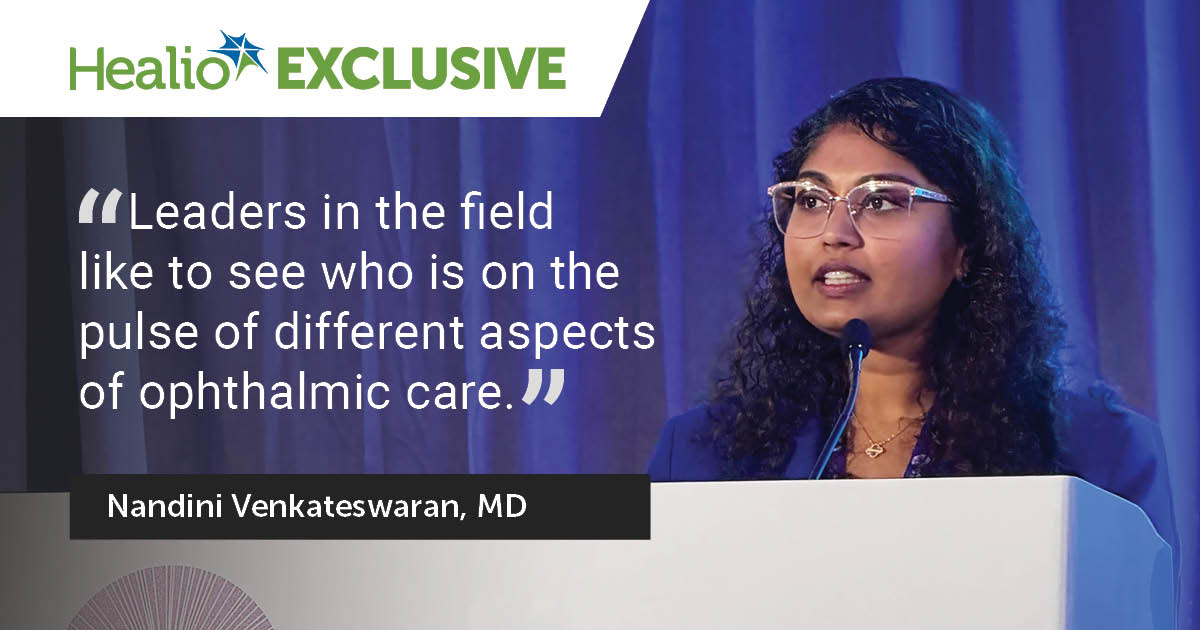
“It’s been a wonderful opportunity for me to become a mini expert in all the different topics I’ve been asked to present on at numerous national and international meetings these last several years,” she said. “It has also opened a lot of doors in the ophthalmic community and with industry partners. Leaders in the field like to see who is on the pulse of different aspects of ophthalmic care. I have found it to be an extremely enjoyable part of my career.”
For more information:
Laura M. Periman, MD, of Periman Eye Institute in Seattle, can be reached at dryeyemaster@gmail.com.
William B. Trattler, MD, of the Center for Excellence in Eye Care in Miami, can be reached at wtrattler@gmail.com.
Nandini Venkateswaran, MD, of Harvard Medical School and Massachusetts Eye and Ear, can be reached at nandini.venkat89@gmail.com.
Elizabeth Yeu, MD, chief medical officer at Tarsus Pharmaceuticals, can be reached at eyeulin@gmail.com.
Sources/Disclosures
Source:
Healio Interviews
Disclosures:
No products or companies that would require financial disclosure are mentioned in this article.

Ask a clinical question and tap into Healio AI’s knowledge base.
- PubMed, enrolling/recruiting trials, guidelines
- Clinical Guidance, Healio CME, FDA news
- Healio’s exclusive daily news coverage of clinical data