
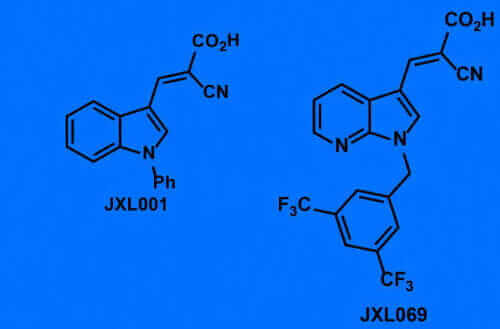

For several decades, hair loss treatment in men largely focused on reducing dihydrotestosterone (DHT) levels via the use of finasteride (Propecia) or dutasteride (Avodart). This started to change in recent years with the rise of new topical treatments targeting scalp androgen receptors. I posted a list of seven in 2024. with most of them currently in clinical trials. It seems like there is now a third popular category of new hair loss products taking off in 2026: mitochondrial pyruvate carrier (MPC) inhibitors.
Mitochondrial Pyruvate Carrier Inhibitors to Treat Hair Loss
A mitochondrial pyruvate carrier inhibitor is a small molecule that blocks the transport of pyruvate into the mitochondria. This alters cellular energy metabolism and production.
The subject of MPC inhibition to treat hair loss first came to my attention in 2017, when I wrote a post covering UCLA researcher Dr. William Lowry and his discovery of MPC inhibitor UK5099 to treat hair loss. His team found that the inhibition of mitochondrial pyruvate carrier may reverse hair loss via an increase in lactate. He later co-founded a now renowned company named Pelage Pharmaceuticals (US) in order to develop this hair loss treatment. See further below for more on Pelage.
More recently, a 2025 study from the University of Cambridge (UK) analyzed the inhibition of the human mitochondrial pyruvate carrier and its implications in the the development of new drugs to treat:
“Diabetes, fatty liver disease, Parkinson’s disease, specific cancers, and even hair loss“.
Also significant is a 2025 study from the US in relation to advances in the development of MPC inhibitors for therapeutic applications. They list the names of a bunch of JXL and other MPC inhibitors in a table. Dr. Lowry’s team also has a paper from 2021 in which they break out the entire range of JXL001 through JXL096.
As of September 2026, three companies are working on developing MPC inhibitors for hair growth. I will update the below section as more companies inevitably jump on to the MPC inhibitor bandwagon due to the success of Pelage Pharmaceuticals (in garnering unprecedented publicity and financing). I am sure companies will use AI to develop new types of MPC inhibitors in the coming years.
Pelage Pharmaceuticals PP405
The far and away leader of the MPC inhibitor trend is the pioneer Pelage Pharmaceuticals (US) via its PP405 topical MPC inhibitor drug candidate. It has raised sizable funds from Google Ventures and others in order to begin Phase 3 clinical trials for PP405 by the end of this year. In July 2026, it was speculated that PP405 is the same as JXL069 (which is a superior version of JXL001, aka UK5099). The President and co-founder of Pelage Dr. Lowry replied to to me in an e-mail earlier today and encouraged this blog’s readers to participate in the company’s Phase 3 clinical trials.
Kintor Pharmaceutical KT-215
In August 2026, Kintor Pharmaceutical (China) updated its pipeline page and gave us a surprise. It has added a third drug to fight androgenetic alopecia (AGA) to its pipeline. This one is a topical MPC inhibitor called KT-215. It is currently only in the pre-clinical stage of development. However, Kintor has a knack for conducting numerous clinical trials in China and the US with ease due to ready availability of funds. Trials in China also seem to go a little faster than in the US.
Even if KT-215 is successful in all phase of clinical trials, it would likely not come to market for over five years. Moreover, it would have to be deemed at least as effective than Pelage Pharmaceuticals’ PP405 in the event that the latter gets released in the US. Nevertheless, still a great sign to see scientists around the world agreeing that MPC inhibition could lead to hair regrowth.
Triple Hair TH65
I covered Triple Hair (Canada) in a 2024 post that was later updated in 2026. The company began Phase 3 clinical trials for its Therapy-07 (THO7) topical in April 2026 in Vancouver, Canada, It contains minoxidil, finasteride and latanoprost (a prostaglandin F2α analog). This product is already available for sale via prescription.
However, in August 2026, Triple Hair surprised everyone when it released an updated pipeline on its Instagram. In there, it says that the company was working on an MPC inhibitor called TH65 to treat AGA. It is hard for me to believe that this small Canadian company has the funds to ever go through 3 phases of trials for TH65. Perhaps they are aiming to release a hair loss cosmeceutical that might be a weak MPC inhibitor? I am not knowledgeable enough to know if this is legal and possible, so this is just speculation on my part.