
September 11, 2026
3 min read

Key takeaways:
- A blood-based assay reached 81% sensitivity for advanced adenomas and 85% specificity for advanced neoplasia.
- The test may address the “Achilles’ heel” of blood-based screening: detection of precancerous lesions.
Researchers have developed a blood-based assay that could help identify individuals with precursor lesions for colorectal cancer, a known limitation of many blood-based screening tests.
The assay, known as DENEB, detected 81% of advanced adenomas, as well as 91% of CRC overall and 92% of stage I to III cancers.

Screening rates among adults at average risk for CRC in the U.S. often fall short of the proposed 80% benchmark for population-level impact, according to study background. Blood-based tests have the potential to reach people who would otherwise remain unscreened.
However, these tests have an “Achilles’ heel,” according to Ajay Goel, PhD, AGAF.
“Several [blood-based] tests out there can find cancers — even stage II cancers — but where they fail is finding precancerous polyps, particularly advanced adenomas,” Goel, professor and founding chair of the department of molecular diagnostics and experimental therapeutics at City of Hope in Duarte, California, told Healio.
Existing blood-based tests have generally shown much lower sensitivity for advanced adenomas than for CRC, while colonoscopy remains the most effective preventive tool for detecting and removing precancerous lesions, he said.
In a three-stage, multicenter study, Goel and colleagues aimed to address this shortcoming. They investigated a blood-based assay with a multitarget approach that captured microRNA signals from both CRC and advanced adenomas.
“Advanced adenomas were treated as a primary biological endpoint from the earliest biomarker discovery phase,” Goel said.
Assay development
Researchers developed discovery and clinical cohorts in Spain and Japan, and used three external in silico datasets from China, Japan and Spain. Clinical participants had colonoscopy findings from screening or diagnostic colonoscopy, and treatment-naive patients with CRC also were recruited before surgery to enrich for CRC as an outcome.
Based on colonoscopy findings and histopathology, individuals were classified as having CRC, advanced adenomas or low-risk adenomas, or as controls.
The discovery cohorts included 274 participants from Spain and 307 from Japan, with combined data for both cohorts spanning March 2010 to December 2017.
Researchers catalogued microRNA biomarkers that were overexpressed in the blood of patients with CRC or adenomas in the discovery cohorts.
The in silico cohorts — comprised of 99 individuals from Japan, 61 from Spain and 107 from China — served as a reproducibility filter for biological validation of biomarkers identified in the discovery cohorts.
After discovery and in silico filtering, Goel and colleagues retained a panel of 19 cell-free and 20 exosomal microRNAs associated with CRC and advanced adenomas, which were then measured by reverse transcription quantitative polymerase chain reaction in the clinical cohorts. These cohorts were used for model training and independent testing.
The first included 535 individuals from participating centers in Spain and Japan, with data gathered between July 2018 and September 2023. A second clinical cohort included 230 individuals from the same sites during that time period and was used for independent testing.
Sensitivity for CRC and advanced adenomas, as well as specificity for advanced neoplasia, served as primary endpoints.
CRC and adenoma detection
The assay had sensitivity of 91% (95% CI, 80%-96%) for any-stage CRC and 92% (95% CI, 80%-97%) for stage I, II or III cancers. Sensitivity for advanced adenomas reached 81% (95% CI, 69%-89%).
“I was intrigued by the evidence that advanced adenomas and cancer appear to have related but distinct circulating signatures,” Goel said. “We were able to detect both with high sensitivity while maintaining 85% specificity for advanced neoplasia.
“When we plotted the two risk scores, patients with advanced adenomas and cancers clustered separately,” he continued. “That was striking because it suggests we can detect both with high accuracy while also seeing that, biologically, they have distinguishable molecular signatures.”
Specificity for advanced neoplasia was 85% (95% CI, 77%-90%) and 83% (95% CI, 72%-91%) for negative colonoscopy.
Goel and colleagues acknowledged study limitations, including that the cohorts were comprised primarily of Asian and white individuals; lack of data on potential confounders such as lifestyle factors, comorbidities and medications; and the outcome-enriched study design.
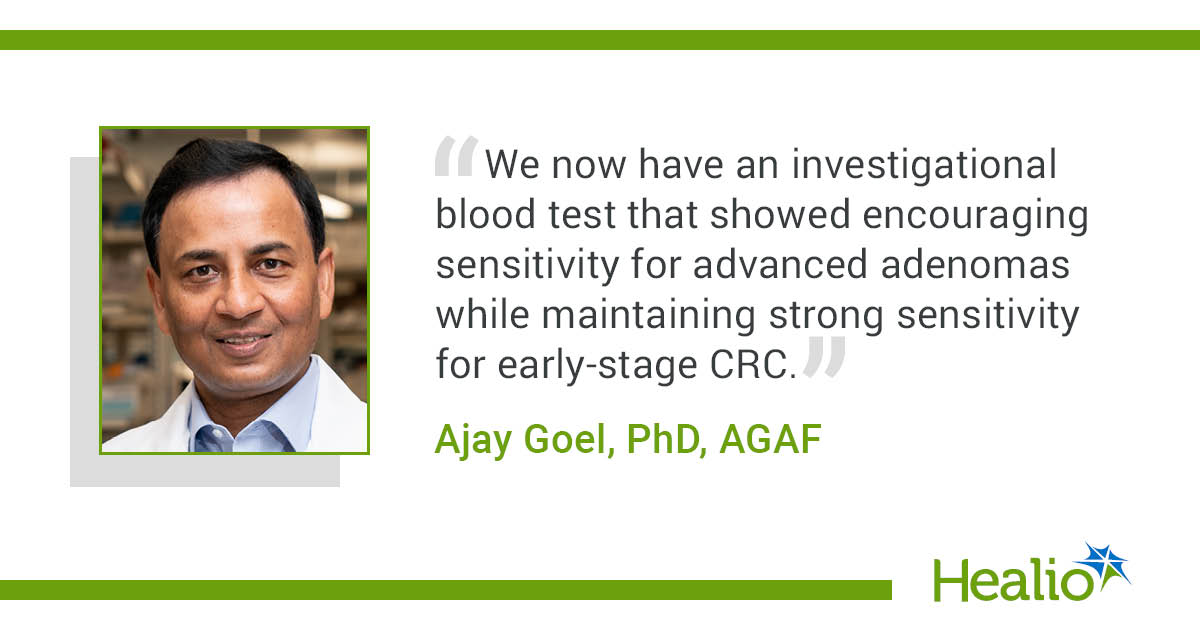
“It was not a population-based screening trial,” Goel said. “The results therefore should not be interpreted as showing that DENEB is ready to replace established screening modalities [such as] colonoscopy. But I think the data we have published clearly point us in the right direction. We now have an investigational blood test that showed encouraging sensitivity for advanced adenomas while maintaining strong sensitivity for early-stage CRC.”
According to the researchers, the current study established biological validity and diagnostic potential.
“The critical next step is a large-scale, prospective phase 4 study in an actual screening population,” Goel said.
Goel emphasized that a positive blood-based test must be followed by colonoscopy, which remains the “most effective preventive tool” for CRC.
“If DENEB’s performance is confirmed prospectively in future screening studies, I could envision it functioning as a complementary or rescue screening strategy,” he told Healio.
For more information:
Ajay Goel, PhD, AGAF, is founding director of biotech innovations at Beckman Research Institute and associate director for basic science at City of Hope Comprehensive Cancer Center in Duarte, California. He can be reached at ajgoel@coh.org.

Ask a clinical question and tap into Healio AI’s knowledge base.
- PubMed, enrolling/recruiting trials, guidelines
- Clinical Guidance, Healio CME, FDA news
- Healio’s exclusive daily news coverage of clinical data