
September 16, 2026
5 min read

Key takeaways:
- A detailed patient history is key to diagnosing alpha-gal syndrome, as the antibody test can yield false positives.
- Symptoms include abdominal pain, vomiting and diarrhea 4 to 8 hours after eating mammalian meat.
Summer may be winding down, but tick season is still in full swing — and that means the possibility of developing alpha-gal syndrome remains high in certain areas of the country.
The food allergy — caused by an immunoglobulin E (IgE)-mediated reaction hours after eating beef, pork or other mammalian meat or mammalian-derived products and triggered by the bite of a lone star tick — should be considered among patients with unexplained gastrointestinal symptoms like abdominal pain, vomiting and diarrhea.

In 2023, the AGA published a clinical practice update on the diagnosis and management of alpha-gal syndrome. Now, more than 3 years later, researchers are still trying to raise awareness about the unusual food allergy.
“It’s really the weirdest medical condition I’ve ever heard of, and it is new,” Sarah K. McGill, MD, MSc, professor of gastroenterology and hepatology at University of North Carolina at Chapel Hill and coauthor of the update, told Healio. “When I was doing my medical training, it had not been discovered, so it’s something we’re all trying to wrap our heads around.
“And it can be life-threatening,” she continued, “so we all need to take notice and get up to speed on how to diagnose and manage it.”
The CDC estimates that 6% to 31% of people aged older than 16 years in endemic areas may have alpha-gal IgE antibodies, but not all seropositive individuals develop alpha-gal syndrome.
The diagnosis can be tricky, according to McGill.
“That requires getting a good history, including, ‘What did you eat before you got sick?’” she said. “It is a challenging diagnosis, because the time delay leads most patients to not link their symptoms with mammalian products. Plus, the blood test has the potential to have a lot of false positives, so following up with the patient clinically is very important, even after a positive blood test.”
Healio spoke with McGill about diagnosing alpha-gal syndrome, preventive measures patients can take and the biggest misconception about the condition.
Healio: What do gastroenterologists recognize now — 3 years after the AGA clinical practice update — that they might have missed in 2023?
McGill: The year the clinical practice update came out, the CDC surveyed primary care providers, and about half of them had never heard of alpha-gal syndrome. Unlike primary care providers, gastroenterologists don’t typically manage food allergies, so you can probably take that awareness number and cut it in half.
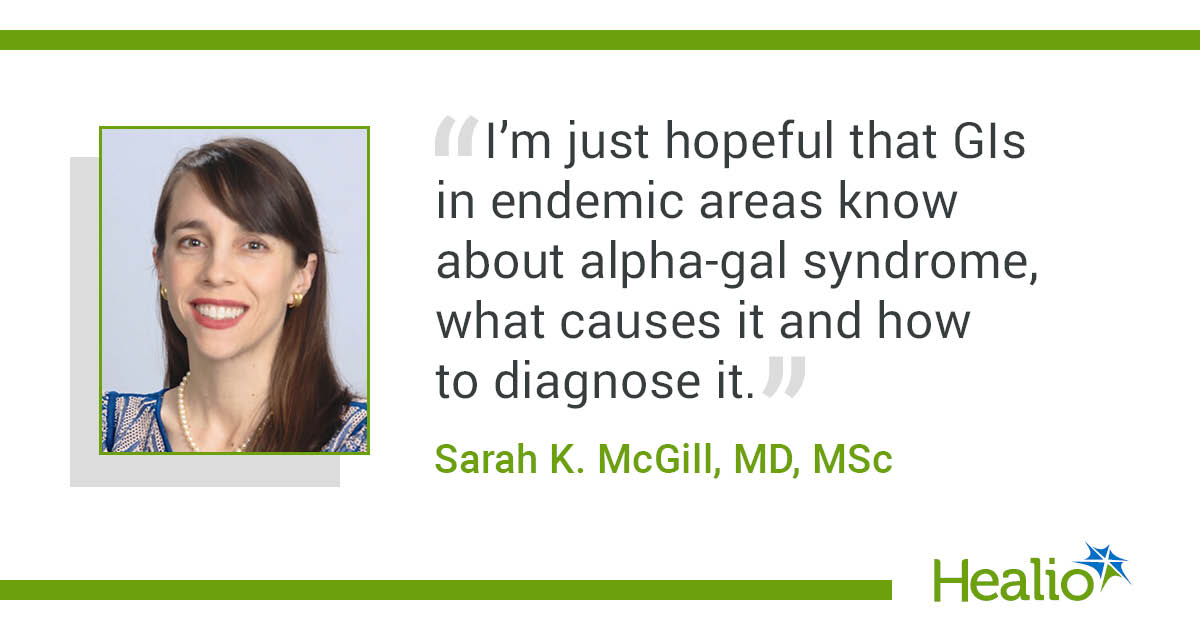
At this point, I’m just hopeful that GIs in endemic areas know about alpha-gal syndrome, what causes it and how to diagnose it. We’re probably not there yet.
Healio: Are clinicians testing for alpha-gal often enough? When should unexplained GI symptoms in an endemic area trigger testing?
McGill: The most convincing clinical scenario is a person in an endemic area who’s having intermittent abdominal pain, vomiting, diarrhea or some variation of that within 4 to 8 hours after eating mammalian meat, like pork or beef. That patient should certainly be screened with the alpha-gal IgE blood test, and if that’s positive, followed up a few weeks after assuming an alpha-gal avoidant diet to ensure that the symptoms have resolved or improved.
When we talk about alpha-gal endemic areas, that’s a pretty broad part of the Eastern U.S., including the Northeast up to Martha’s Vineyard — that’s the one that’s getting all the attention. The Midwest is highly endemic, the mid-Atlantic states and the Southeast.
Alpha-gal syndrome lays at this intersection of exploding autoimmune illness, because of depletions in the gut microbiome, and climate change, as the Lone Star tick is now endemic in regions that were too cold for it a few decades ago.
Healio: Have diagnostic practices evolved? When should clinicians remain suspicious, despite a negative test result?
McGill: We know that the IgE test to diagnose food allergies has problems with false positives. That hasn’t changed much.
With GIs and alpha-gal syndrome, since it is a really new diagnosis and we’re just learning how to diagnose it and manage it, we definitely need to keep in mind that every positive test does not mean that someone has alpha-gal syndrome.
Every test should be performed with some information from the patient that [alpha-gal syndrome] is what you’re looking for. Would testing for an allergy to mammalian meat even make sense in their case? Do they eat mammalian meat? Have they had problems a few hours after eating mammalian meat? Do they go into the outdoors?
This diagnosis is not made by the test alone. We need to see how they do with a mammalian meat-free or alpha-gal avoidant diet.
The test is very similar to other tests that we do; for example, the Clostridioides difficile test. C. diff also requires a particular clinical scenario for it to be valid, because that has problems with false positives and false negatives. Celiac testing also requires a two-step diagnosis.
However, if the alpha-gal IgE blood test is negative, clinicians should largely move on to other diagnoses and management. The rare exception, I would say, is in patients where the clinical scenario is highly supportive — recurrent abdominal distress a few hours after eating mammalian meat — and then symptom resolution with avoidance.
Healio: Have dietary recommendations caught up with the science? What should gastroenterologists know about dairy, gelatin, lard, medications and other mammalian-derived products?
McGill: Clinically, tolerance of alpha-gal among patients with alpha-gal syndrome is variable. Some patients only have trouble with, let’s say beef, but are OK with pork. Some patients only have trouble with mammalian meat but not dairy. Others are very symptomatic, even with small amounts of alpha-gal, like found in flavorings of processed foods.
For now, we encourage patients to avoid what they don’t tolerate, because we don’t have firm evidence that being more restrictive leads to better outcomes.
Healio: Do repeat tick bites change the game? What do we know about prevention?
McGill: Tick prevention is key. I’ll say it three times: permethrin, permethrin, permethrin. Permethrin is a natural chemical made from the chrysanthemum flower that poisons ticks. Using permethrin-treated shoes, socks and pants is highly effective. Other anti-mosquito chemicals don’t work for ticks.
We know that getting more tick bites can cause antibody levels to shoot up, and sometimes that makes things worse clinically as well, decreasing tolerance.
Healio: What is the biggest misconception about alpha-gal syndrome that you wish gastroenterologists would stop making in 2026?
McGill: I think the biggest misconception is that alpha-gal syndrome doesn’t exist or it’s somehow a fake disease or patients are being weak or sensitive. I completely sympathize with people who are doubtful, because it does sound like a science fiction story: It’s a tick bite that turns your body against itself.
Healio: What research on alpha-gal syndrome are you watching?
McGill: There are two double-blind oral food challenge studies underway, trying to figure out if food challenge can be the gold standard in diagnosing alpha-gal syndrome. In these challenge studies, we’re using alpha-gal-free pork as a comparator to see if symptoms are different after eating alpha-gal-free pork or standard pork. Look for those results on the horizon.
We’re also trying to get allergic biomarkers and intestinal permeability biomarkers in mechanistic studies to understand what happens with alpha-gal exposure.
For more information:
Sarah K. McGill, MD, MSc, can be reached at gastroenterology@healio.com.
Sources/Disclosures
Source:
Healio Interviews
References:
Disclosures:
McGill reports research support from Guardant Health, Revivicor and EvoEndo, and financial relationships with Pfizer (monitoring board) and Arrowood Pharmaceuticals (stock).

Ask a clinical question and tap into Healio AI’s knowledge base.
- PubMed, enrolling/recruiting trials, guidelines
- Clinical Guidance, Healio CME, FDA news
- Healio’s exclusive daily news coverage of clinical data