
September 16, 2026
3 min read

Key takeaways:
- PANXEON examines three pancreatic cancer biomarkers and uses AI to calculate a composite risk score.
- It showed sensitivity for detecting early-stage disease and high-grade dysplasia, a precancerous condition.
An investigational blood test may allow for detection of pancreatic cancer at its earliest stages when it is potentially curable, according to prospective study results.
The liquid biopsy also demonstrated the ability to identify high-grade dysplasia in the pancreas. Detection of the precancerous condition could establish a window for treatment prior to the development of invasive disease, researchers believe.

Data derived from Xu C, et al. Nat Med. 2026;doi:10.1038/s41591-026-04625-x.

Ajay Goel
“A stage shift is not just a statistic,” senior author Ajay Goel, PhD, AGAF, chair of City of Hope’s department of molecular diagnostics and experimental therapeutics, said in a press release. “The earlier we find pancreatic cancer, the greater the chance that meaningful intervention is still possible.”
‘A clearer picture’
Pancreatic cancer is the deadliest of all common malignancies, largely because symptoms often do not arise until the disease has reached advanced stages.
More than three-quarters of pancreatic cancers are diagnosed after it has spread beyond the pancreas, making it less amenable to surgical resection.
Approximately 13% of patients survive 5 years after diagnosis, and that rate drops to 3% for individuals with distant disease, according to American Cancer Society statistics.
As Healio previously reported, multiple blood tests and biomarker combinations have been evaluated for detection of early-stage pancreatic cancer. However, no blood-based assay has proven clinically relevant for that purpose, according to study background.
City of Hope researchers led the development of an investigational blood test called PANXEON, the acronym for which stands for PANcreatic cancer eXosome Early detectiON.
It is the first liquid biopsy to examine three established pancreatic cancer biomarkers — carbohydrate antigen 19-9 (CA19-9), circulating microRNAs and exosomal microRNAs — in each sample. The combination of the distinct biological signals provides “a clearer picture of what may be happening in the pancreas,” Goel said.
AI combines the measurements of each marker into one composite risk score.
Goel and colleagues conducted an international, multicenter, observational study to validate and test the assay.
The analysis included 1,757 plasma samples from 1,649 unique individuals from the U.S., Europe or Asia.
Some had pancreatic ductal adenocarcinoma (PDAC) and others did not.
Some members of the cohort also had pancreatic cysts, chronic pancreatitis, or inherited or familial genetic risk. People at elevated risk for pancreatic cancer due to these conditions undergo monitoring strategies that often are invasive or expensive but offer limited benefit for detecting early-stage disease, according to researchers.
‘Findings represent progress’
PANXEON demonstrated high sensitivity for detecting stage I or stage II disease.
In the testing cohort, the microRNA signature achieved an area under the receiver operating characteristic curve of 88.6%. Researchers reported 83.8% sensitivity for early-stage disease and “minimal cross-reactivity” with other gastrointestinal malignancies.
In a cohort of 19 people with PDAC, microRNA signature levels declined while patients underwent neoadjuvant chemotherapy and after surgery but increased prior to disease recurrence.
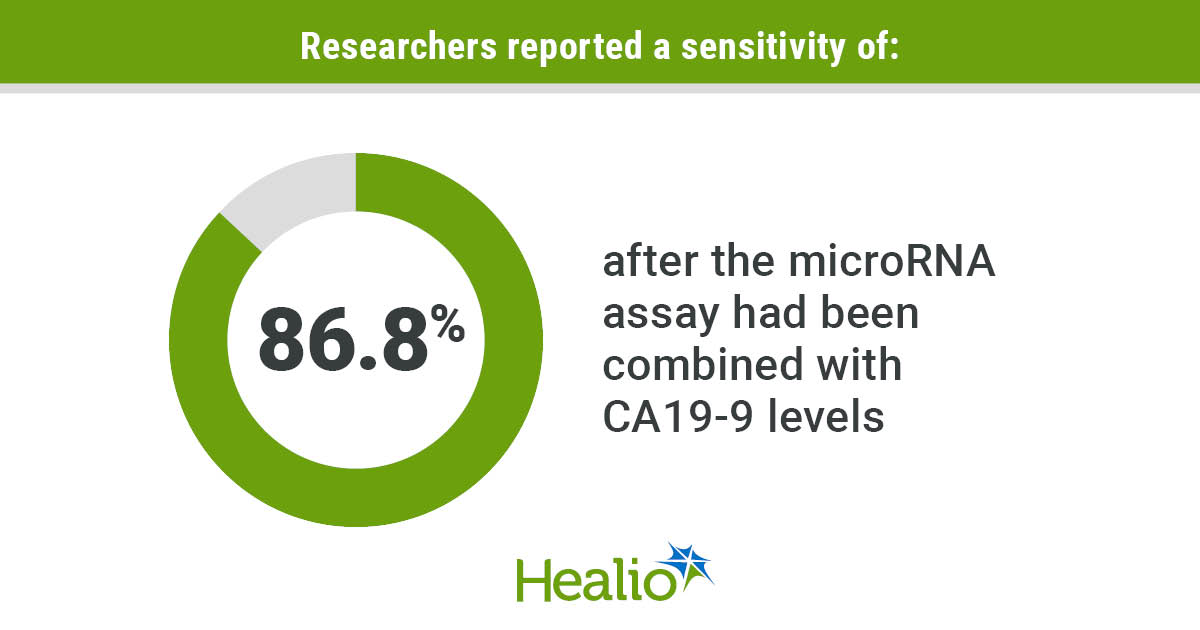
When investigators combined the microRNA signature with CA19.9 levels, sensitivity reached 86.8% for stage I or stage II PDAC, with false-positive rates of 15.6% among high-risk controls and 3.2% among low-risk controls.
PANXEON also detected high-grade dysplasia among people who had pancreatic cysts, achieving sensitivity of 64.3% in this setting.
Improved ability to detect this precancerous condition could help risk-stratify individuals and identify those who may benefit from active monitoring or intervention prior to development of invasive cancer, according to researchers.
The results suggest PANXEON’s composite biomarker could add value to existing strategies for detection of early-stage pancreatic cancer or identification of those at high risk who warrant further evaluation, investigators wrote.
Additional large-scale prospective studies to validate the test’s utility are warranted, they added.
“Pancreatic cancer remains so deadly largely because we find it after the window for cure has begun to close,” Goel said. “For patients, these findings represent progress toward finding pancreatic cancer before symptoms appear and while more treatment options remain available.”
Sources/Disclosures
Source:
Xu C, et al. Nat Med. 2026;doi:10.1038/s41591-026-04625-x.
References:
Disclosures:
Goel reports a consulting role with Biocartis, which has an option to acquire the rights to PANXEON. Please see the study for all authors’ relevant financial disclosures. The NCI and Italian Association for Cancer Research supported this study.

Ask a clinical question and tap into Healio AI’s knowledge base.
- PubMed, enrolling/recruiting trials, guidelines
- Clinical Guidance, Healio CME, FDA news
- Healio’s exclusive daily news coverage of clinical data