
September 22, 2026
5 min read

Key takeaways:
- High heat can threaten an athlete’s kidney health through severe dehydration, heat stroke and rhabdomyolysis.
- Athletes should acclimatize to an activity and be aware of the Wet Bulb Globe Temperature.
Athletes at all levels — from playgrounds to elite venues — are at increasing risk for heat stroke and heat-related organ damage, according to Raeeda Gheewala, MD, a nephrologist and founder and CEO of Sports Nephrology in Austin, Texas.
With global temperatures rising, high heat conditions are more likely to affect individual sporting events, last longer into training seasons and occur in more geographic areas than in the past.

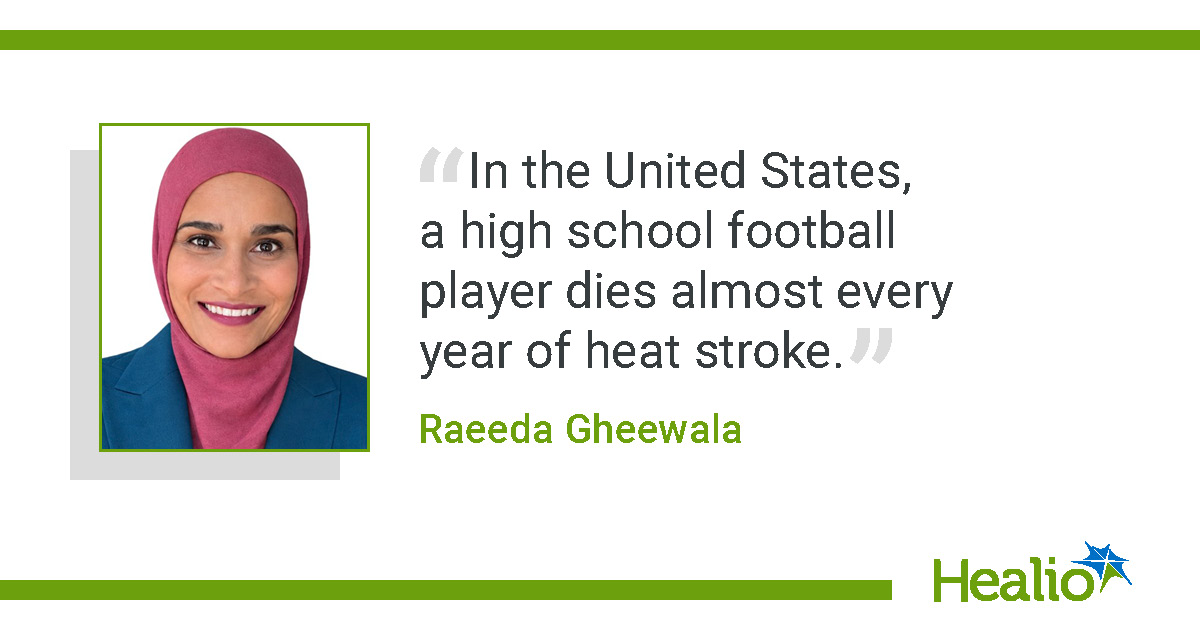
“In the United States, a high school football player dies almost every year of heat stroke, usually in the Southern states. Last summer, a 15-year-old from Dallas and a student in Tennessee died of heat stroke. They were both football players,” Gheewala told Healio.
Gheewala’s patients are mostly elite athletes interested in maintaining peak performance and overall wellness. She is also a medical advisor for the Korey Stringer Institute at the University of Connecticut, named for a professional football player who died from heat stroke during training camp in August 2001.
Healio talked with Gheewala about how rising temperatures affect athletes and their kidney health and how trainers, coaches and parents can make sports safer.
Healio: How does exercising, training or playing sports in high heat damage the kidneys ?
Gheewala: When anybody exercises outside in the heat, blood flow is shunted away from the body to the skin to help with cooling. Sweating is a response to dissipate heat, and it causes loss of both salt and water.
Kidney damage is usually caused by a combination of the heat, exercise intensity and acclimatization of the athlete to the exercise. A weekend warrior who goes to the gym and lifts weights they never lifted before has a higher risk for rhabdomyolysis, a muscle injury that results in blood in the urine and can cause kidney damage and potentially kidney failure.
NSAIDs or other anti-inflammatory medications can reduce blood flow to the kidney and can cause chronic kidney disease when taking long term, but also can cause acute kidney failure in the right setting. For example, for a marathon runner who has not properly trained and acclimatized and is taking an NSAID, heat stress and dehydration together can result in acute kidney injury.
Endurance athletes, like marathon runners and Ironman athletes, who are playing or running for hours at a time, have increased risk for exercise-associated hyponatremia, because they are drinking water and might not be taking in enough salt.
Healio: You mentioned becoming acclimatized to a workout. Can some damage be prevented with better training?
Gheewala: Yes. In the sports medicine literature, acclimatization has been researched for years. Generally, about 7 to 14 days of training is recommended whether that’s training to the intensity of the exercise, the environmental conditions or the equipment.
For example, football poses a higher heat stress risk because of the equipment, the heavy uniform can trap heat. The athletes have to take off their uniforms to cool off. If a player practices without their uniform and then plays in a game with the uniform and other equipment, those are not the same conditions. All that is important.
Healio: We’re talking in early September. It’s hot and school sports are starting. How concerned should we be about heat for high school or college athletes?
Gheewala: There’s not just a single factor for determining heat risk. Temperature is just one number. The Wet Bulb Globe Temperature is a score that includes four measures: temperature, sun exposure, wind exposure and humidity. Schools, athletes and teams use the Wet Bulb Globe Temperature to determine if it’s safe for athletes to play or not. It’s a risk scale of green, yellow, red and black. You can Google the number for your city on a given day.
Sun exposure and wind exposure have a big effect on heat risk. For example, I went to an Austin FC soccer match a few weeks ago, and they delayed the starting time by 1 hour so it would be after sunset. That itself reduced the Wet Bulb Globe Temperature and brought it into the yellow range instead of the red or black. So, just playing in the shade matters. And if there’s wind, that can improve conditions and reduce risk for both players and fans alike.
The risk for heat stroke is gaining more awareness, and people and organizations are making changes. This year FIFA required 3-minute hydration breaks during each World Cup match.
Healio: How should coaches or parents respond to signs of heat stress?
Gheewala: There are two things that make the diagnosis of heat stroke: a core body temperature of 104° F plus a neurologic or cognitive symptom, like headache, nausea, agitation, belligerence. This is assessed by an athletic trainer and is part of their training — athletic trainers are the ones who’ve done the research in heat stroke, and I’m learning all this as a nephrologist, working on the sports medicine side.
The standard of care is cold water immersion. You put the athlete into an ice bath to lower their temperature to about 102° F. It’s difficult. Not everyone has the equipment, knows the standards or has the education and the training to do that. When emergency medical services (EMS) arrives, they also need to be trained to cool first and transport second.
I recently designed a certification course for coaches and athletic trainers specifically on heat stroke, rhabdomyolysis and hyponatremia, which are three conditions athletes can have all at the same time. Coaches in a big school district or a big college will have those resources, but I wanted to make it available to any kind of coach, such as Little League coaches, who could be parents. It covers the steps to take if they’re the first person there until EMS arrives, just like classes for CPR.
Healio: At what point would kidney damage possibly occur?
Gheewala: Heat stroke can cause kidney and liver damage. This has not been thoroughly studied for acute kidney injury (AKI), but there have been case reports that AKI is more than likely reversible if the person survives the brain injury of heat stroke itself.
I volunteered in the medical tent at the ASICS Falmouth Road Race in Massachusetts a few weeks ago to learn about heat stroke. Participants have heat strokes every year. This year a woman was hospitalized and discharged the next day despite having a temperature of 108° F. I don’t know if she would have survived if she didn’t receive immediate cold water immersion therapy.
Healio: Anything else you’d like to add?
Gheewala: The Korey Stringer Institute has done lots of research in the past few decades on heat stroke in athletes. They’re now expanding it to include military personnel who work out in the heat and outside laborers, like construction workers, who are often not as healthy as athletes from a nutritional status. Do repeated episodes cause chronic kidney disease in those people, for example? That’s where I plan to do more research.
For more information:
Raeeda Gheewala, MD, can be reached at info@sportskidney.com. The Kidney Health & Heat Safety Certification Program is available at:
https://ksod8p4x0ib5xiurfdni.app.clientclub.net/courses/offers/18d1239b-0553-48f8-aef5-346177a01603.
Sources/Disclosures
Source:
Healio Interviews
Disclosures:
Gheewala reports no relevant financial disclosures.

Ask a clinical question and tap into Healio AI’s knowledge base.
- PubMed, enrolling/recruiting trials, guidelines
- Clinical Guidance, Healio CME, FDA news
- Healio’s exclusive daily news coverage of clinical data