September 29, 2026
4 min read

Key takeaways:
- 2.3 million cancers diagnosed worldwide in 2024 — 12% of all cases — were attributable to infections.
- Greater access to vaccination, screening and treatment can reduce the burden of infection-related cancers.
More than 2 million new cancers diagnosed worldwide in 2024 could be attributable to infections, according to study findings.
This equates to about one of every eight cases.

Data derived from Rumgay H, et al. Lancet Oncol. 2026; 10.1016/S1470-2045(26)00307-4.

Harriet Rumgay
“While this burden is enormous, it is also largely preventable,” lead author Harriet Rumgay, PhD, an epidemiologist in the International Agency for Research on Cancer’s (IARC) cancer surveillance branch, told Healio. “We already have effective tools and public health strategies that can prevent many infection-related cancers, including vaccination, screening, testing and treatment programs. Our findings reinforce the message that preventing infections is critical to preventing cancer globally. Expanding access to effective interventions and ensuring they are implemented equitably could dramatically reduce the global burden of cancer.”
Contemporary assessment
An estimated 20.6 million new cancers are expected to be diagnosed worldwide this year, and that number will rise to 35 million in 2050, according to WHO projections.
As Healio previously reported, an analysis released earlier this year showed infections represent the second leading avoidable cause of cancer worldwide behind only tobacco.
Infections are the leading modifiable risk factor for cancer among women in 141 countries and among men in 58 countries, according to study background.
The IARC has classified 13 infectious agents — nine viruses, three parasites and one bacterium — as group 1 carcinogens, meaning sufficient evidence exists that they cause cancer in humans.
The IARC last published data about the impact of infections on the global cancer burden in 2018. Since then, strong evidence has established additional cancer-causing infections — such as HIV and Merkel cell polyomavirus — and identified new cancer types associated with well-established carcinogenic infections, Rumgay said.
“This new evidence made it important to revisit and update the global estimates with the most comprehensive and contemporary assessment,” she said.
‘Striking’ findings
Rumgay and colleagues used Global Cancer Observatory’s Cancer Today database to estimate absolute numbers, population-attributable fractions (PAF) and age-standardized incidence rates (ASIR) of new cancer cases attributable to infectious agents classified as group 1 carcinogens.
These included HPV, hepatitis B and C viruses, Helicobacter pylori, Epstein-Barr virus, HIV and Merkel cell polyomavirus, among others.
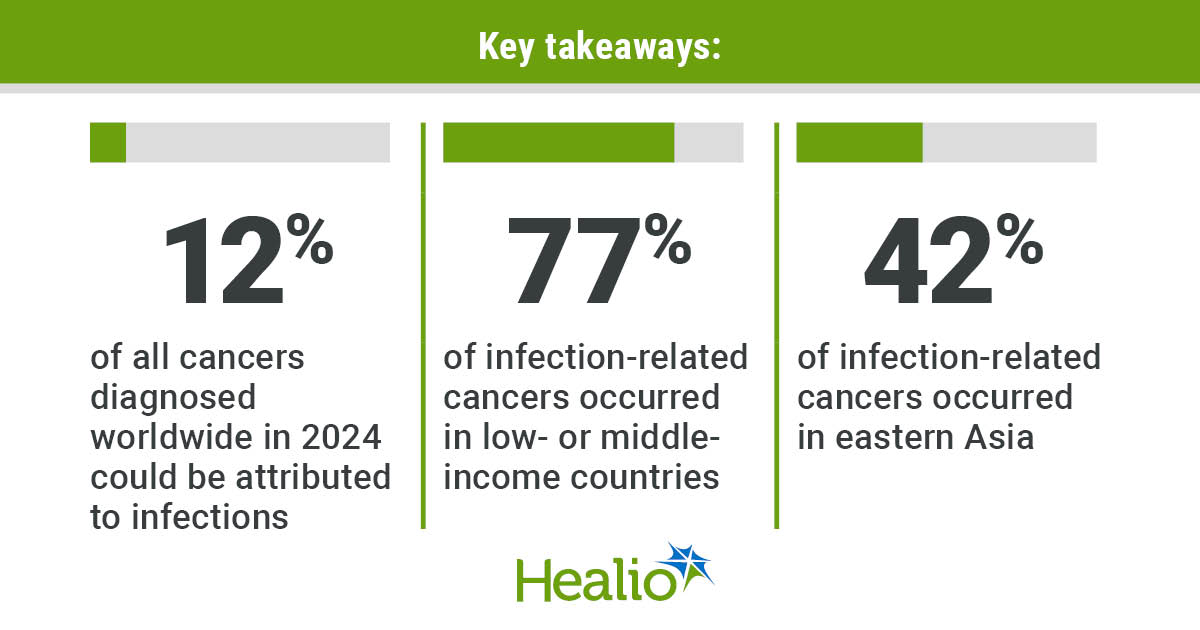
Researchers determined 2.3 million new cancers in 2024 — approximately one in eight cases — had been attributable to infections.
Five infectious agents accounted for nearly all infection-related cancers: H. pylori (absolute, n = 760,000; PAF = 4%), HPV (absolute, n = 750,000; PAF = 4%), HBV (absolute, n = 360,000; PAF = 2%); Epstein-Barr virus (absolute, n = 260,000; PAF = 1%) and HCV (absolute, n = 160,000; PAF < 1%).
Rumgay described the cancer burden attributable to Epstein-Barr virus as one of the “most striking” findings. The role of Epstein-Barr virus — previously linked to nasopharyngeal cancer and lymphoma —proved larger than expected due to incorporation of new evidence that showed it also has a causal role in gastric cancer, Rumgay said.
The ASIR for all infections combined reached 22.7 cancer cases per 100,000 person-years.
Analysis by infection type revealed the highest ASIRs, given as cases per 100,000 person-years, for HPV (7.7), H. pylori (6.9), HBV (3.4), Epstein-Barr virus (2.6), HCV (1.5) and Kaposi’s sarcoma-associated herpesvirus (0.4).
More than three-quarters (77%) of infection-related cancers occurred in low- or middle-income countries.
Analyses by region showed the greatest burden of infection-attributable cancers in eastern Asia, which accounted for 42% of all infection-related cancers worldwide. The 990,000 absolute cases in this region — driven largely by H. pylori and HBV — equated to a PAF of 15% and an ASIR of 31.9 cases per 100,000 person-years.
Other regions that accounted for considerable shares of the global burden included sub-Saharan Africa (PAF, 25%; ASIR, 28.5), Central and Eastern Europe (PAF, 10%; ASIR, 24.3) and southeastern Asia (PAF, 16%; ASIR, 23.1).
Regions with the lowest PAF included northern Europe (4%), as well as western Europe, North America and Oceania (5% each).
Regions with the lowest ASIRs included south-central Asia (13.3), western Asia (14.1), northern Europe (14.1), western Europe (15) and North America (15.8).
Analyses that examined links between specific infections and cancer types revealed the strongest associations between H. pylori and gastric cancer; HPV and cervix cancer; HBV/HCV and hepatocellular carcinoma; and Epstein-Barr virus and nasopharyngeal cancer.
‘Global health equity issue’
A majority of infection-related cancers can be prevented through vaccination, testing, screening or preventive strategies. However, these interventions are underutilized in many regions due to persistent health system, political and financial barriers, study authors wrote.
Multifaceted strategies are needed to reduce the global burden of these malignancies, Rumgay said.
“First, we need greater implementation of — and equitable access to — prevention tools that are already proven to reduce cancer risk,” she said.
Key efforts include vaccination against HBV and HPV; testing and treatment for H. pylori, HIV, and HBV and HCV; and screening programs that prevent HPV-driven cervical cancer, Rumgay said.
“Second, we need continued investment in research and development for infections where effective prevention tools do not yet exist,” Rumgay added. “A major priority is the development of vaccines against Epstein-Barr virus, which causes several cancers and has also been linked to multiple sclerosis. We also need to develop new tools to prevent infection with Kaposi sarcoma-associated herpesvirus [KSHV], particularly because the burden of KSHV-related cancers falls disproportionately on resource-limited countries in sub-Saharan Africa.”
Improved access to vaccination, screening and treatment is particularly important in the low- and middle-income countries that shoulder a disproportionate share of the global infection-related cancer burden, Rumgay said.
“Infection-related cancers are not only a cancer prevention challenge but also a global health equity issue,” Rumgay said. “Large reductions in cancer burden are achievable with existing interventions, and ensuring equitable access should be a global priority.”
For more information:
Harriet Rumgay, PhD, can be reached at rumgayh@iarc.who.int.

Ask a clinical question and tap into Healio AI’s knowledge base.
- PubMed, enrolling/recruiting trials, guidelines
- Clinical Guidance, Healio CME, FDA news
- Healio’s exclusive daily news coverage of clinical data