September 30, 2026
6 min read
Key takeaways:
- Invisible work is defined as tasks done behind-the-scenes in the clinic or at home that are often unseen.
- Physicians often perform invisible work, but for women physicians the burden is greater.
CHICAGO — For women physicians, the workday often extends beyond the clinic, with unseen tasks at work and home adding to the demands of practicing medicine, according to a presenter at the Women in Medicine Summit.
These unseen tasks, which range from additional professional expectations, such as mentoring and responding to patient messages, to family responsibilities, such as coordinating care for children and running a household, are known as “invisible work,” and may be impacting women’s roles in medicine, according to Gretchen Rickards, MD, MPH, PCC, internal medicine physician at ChristianaCare and founder of GR Coaching and Consulting.

Data derived from interview.

Gretchen Rickards
“We are losing women physicians from clinical practice, and we are losing them far too early,” Rickards told Healio. “A large national study published this year found that women had a 43% higher likelihood of leaving clinical practice than men at any given age. Among physicians who left during the study period, the median age was 49 for women and 64 for men.”
Within 6 years of training, women physicians are also significantly more likely than men to be working part-time or not at all, with family cited as the most influential factor by more than three-quarters of those women, according to a 2019 study published in JAMA Network Open.
Women physicians also report higher levels of burnout, according to the latest AMA data. Despite overall improvement in physician burnout since the height of the pandemic, the AMA found that 46% of women physicians vs. 37% of men still report symptoms of burnout in 2026.
“Those numbers should make us curious,” Rickards said. “What is different about women’s experience in medicine? What are women being asked to carry, both at work and at home?”
According to Rickards, invisible work is not the whole explanation for these differences, but it is a contributor that is underrecognized.
“Understanding why women are stepping back from clinical practice matters not only for women physicians themselves, but for healthcare more broadly,” Rickards said. “When experienced women physicians reduce their hours or leave clinical medicine, our patients and organizations lose their expertise and perspectives, and the next generation of physicians loses mentors and role models.”
Healio spoke with Rickards about how to identify invisible work and how women and organizations can take steps to reduce this burden.
Healio: What is invisible work?
Rickards: Invisible work is all the work that happens behind the scenes to keep our workplaces and households functioning but that often goes unseen, uncounted, unrecognized or undervalued.
Sociologist Arlene Kaplan Daniels, PhD, introduced the term in the 1980s to describe forms of unpaid labor traditionally carried by women, such as housework and volunteer work, that are essential to families and communities but culturally and economically devalued. Invisible work can take many forms. It can include the mental load of anticipating and remembering what needs to be done at work and at home; the emotional and relational work of supporting colleagues, friends and family; coordinating and providing care for children, aging parents or other family members; domestic work and household administration; and necessary but often undervalued work in our organizations, such as mentoring, committee service and planning social events.
For physicians, invisible work can also include patient care that continues outside the exam room and often long after the workday ends: finishing notes, reviewing results, responding to patient messages, following up on care or staying late to support a patient or family through a difficult conversation. Any one of these tasks may seem small, but the cumulative weight can be enormous in terms of time, attention and emotional energy.
There is also an opportunity cost. At home, invisible work can crowd out rest, relationships, hobbies and time for ourselves. At work, it can leave less time and energy for scholarship, professional development, networking and other career-advancing opportunities.
Healio: Does invisible work disproportionately affect women physicians? If so, in what ways and why?
Rickards: Invisible work is certainly not unique to women physicians. Women across professions carry a disproportionate share of it, both at work and at home. There are aspects of medicine, however, that can amplify its impact. Physicians work long hours in an extraordinarily physically and emotionally demanding environment.
Women physicians also tend to carry more invisible work than their male physician peers. Research has found that women physicians receive more patient and staff messages, spend more time on notes and other EHR work, and report spending more time on the citizenship work that keeps our organizations functioning. Women physicians with children also spend more time on parenting and domestic responsibilities than their male physician peers. When you layer all of that onto the demands of practicing medicine, the cumulative impact can be significant.
Healio: What are some solutions to lessen the burden of invisible work for women in healthcare?
Rickards: I do not think the answer is to tell women to get better at saying no or simply do less. Not all invisible work is work we want to eliminate. Some of it is necessary, and some of it can be deeply meaningful or fulfilling, such as mentoring trainees, supporting a patient through a difficult moment or caring for someone we love.
Instead, I encourage women to ask: Am I carrying this intentionally? And am I carrying it in a way that is sustainable? From there, I use a simple framework: What do I want to keep, reshape, share or put down?
At the same time, we cannot put the responsibility for solving this back on individual women. Organizations have a role, too. Leaders can start by naming invisible work, looking at who is carrying it, distributing necessary work more intentionally, valuing the work they say is important, and redesigning work when possible.
Sometimes the best answer is not figuring out who else can carry a task. It is asking whether the work needs to be done at all, or whether it can be eliminated, simplified, automated or better supported.
Healio: What are the key points you would like women physicians to take away about this topic?
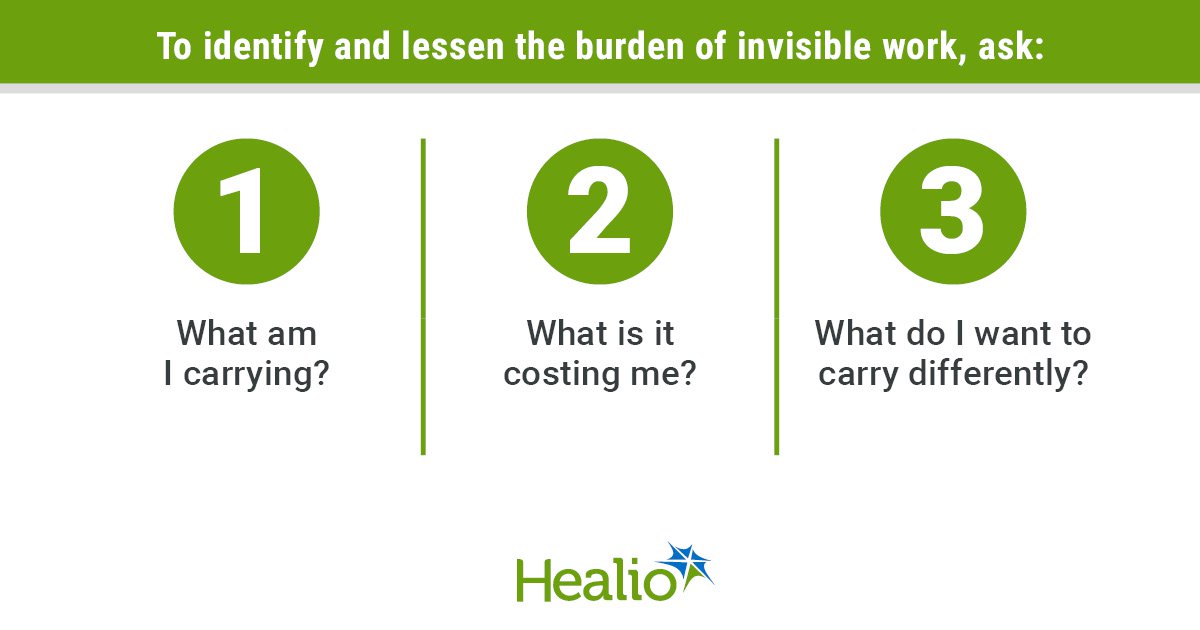
Rickards: The biggest thing I want women physicians to do is see what they are carrying. Invisible work can become so much a part of our daily lives that we stop recognizing it as work. I want women to see it and ask themselves: What am I carrying? What is it costing me? And what do I want to carry differently?
I also want physicians to pay attention to what others are carrying. Regardless of formal leadership titles, we all have opportunities to influence how work gets distributed. Who always checks on the struggling colleague? Who takes the meeting notes? Who organizes the staff gift? Who has multiple mentees? Noticing those patterns is the first step toward distributing that work more intentionally.
Healio: What is your advice for women in medicine who are burdened by invisible work?
Rickards: In preparing for this talk, I decided to track my own invisible work at home for several weeks. I am in a dual-physician household, and we are fortunate to be able to outsource a fair amount already. Despite this, I still averaged over 20 hours a week of invisible work at home. What struck me more than the number itself was how much it did not reflect. A 5-minute emotionally charged conversation with my spouse or child might register as 5 minutes on a clock, but I could carry its emotional impact for hours. Simply adding up minutes also does not account for the constant task switching throughout the day and how mentally draining that can be. That experience made me even more aware that the cost of invisible work is not measured in time alone. It also takes a significant toll on attention and energy.
My advice for women physicians is to start by naming the work. That was transformative for me personally. During the pandemic, I felt like I was constantly failing at both work and home, no matter how much I was doing. When a physician coach introduced me to the idea of invisible work, it was a lightning-bolt moment. I finally had language for so much of what I was carrying. Naming the work doesn’t make it disappear, but it does make it possible to be more intentional about what you want to keep, what needs to change, what can be shared and what you may finally be ready to put down. I would encourage women to start with just one question: What is one thing you want to carry differently?
For more information:
Gretchen Rickards, MD, MPH, PCC, can be reached at dermatology@healio.com.
Sources/Disclosures
Source:
Healio Interviews
References:
Disclosures:
Rickards reports no relevant financial disclosures.

Ask a clinical question and tap into Healio AI’s knowledge base.
- PubMed, enrolling/recruiting trials, guidelines
- Clinical Guidance, Healio CME, FDA news
- Healio’s exclusive daily news coverage of clinical data