September 30, 2026
2 min read

Key takeaways:
- Strong leadership does not start with a “command and control” mindset. Good ideas come from collaboration.
- As a leader, set realistic expectations and avoid “telegraphing your emotions.”
CHICAGO — Women leaders are still underrepresented in medicine, so now is the perfect time for them to redefine what strong leadership looks like within their communities, according to a speaker at the Women in Medicine Summit.
“Leadership is not a narrow ‘command and control’ mindset or individuals whose egos enter the room before they do and who suck all the oxygen out,” Joanne M. Conroy, MD, president and CEO of Dartmouth Health, told Healio. “Leadership is expanding the oxygen in the room and actually creating an opportunity for many people to be a part of your team.”

A report from McKinsey & Company and LeanIn.org found that, in 2025, women held 29% of C-suite leadership roles in corporate America, so representation is still lacking.
“We don’t have a lot of great leadership examples currently,” Conroy told Healio. “It’s probably up to a lot of these women in the room to redefine leadership for their communities, their institutions and their world of influence.”
For women who aim to redefine what leadership looks like, Conroy highlighted four pillars: authenticity, commitment to a higher cause, being present and purposeful decision-making.
“A lot of times, women leaders just do what is put in front of them rather than saying, ‘How is this going to advance the purpose I feel so passionate about?’” she told Healio. “Understanding those kinds of characteristics will make you a much more effective leader.”
The first step toward embracing these four tenets, Conroy said, is learning from every opportunity that reveals itself, including mistakes. For example, she learned from experience that oftentimes the best ideas are achieved when everyone in an organization feels important.
“A bad idea won’t carry the day, but the right idea has to have a lot of people’s fingerprints on it,” Conroy said. “How do you engage people so they are part of building it? That gets you the product that you need with a level of ownership.”
Eventually, every leader will need to make difficult decisions. When problem-solving, it is important to have realistic expectations about each individual on a team.
“When the going gets tough, there are a lot of people who have weak knees,” Conroy told Healio. “You can be explicit about what you need people to do, but you also need to make sure your antennae are up about whether they are actually able to carry that out. … It is not a judgment about them as individuals or the qualities that they have. It’s about having a realistic assessment of who is on your team and who you are depending on.”
Additionally, Conroy recommended learning how to avoid “telegraphing your emotions” by gaining control over body language and facial expressions.
“If you react in a positive or negative way, it takes a conversation in a different direction that doesn’t benefit you,” Conroy said. “You don’t want to impede the conversation, but you also don’t want to steer it.”
For women in medicine who may be dealing with imposter syndrome, learning to “pat yourself on the back” is important, according to Conroy.
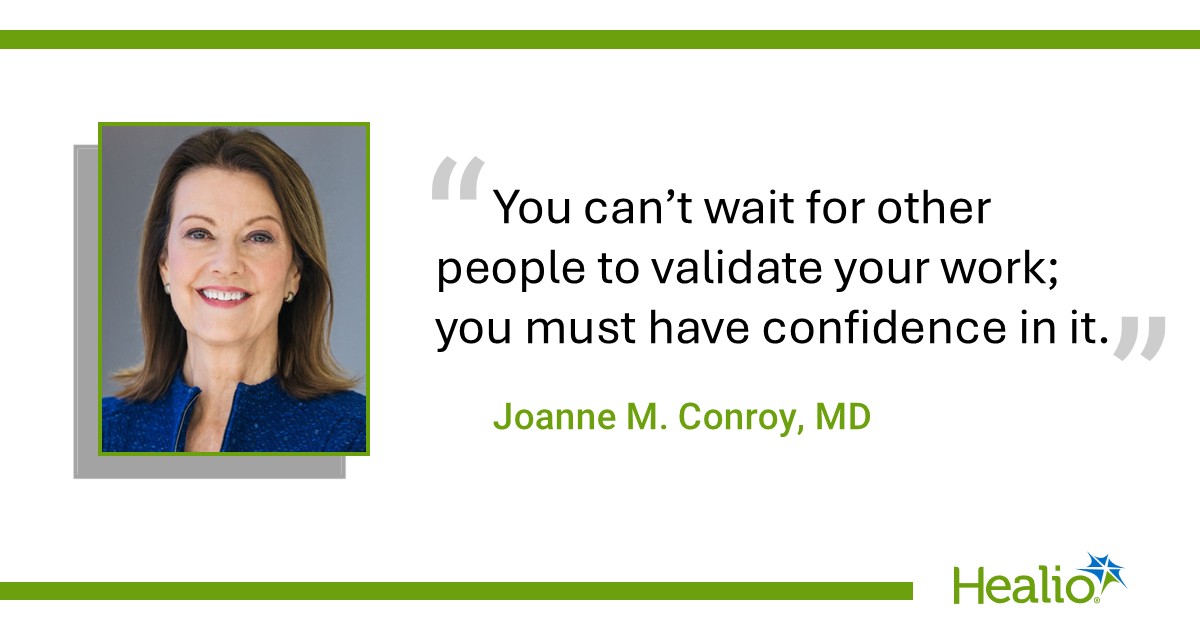
“You can’t wait for other people to validate your work; you must have confidence in it,” she said. “This is the time and the opportunity for women to step forward, be courageous, stand for something that matters to you, and set a new example for leadership in your organizations and in your communities.”
For more information:
Joanne M. Conroy, MD, can be reached at office.of.the.ceo@hitchcock.org.
Sources/Disclosures
Source:
Conroy JM. Leadership when we need it most. Women in Medicine Summit; Sept. 24-26, 2026; Chicago.
Reference:
Disclosures:
Conroy reports no relevant financial disclosures.

Ask a clinical question and tap into Healio AI’s knowledge base.
- PubMed, enrolling/recruiting trials, guidelines
- Clinical Guidance, Healio CME, FDA news
- Healio’s exclusive daily news coverage of clinical data