October 01, 2026
4 min read

Key takeaways:
- Just 39.5% of U.S. adults demonstrated serologic immunity to HAV and 27.1% had immunity to HBV.
- Most high-risk groups, including those with chronic liver disease, had lower immunity than the general population.
Despite years of vaccine availability and recommendation, serologic immunity to hepatitis A and B viruses remains low in the U.S., even among high-risk groups, according to cross-sectional study results published in JAMA Internal Medicine.
Findings showed that in a sample representing more than 226 million adults, 39.5% exhibited serologic immunity to HAV and 27.1% to HBV, with 25.2% demonstrating vaccine-derived HBV immunity. HAV immunity was as low as 26.7% among those with metabolic dysfunction-associated alcohol-related liver disease.

“Prior studies had shown low levels of hepatitis A and B immunity among U.S. adults, but contemporary national estimates were limited, especially for high-risk groups such as patients with chronic liver disease, chronic kidney disease, immunosuppression and pregnancy,” Giovanni A. Roldan, MD, an advanced endoscopy fellow at Baylor College of Medicine, told Healio.
The CDC and the Advisory Committee on Immunization Practices (ACIP) have long maintained a universal recommendation for HBV birth dose vaccination, changing their position just last year to include only infants with known risk factors.
When the universal birth dose recommendation was adopted in 1991, researchers observed a corresponding 95% reduction in HBV infection among infants, Roldan and colleagues wrote.
“This study was prompted by recent changes in hepatitis B vaccine policy in December of 2025, and the need to understand the current baseline of population-level protection in the United States,” Roldan said.
‘Suboptimal’ serologic protection
Roldan and colleagues conducted the study using National Health and Nutrition Examination Survey data from 13,514 adults (mean age, 48.65 years; 51.76% women) between January 2017 and August 2023. The researchers estimated the sample represented 226.1 million adults.
Prevalence of serologic immunity to HAV and HBV, as well as vaccine-derived immunity to HBV, in the study sample and high-risk subgroups served as the primary outcome. Independent factors associated with immunity also were assessed.
Overall, 39.5% (95% CI, 37.7%-41.3%) demonstrated serologic immunity to HAV, 27.1% (95% CI, 25.8%-28.4%) to HBV and 25.2% (95% CI, 23.9%-26.5%) exhibited vaccine-derived HBV immunity.
“Our findings suggest that, despite decades of vaccine availability and long-standing recommendations, measurable serologic protection remains suboptimal in the U.S. adult population,” Roldan said.
About two-thirds (66.9%) of U.S. adults were considered to be in a high-risk subgroup, which included individuals with diabetes, chronic liver disease and chronic kidney diseases, as well as pregnant people and those on immunosuppressive therapy. HAV immunity spanned 26.7% to 63.7% across these subgroups, whereas HBV vaccine-derived immunity ranged from 14% to 38.6%.
Unlike other high-risk subgroups, those with advanced chronic kidney disease demonstrated higher HAV immunity (53.9%; 95% CI, 39.4%-68.4%), as well as HBV immunity (32.3%; 95% CI, 21.6%-43%), than the general population. Pregnant individuals also exhibited higher HBV immunity (38.6%; 95% CI, 28%-49.1%).
“Some groups with more structured access to vaccination, such as patients with advanced kidney disease and pregnant patients, appeared to have higher levels of protection than other high-risk groups,” Roldan said. “This suggests that vaccines work, but that that systems for identifying, vaccinating and following patients are not being applied consistently across clinical settings.”
Linking factors
Factors associated with HAV immunity included younger age (adjusted OR = 0.51; 95% CI, 0.44-0.6), lower educational attainment (aOR = 0.32; 95% CI, 0.24-0.42), being born outside the U.S. (aOR = 4.54; 95% CI, 3.74-5.52) and liver disease awareness (OR = 1.65; 95% CI, 1.29-2.09).
Certain ethnic backgrounds also were linked to HAV immunity, including non-Hispanic Black (aOR = 1.67; 95% CI, 1.34-2.09), Mexican American (aOR = 4.22; 95% CI, 3.42-5.21), other Hispanic (aOR = 2.01; 95% CI, 1.6- 2.54), non-Hispanic Asian (aOR = 3.03; 95% CI, 2.45-3.76), and multiracial or other race and ethnicity (aOR = 1.36; 95% CI, 1.04-1.79).
Conversely, data linked obesity to lower odds of HAV immunity (aOR = 0.83; 95% CI, 0.72-0.96).
Those with vaccine-derived HBV immunity were more likely to be younger (aOR = 0.18; 95% CI, 0.15-0.23), female (aOR = 1.36; 95% CI, 1.18-1.56), non-Hispanic Asian (aOR = 1.47; 95% CI, 1.17-1.86), non-Hispanic Black (aOR = 1.15; 95% CI, 1-1.32) and have higher educational attainment (aOR = 3.29; 95% CI, 2.35-4.61).
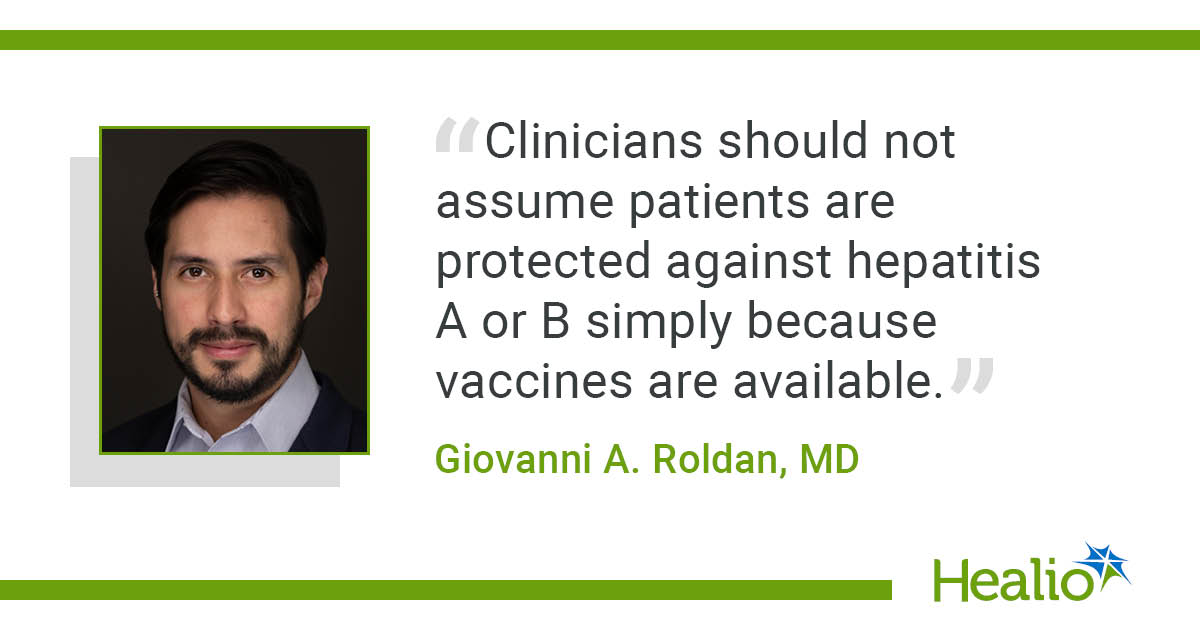
“Clinicians should not assume patients are protected against hepatitis A or B simply because vaccines are available or recommended,” Roldan said.
Researchers acknowledged study limitations, including that NHANES does not include data for individuals who are incarcerated or homeless — populations considered at elevated risk for viral hepatitis.
“The most pressing next step is to understand how vaccine policy changes affect immunity across different age cohorts over time,” Roldan said. “Our study provides an important baseline for evaluating future trends in hepatitis A and B protection.”
He also emphasized the importance of health system-level efforts in promoting HAV and HBV immunity.
“Strategies such as electronic health record reminders, standing vaccination orders, automatic prompts based on serology results and linkage with state vaccine registries could help ensure that eligible patients are not missed,” Roldan told Healio.
For more information:
Giovanni A. Roldan, MD, can be reached at giovanni.roldancarrillo@bcm.edu.

Ask a clinical question and tap into Healio AI’s knowledge base.
- PubMed, enrolling/recruiting trials, guidelines
- Clinical Guidance, Healio CME, FDA news
- Healio’s exclusive daily news coverage of clinical data