October 07, 2026
4 min read

Key takeaways:
- Patients who lose at least 10% of their body weight in years before colorectal cancer diagnosis have worse survival.
- This weight loss helps explain obesity paradox in colorectal cancer.
Pre-diagnostic weight loss could explain the “obesity paradox” — where patients who have overweight or obesity have improved survival — observed in colorectal cancer.
A study of more than 5,500 individuals with colorectal cancer from Germany showed patients who had overweight did have improved survival, but weight loss prior to diagnosis attenuated that OS advantage.

Data derived from Mandic M, et al. JAMA Netw Open. 2026;doi:10.1001/jamanetworkopen.2026.29571.
Furthermore, individuals who lost at least 10% of their weight before being diagnosed had a 55% higher risk for death.

Marko Mandic
“This study provides no evidence that being overweight is actually beneficial for colorectal cancer survival, and clinicians should not interpret the so-called ‘obesity paradox’ as a reason to encourage weight gain in normal-weight patients, which is unfortunately how some earlier findings on this topic have been interpreted,” Marko Mandic, PhD, German Cancer Research Center in Heidelberg, Germany, told Healio.
“That said, underweight or frail patients are a distinct clinical picture, and weight loss or low body weight in that group likely reflects a real vulnerability that deserves clinical attention and support rather than reassurance. BMI recorded at diagnosis should be interpreted with caution, since it doesn’t tell the full story on its own — a patient’s broader weight history carries important prognostic information that a single BMI measurement can mask.”
Contradictory data
Colorectal cancer is one of 13 malignancies that have been associated with obesity, according to CDC.
However, several studies also have uncovered an “obesity paradox.”
Healio previously reported patients with gastrointestinal cancers and obesity treated with immunotherapy survived significantly longer than those with normal BMI (26.8 months vs. 13.9 months).
“The obesity paradox in colorectal cancer has been debated for years,” Mandic said. “Multiple studies have shown that patients who are overweight at the time of diagnosis tend to survive longer than patients with a normal BMI. On the surface, this seems to contradict everything we know about obesity as a risk factor for developing colorectal cancer in the first place.
“We suspected this paradox might be an artifact rather than a true biological protective effect. Colorectal cancer often causes unintentional weight loss in the months and years leading up to diagnosis — sometimes long before any symptoms are apparent. That means a patient’s BMI measured at diagnosis doesn’t necessarily reflect their long-term weight status.”
As an example, a patient who had been overweight for several years could have normal BMI at diagnosis due to the malignancy, Mandic explained.
“We had already shown in prior analyses that failing to account for this pre-diagnostic weight loss may lead to a substantial underestimation of the BMI-cancer risk relationship,” he said. “It was a natural and important next step to ask whether the same bias was distorting our understanding of BMI and survival.”
They used data from the Colorectal Cancer: Chances of Prevention Through Screening study, which enrolled adults aged 30 years and older with colorectal cancer in Germany from 2001 to 2016.
Mandic and colleagues’ cohort included 5,521 patients (median age, 69 years; interquartile range, 61-76; 61% men).
Researchers classified patients as having underweight (BMI < 18.5 kg/m²), normal weight (BMI 18.5 kg/m² to < 25 kg/m²), overweight (BMI 25 kg/m² to < 30 kg/m²), obesity class I (BMI 30 kg/m² to < 35 kg/m²) or obesity class II and III (BMI 35 kg/m²).
OS, RFS and colorectal cancer-specific survival (CSS) served as primary endpoints.
‘Misattributed’
Patients with overweight had significantly improved OS (HR = 0.89; 95% CI, 0.81-0.98) compared with those with normal weight, and those with obesity had trends toward improved survival, but they did not reach statistical significance.
Additionally, patients with underweight had significantly lower OS (HR = 1.4; 95% CI, 1.09-1.8) than those with normal weight.
Researchers noted parallels in RFS and CSS-specific survival, but wrote the “lower number of events limited statistical power.”
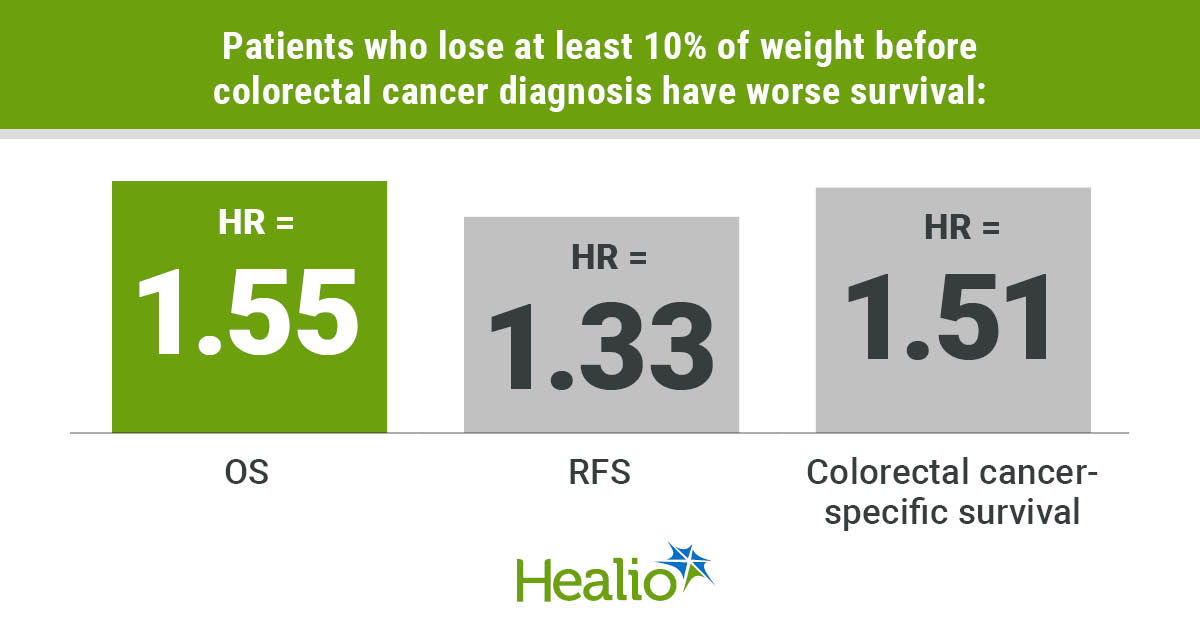
Patients who lost at least 10% of their body weight 5 to 14 years prior to diagnosis had significantly worse OS (HR = 1.55; 95% CI, 1.39-1.72), RFS (HR = 1.33; 95% CI, 1.17-1.52) and colorectal cancer-specific survival (HR = 1.51; 95% CI, 1.31-1.74).
Similar results based on sex and stage of disease could be seen as well.
After accounting for pre-diagnostic weight loss, Mandic and colleagues no longer observed a significant association or trends with OS and overweight and obesity.
“The obesity paradox seems to be less about extra body weight being protective, and more about undiagnosed, cancer-related weight loss being a hidden marker of poor prognosis that was previously being misattributed to BMI itself,” Mandic said.
Researchers acknowledged study limitations, including self-reported height and weight and the lack of uniformity of pre-diagnostic weight change data among patients.
“The next step is replication in other cohorts, ideally with more detailed body composition data rather than BMI alone, along with markers of systemic inflammation and cancer cachexia,” Mandic said. “It would also help to have studies with more objective, prospectively collected pre-diagnostic weight measurements and trajectories, rather than relying on self-reported weight history, since that would let us pin down the timing and pattern of weight change with much more precision. From there, it would be worth exploring whether weight history could help identify patients who may benefit from closer monitoring or earlier supportive care.”
For more information:
Marko Mandic, PhD, can be reached at marko.mandic@dkfz-heidelberg.de.

Ask a clinical question and tap into Healio AI’s knowledge base.
- PubMed, enrolling/recruiting trials, guidelines
- Clinical Guidance, Healio CME, FDA news
- Healio’s exclusive daily news coverage of clinical data