October 07, 2026
3 min read

Key takeaways:
- Cancer mortality for young adults in Canada has fallen for most malignancies over the past 25 years.
- However, colorectal cancer mortality continues to increase.
Cancer mortality for individuals aged under 50 years in Canada has significantly decreased for nine of the 10 deadliest malignancies since 2000.
“This is a great news story,” Darren R. Brenner, PhD, professor at Cumming School of Medicine at University of Calgary, told Healio.

Data derived from Hutchinson JM, et al. JAMA Netw Open. 2026;doi:10.1001/jamanetworkopen.2026.29646.
However, colorectal cancer mortality has significantly increased during the same time, raising questions about whether Canada should follow the lead of other Western countries and lower the screening age to 45 years.

Darren R. Brenner
“It’s concerning,” Brenner said. “By not screening this younger cohort, more people every year in Canada are dying from colorectal cancer than in previous years.”
U.S. trends
Incidence for 14 different malignancies increased among individuals aged less than 50 years in the U.S. between 2010 and 2019, including breast cancer, colon cancer and melanoma, according to the 15th annual American Association for Cancer Research’s Cancer Progress Report.
Healio also previously reported cancer mortality fell 44% among the same population between 1990 and 2023, including for leukemia and for breast, brain and lung cancers.
Colorectal cancer mortality, however, increased 1.1% annually between 2005 and 2023.
Brenner and colleagues investigated whether similar trends could be seen in Canada.
They used Statistics Canada to evaluate cancer mortality for adults aged 20 to 49 years between 2000 and 2024.
Yearly change for the 10 leading causes of cancer-related death served as the primary endpoint.
‘Lower the screening age’
Canada had 326,779 total deaths in 2024, 85,589 due to malignancies.
Cancer deaths for individuals aged 20 to 49 years between 2000 and 2024 totaled 85,439, with 59,858 the result of the 10 malignancies that produce the most mortality.
Cancer deaths significantly decreased among that population for all those malignancies, except colorectal cancer.
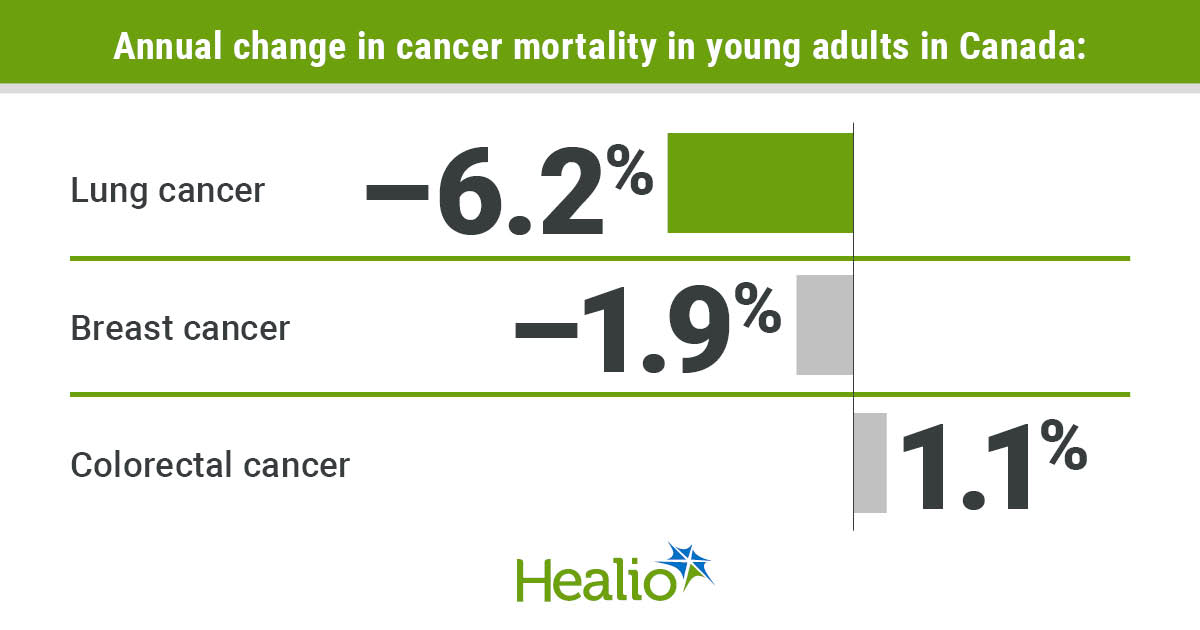
Lung and bronchus cancer mortality declined the most (average annual percent change, –6.2%), followed by non-Hodgkin lymphoma (AAPC, –4.5%), skin melanoma (AAPC, –3.6%), leukemia (AAPC, –2.4%), breast (AAPC, –1.9%), stomach (AAPC, –1.6%), brain (AAPC, –1%), pancreas (AAPC, –0.5%) and cervical cancer (AAPC, –0.3%).
“Some of the [decreases] are the function of primary prevention,” Brenner said. “When we see lung cancer deaths among people under age 50 going down, this is likely the product of tobacco cessation through lots of public health and collective action. [Declines in] melanoma [mortality] in younger people is probably the product of sun-safe generations. These are the first cohorts of people that would have grown up in sun-safe generations. That’s really good. Then breast cancer, that’s probably the product of multiple things, including early detection through screening and advancements in how breast cancers are treated.”
Conversely, colorectal cancer mortality increased 1.1% annually.
Researchers acknowledged study limitations, including lack of data on social determinants of health, including ethnicity and income.
Brenner emphasized the importance of earlier screening to combat the rise in colorectal cancer mortality.
“The primary thing we can do is to lower the screening age,” Brenner said. “In Canada, we still screen starting at age 50 in most provinces and territories. The U.S. has lowered to age 45, and the recent data [show] that it’s having a positive impact. You are seeing more early-stage cancers being diagnosed in that cohort of 45 to 49. We’re seeing more younger people being screened. We’re seeing the same amounts of early-stage lesions and polyps being removed in that 45-to-49 group as you would see in a 50-year-old population. All the early clinical indications from the U.S. are that screening at 45 is working, and it should be something that we should do here in Canada, as well.”
Brenner and colleagues have conducted simulations to determine what the impact of lowering the screening age would be.
“All our data and our next research are starting to suggest that lowering that screening age could prevent cancers, save lives, and be cost-effective in the long run here in Canada,” he said.
For more information:
Darren R. Brenner, PhD, can be reached at darren.brenner@ucalgary.ca.

Ask a clinical question and tap into Healio AI’s knowledge base.
- PubMed, enrolling/recruiting trials, guidelines
- Clinical Guidance, Healio CME, FDA news
- Healio’s exclusive daily news coverage of clinical data