Reference:
October 09, 2026
3 min read

Key takeaways:
- Sex, left-sided cancers and mutational burden can significantly differ in early- and late-onset colorectal cancer with liver metastases.
- Patients with early-onset disease had significantly longer survival.
Early-onset colorectal cancer with liver-only metastases can have significant differences in biology from late-onset malignancies.
A study of nearly 1,700 individuals from Australia showed early-onset disease occurred more often in women, and patients had higher rates of BRAF mutations and left-sided cancers.

Data derived from Barreto SG, et al. Med J Aust. 2026;doi:10.5694/mja2.70266.
Additionally, those with early-onset disease had better functional status, fewer comorbidities and significantly longer survival.

Savio G. Barreto
“These [biological differences] likely impact the behavior of the cancer and, hence, response to treatments,” Savio G. Barreto, FRACS, PhD, professor of surgery at Flinders University in Australia, told Healio. “Understanding these nuanced differences is key to the delivery of personalized therapy.”
‘Lack of clarity’
Colorectal cancer incidence declined 0.9% annually in the U.S. between 2013 and 2022, but rose 3% per year for individuals aged 20 to 49 years, according to Colorectal Cancer Statistics 2026 report.
Similar trends can be seen globally, and Australia has the highest prevalence of early-onset disease, according to study background.
“Metastases to the liver is a key determinant of poor long-term survival in such patients,” Barreto said. “There is a lack of clarity on the ideal timing of the sequence of therapies [surgery vs. chemotherapy vs. immunotherapy], and given the low number of patients, it is difficult to carry out well powered prospective randomized controlled trials.
“To empower clinical decision-making based on evidence, and to clarify if the ‘one size fits all’ policy for treating patients across all ages is justified, we decided to embark on this analysis comparing early- and late-onset colorectal cancer focusing on liver only metastases.”
Researchers used the Treatment of Recurrent and Advanced Colorectal Cancer registry in Australia to investigate.
Their retrospective analysis included 1,691 consecutive adults (median age, 65 years; interquartile range, 55-75; 63.3% men; 83.7% with late-stage disease) enrolled in the registry between Jan. 14, 2009, and Sept. 2, 2024.
Cancer biology, treatments and outcomes among patients with early-onset and late-onset colorectal cancer served as primary endpoints.
‘Pleasantly surprised’
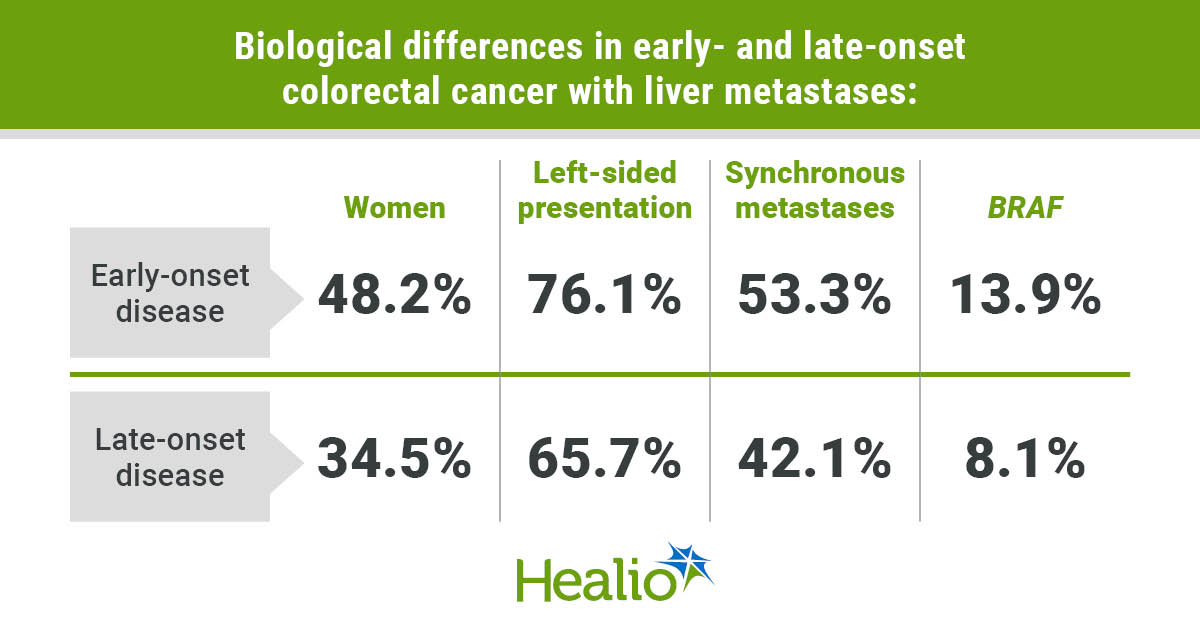
The early-onset cohort consisted of significantly higher rates of women (48.2% vs. 34.5%), patients with a Charlson comorbidity index of 0 to 1 (97.1% vs. 80.4%), ECOG score of 0 to 1 (97.4% vs. 85%), left colon and rectal malignancies (76.1% vs. 65.7%) and synchronous metastases at presentation (53.3% vs. 42.1%; all P < .001).
Patients with early-onset disease also had significantly higher rates of cancers with BRAF mutations (13.9% vs. 8.1%; P = .01), but not KRAS or NRAS mutations. Mismatch repair status did not differ between early- and late-stage disease, either.
Clinicians offered active treatments to patients with early-onset malignancies at significantly higher rates (98.6% vs. 92.1%; P < .001). Those with early-onset disease also received active treatments with greater frequency (96% vs. 88.5%; P < .001).
Researchers observed significantly longer median OS for patients with early-onset colorectal cancer (3.2 years vs. 2.38 years; P < .001). Among those with metachronous metastases, patients with early-onset disease also had significantly longer median OS (8.86 years vs. 3.83 years; P < .001).
Among those undergoing liver resection, OS did not significantly differ.
Among patients with early-onset colorectal cancer, researchers observed significantly worse survival among those with KRAS (HR = 2.38; 95% CI, 1.39-4.06), NRAS (HR = 3.57; 95% CI, 1.11-11.5) and BRAF V600E (HR = 2.83; 95% CI, 1.33-6.02) mutations.
They found similar associations among patients with late-onset disease with KRAS (HR = 1.55; 95% CI, 1.22-1.98) and BRAF (HR = 2.61; 95% CI, 1.79-3.81) mutations.
“I was pleasantly surprised that the findings confirmed a long-held belief that early-onset cancers possess differences in biology and behavior compared to late-onset disease,” Barreto said. “While we have long since known about the importance of BRAF mutations negatively impacting survival in early-onset colorectal cancer, the impact of NRAS mutations is novel.”
Both cohorts had significantly improved survival if they had surgery then adjuvant chemotherapy and/or biological treatments (early onset, HR = 0.19; 95% CI, 0.08-0.44; late-onset, HR = 0.34; 95% CI, 0.25-0.47). Barreto and colleagues observed greater benefit among patients with synchronous metastases (median survival, 6 years vs. 2.91 years) and left colon primary malignancies (median survival, 5.98 years vs. 4.67 years).
Researchers acknowledged study limitations, including its observational nature and the population size.
Barreto noted future research should investigate epigenetic biomarkers to better ascertain risk.
Barreto and colleagues plan to continue analyzing the “cardinal” question, “What is driving the rise in early-onset adult cancers?”
“We hypothesized that if the cumulative effect of exposures/stressors overwhelms the body’s own protective systems [nutritional, neurohormonal, immune, etc] at two critical time periods, namely, the perinatal period as well as adolescence and young adulthood, it could trigger epigenetic modifications,” he said. “We now know that epigenetic modifications can influence every hallmark of cancer.”
Reference:
For more information:
Savio G. Barreto, FRACS, PhD, can be reached at savio.barreto@flinders.edu.au.
Perspective

I see this as an important contribution to understanding early-onset colorectal cancer, particularly in patients with liver-only metastatic disease.
Some findings were consistent with what I would expect: younger patients, defined here as age 50 years or younger, had fewer comorbidities, more left-sided tumors, and were more likely to receive active treatment.
What stood out was the higher frequency of BRAF V600E mutations among younger patients with available testing despite longer overall survival in the younger group. That underscores the importance of considering tumor biology alongside overall health and treatment selection when interpreting survival differences. However, BRAF results were available for only about 61% of the cohort, and testing was more common among younger patients, so that finding deserves further investigation.
The nearly identical median survival among younger and older patients who underwent liver resection was also striking: 5.99 vs. 5.88 years, measured from the diagnosis of metastatic disease.
The most important take-home message is age alone should not determine treatment. Patients with liver-only metastatic colorectal cancer need an individualized assessment that considers tumor biology, overall health, disease extent, and whether their metastases can be locally addressed, with multidisciplinary discussion early on.
However, I would be cautious about interpreting this study as proof that surgery should always come first. It was observational, and the apparent survival advantages associated with surgery-containing treatment sequences in younger patients were no longer statistically significant after weighting to reduce measured treatment-selection bias. Those comparisons were against systemic therapy alone, rather than a direct comparison of surgery first vs. systemic therapy first.
The weighted estimates also had wide confidence intervals, so this should not be interpreted as evidence that surgery offers no benefit. These findings help frame important clinical questions; they do not establish the best treatment sequence.
We need prospective studies with enough younger patients to determine who benefits most from surgery first vs. systemic therapy first, and whether molecular features such as BRAF or RAS mutations should influence that decision. More complete molecular testing and detailed information about disease burden, resectability and treatment timing will be essential.
We also need to understand whether the biological differences observed here hold up in larger, more diverse populations treated with contemporary therapies. For younger adults, research should also include assessments and discussion of quality of life, fertility, treatment toxicity, and the ability to work and care for their families alongside survival. Those outcomes also matter deeply to the patients sitting in front of us as we talk about balancing quality and quantity of life.
This study also does not answer why colorectal cancer is developing at younger ages. That remains a separate, urgent research priority.
Disclosures: Jain reports being a consulting medical editor for Healio’s HemOnc Today and Women in Oncology and host of Oncology Overdrive.

Ask a clinical question and tap into Healio AI’s knowledge base.
- PubMed, enrolling/recruiting trials, guidelines
- Clinical Guidance, Healio CME, FDA news
- Healio’s exclusive daily news coverage of clinical data