October 12, 2026
4 min read

Key takeaways:
- Colorectal cancer mortality for people aged 45 years and older declined nationally across racial and ethnic groups.
- Some counties have mortality rates twice the national average for certain populations.
Colorectal cancer mortality has declined sharply among adults aged 45 years and older across the U.S. since 2000, but some counties continue to have exceedingly high rates among certain racial and ethnic populations.
These “hotspots” are most prevalent among Black men in the Southeast and American Indian or Alaska Native men in Alaska and the Midwest, Paula D. Strassle, PhD, MSPH, assistant professor of epidemiology in the school of public health at University of Maryland, told Healio.

Data derived from GBD US Health Disparities Collaborators, et al. JAMA Oncol. 2026;doi:10.1001/jamaoncol.2026.3194.

Paula D. Strassle
“Roughly 8% of counties are being left behind in this overall positive news and progress we’re seeing in colorectal cancer mortality,” she said. “We see places where they have over 100 deaths per 100,000 in 2019, twice the national average.”
Is it ‘consistent’?
Efforts to improve and expand colorectal cancer screening have saved more than 740,000 lives between 1975 and 2020, according to study background.
However, American Cancer Society still projected 55,230 deaths from colorectal cancer in 2026, the second most of any malignancy behind lung and bronchial cancer (124,990 deaths), according to its Cancer Statistics 2026 report.
Disparities persist, too.
The AACR Cancer Disparities Progress Report 2026 detailed how American Indian or Alaska Native individuals have the greatest increase in early-onset incidence, and people who live in rural areas have a 17% higher risk for being diagnosed and 27% greater risk for colorectal cancer mortality.
Additionally, Black individuals have approximately 20% higher colorectal cancer incidence and 30% lower survival than white patients, Healio previously reported.
“We know that, nationally, we’ve seen these huge declines in colorectal cancer mortality, because colonoscopy not only catches cancer earlier, but can actually remove precancerous polyps,” Strassle said.
“When we look geographically, most of the time we’re looking at state-level estimates, if we’re getting granular. If they get smaller, like a specific county, census tract or hospital catchment area, they’re typically not stratifying by age, sex, and race or ethnicity because of small sample sizes. We wanted to build out this effort to look at not just which racial, ethnic or sex populations are having better or worse outcomes in the United States, but where it’s happening, and if it’s consistent across the U.S.”
Strassle and colleagues evaluated data from 3,110 counties or combined counties from 2000 to 2019 to investigate.
The included counties had a mean annual population of 306 million.
Colorectal cancer mortality rates per 100,000 individuals served as the primary endpoint.
Mortality not falling for all
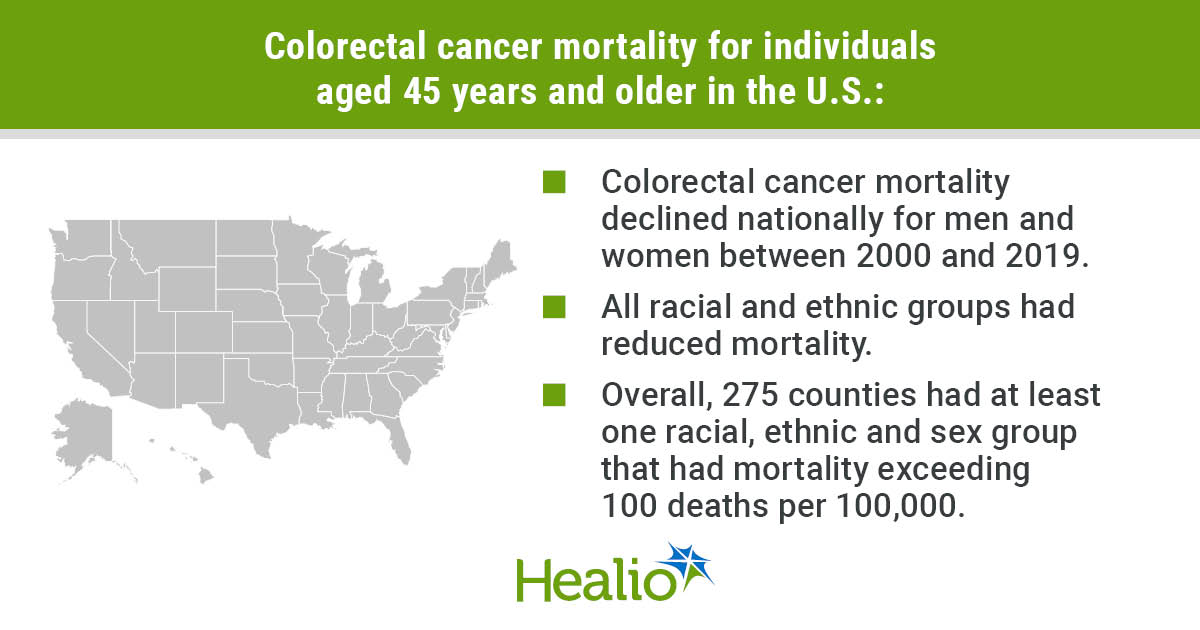
Nationally, colorectal cancer mortality fell substantially among men (82.5 deaths per 100,000 to 54.4) and women (58.9 deaths per 100,000 to 39.7) aged 45 years and older between 2000 and 2019.
Colorectal cancer mortality among individuals aged less than 45 years ranged from 0.7 to 1.8 deaths per 100,000 in 2019.
All racial and ethnic groups had reduced mortality, with the largest drops observed in Black men (–42.9 deaths per 100,000) and Black women (–31.8 deaths per 100,000) aged 45 years and older.
Researchers did not see much change among those aged less than 45 years.
Among those aged 45 years and older, colorectal cancer mortality fell in 100% of counties for Black individuals, 99.9% for white, 94.6% for Asian, 88.4% for Latino and 79.5% for American Indian and Alaska Native.
“That national decline is great,” Strassle said. “We see a decline in almost every county, across each racial and ethnic group in adults 45 and older, who are the ones recommended for screening.”
Black men aged 45 years and older still had the worst colorectal cancer mortality in 2019 (76.1 deaths per 100,000), with the next highest rates occurring in American Indian and Alaska Native men (67.6 deaths per 100,000) and white men (53.7 deaths per 100,000) of the same age.
Similar trends could be seen among women. Black women aged 45 years and older had the worst mortality (50 deaths per 100,000), then American Indian and Alaska Native women (47.9 deaths per 100,000) and white women (40.1 deaths per 100,000) of the same age.
Researchers observed considerable variation among racial and ethnic groups across the U.S.
For example, county-level mortality among American Indian and Alaska Native men aged 45 years and older ranged from a low of 13.6 deaths per 100,000 to 213.5 in 2019. Differences of at least 100 also could be seen among Latino, Black and white men, and American Indian and Alaska Native women.
Among individuals aged 45 years and older, 275 counties had mortality rates that surpassed 100 deaths per 100,000 among at least one racial, ethnic and/or sex population, mostly for Black men (182 counties), and American Indian and Alaska Native men (92 counties).
“These are excessively high rates of colorectal cancer mortality,” Strassle said. “I don’t think any of us expected to see rates so high.”
Researchers acknowledged study limitations, including possible inaccuracies in data that could have affected their model.
Strassle noted future research will try to get more granular, with a focus on counties with higher mortality rates.
“Look to see if these hotspots are more likely to be rural counties, or low-income counties, or counties that have healthcare deserts,” she said. “Some of the known risk factors for colorectal cancer are diet. Do they have higher prevalence of food deserts?
“None of this will be causative analyses, but at least they would give us some potential insight for why these trends we’re seeing may exist, and hopefully that will lead to more individual-level analyses where we can look into these counties to truly identify which risk factors are driving the increased rates.”
For more information:
Paula D. Strassle, PhD, MSPH, can be reached at pdstrass@umd.edu.

Ask a clinical question and tap into Healio AI’s knowledge base.
- PubMed, enrolling/recruiting trials, guidelines
- Clinical Guidance, Healio CME, FDA news
- Healio’s exclusive daily news coverage of clinical data