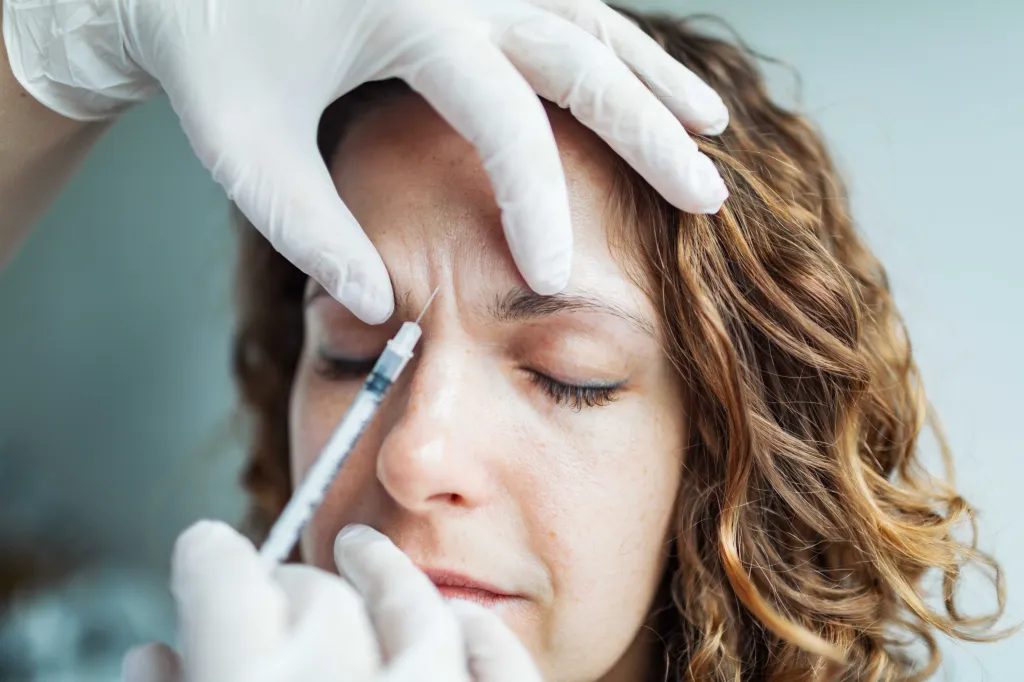
Recently, a friend invited me to a party. Not just any party: a Botox party, with cocktails, mingling, and, of course, the chance to get Botox for less than you’d pay at a doctor’s office.
“Who’s administering the Botox?” I asked. A friend of a friend, she told me: a rheumatologist who had recently gotten a Botox certificate. Rheumatologists, if you weren’t aware, are doctors who specialize in treating conditions like joint inflammation and certain autoimmune disorders.
I politely begged off, explaining that I’d recently had Botox from a dermatologist. That part was true, but the deeper reason was that I didn’t want my face injected by someone who practices a completely unrelated field of medicine. If I develop arthritis, sure. If I’m looking for something cosmetic done to my face, no thank you.
Still, it made me wonder: who’s eligible for these certificates? It turns out that it’s not just cosmetic surgeons and dermatologists who can legally administer Botox – or even dentists who use it to treat TMJ and prevent jaw clenching. All that’s required is an active medical license, not a degree in a particular specialty.
A search online showed that doctors can complete these programs over the course of a few days or, in some cases, a single day. Remote training is offered as well.
While there’s no official government requirement for healthcare providers to administer Botox in the United States, countless programs advertise courses, usually costing a few thousand dollars, that award a Botox “certification” upon completion. The rheumatologist had recently completed one of them and was offering the service as, for lack of a better term, an off-the-clock side hustle.
But, as with anything, just because you can get Botox this way, doesn’t mean you should.
Dr. Anil Shah, a double-board-certified facial plastic surgeon based in Chicago and NYC, says he’s all too familiar with these types of crash courses.
“Most of them are taught by people who aren’t well trained themselves,” says Shah. “With little to no background, doctors are expected to learn facial anatomy, learn to inject safely, and walk out ready to treat patients. That’s not realistic.”
Neither is virtual learning, in his opinion. “The face is three-dimensional and a screen is two-dimensional,” Shah adds. “You need to see the anatomy, touch it, inject it, and watch the muscles move. Unfortunately, providers take these courses in place of real training, and that’s where patients can get hurt.”
What gives Shah the most concern is the idea of these newly certified practitioners injecting Botox in the neck area. “Botox was approved for neck bands in October 2024, and now everyone wants it in the neck,” he explains. “If injected incorrectly, it can cause trouble swallowing and breathing, which can be life-threatening.”
And unlike most facial fillers, which can be dissolved, there’s no quick fix for botched Botox. It’s just a waiting game for it to wear off, which can take months.
“There isn’t a good way to reverse Botox,” confirms Dr. Angela Sturm, a Houston-based double-board-certified facial plastic surgeon and board member for the AAFPRS (American Academy of Facial Plastic and Reconstructive Surgery). “Injecting saline might be able to speed the process, but even with that, you have to wait it out.”
Then there’s the question of quality. Practitioners who hunt for bargain Botox online, especially newer or less experienced ones, risk buying counterfeit product. In 2024, the U.S. Food and Drug Administration (FDA) warned that fake Botox had turned up in “multiple states,” and that patients injected with it suffered blurred vision, gastrointestinal problems, and breathing complications, among other side effects. Today, only one company is authorized to make Botox: Allergan, which is now part of AbbVie. To keep patients safe, all providers should buy it directly from the source. The FDA’s website lists red flags to watch for, including fake lot numbers, vial sizes that don’t exist, and foreign-language labels.
The takeaway? While a bargain may seem enticing and the Botox party a fun opportunity, it may end up doing more harm than good. As Shah puts it, “Don’t trust your face with an amateur.”