October 13, 2026
3 min read

Key takeaways:
- Stress management as a surgeon takes practice.
- Start by identifying your “tells,” then practice resetting yourself to your target energy. When complications arise, process them, then “close the loop.”
NEW ORLEANS — In the high-stakes environment of ocular surgery, stress management is a trainable skill that can be improved with strategic planning and practice, according to a speaker.
At the American Academy of Ophthalmology meeting, Erin S. Seefeldt, MD, an ophthalmologist and founder of Physician Performance Lab, highlighted the scope of burnout among physicians. A survey of 592 participants found that 37% of U.S. ophthalmologists reported burnout symptoms, which can serve as a career-ending factor for a number of clinicians. However, Seefeldt said that combatting it is practical.

Data were derived from Seefeldt ES. Practical tips and tricks for reducing surgical anxiety and burnout among ophthalmic surgeons. Presented at: American Academy of Ophthalmology meeting; Oct. 9-12, 2026; New Orleans.
“This isn’t something that you just magically get throughout your career by being awesome,” she said during the presentation. “There are things that you can do that will help you manage the stresses you are dealing with, and these can be done preoperatively, intraoperatively and postoperatively.”
The first step, Seefeldt said, is for ophthalmologists to identify their own “tells.” It is important for surgeons to know how others perceive them when stress takes over.
“You have to know yourself,” she said. “If you don’t know your tells, just ask your tech or your RN, or whoever works with you, because they can tell you. It is pretty obvious when you are in the OR and something is getting tense.”

Erin S. Seefeldt
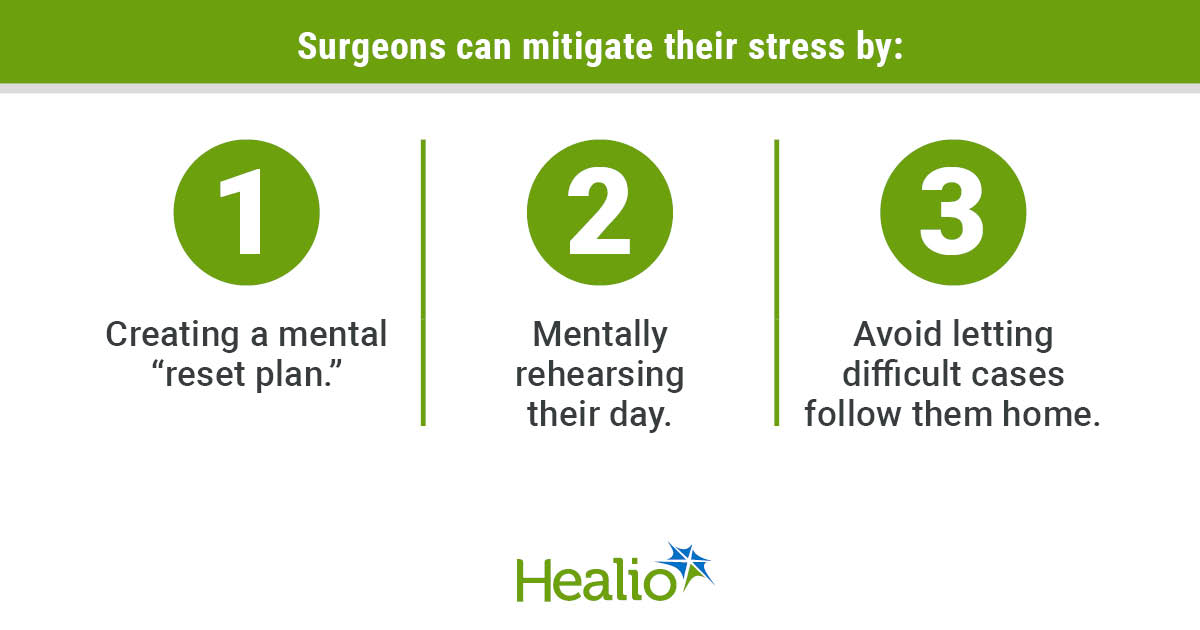
Next, when a tell surfaces, act on it. Ophthalmologists should identify a reset plan, which can range from a slow, controlled breath to an intentional loosening of the jaw or grip. A shoulder shrug can also help surgeons release any built-up tension and return focus to their fine motor muscles. Avoid sighing or audible breath, which can be perceived as frustration, according to Seefeldt.
“The other piece of this that we found over multiple different types of work is knowing your target energy is really important,” Seefeldt said. “So, what does it feel like when you feel good in the OR?”
When entering the OR with low energy, or high levels of tension, having both “ramp up” and calm down techniques can help steer surgeons back toward their target goal. Physical movement and a tailored music playlist can help with fine tuning to the right headspace, while short writing exercises can help relieve a cluttered mind.
“You can keep a piece of paper next to your OR plan,” Seefeldt said. “Write those things and tuck them away so that you can take them out of your mental space.”
Mental rehearsal, or visualizing a smooth, uneventful day in the OR is a good way to start the day in a centered mindset, making possible complications more manageable. When they inevitably arise, recognize that bad surgical outcomes can be avoided. Acknowledge a change in procedure, then calmly pivot to a new approach.
“Say you get vitreous. It’s OK. You are just going from surgery A, a routine cataract procedure, to surgery B, which is the new surgery,” she said. “That helps you to transition unemotionally. Recognize that you have to make this mental shift, and then just click over.”
Ultimately, ophthalmologists should work toward not letting difficult cases follow them home. Seefeldt said that, after taking time to debrief internally or with their team about what went right and what could have been done differently, it is then time to “close the loop” and mentally move on.
Seefeldt recommended setting up monthly team rehearsals for practicing complication management; A well-prepared team will keep the room calm.
“If your team is not prepared for these situations, that creates extra stress for you,” Seefeldt concluded. “You do not want to be running around the room finding [the right tools] for a vitrectomy. You can create these drills. … Start this week.”
Sources/Disclosures
Source:
Seefeldt ES. Practical tips and tricks for reducing surgical anxiety and burnout among ophthalmic surgeons. Presented at: American Academy of Ophthalmology meeting; Oct. 9-12, 2026; New Orleans.
Reference:
Disclosures:
Seefeldt reports being the owner of Physician Performance Lab and Catalyst MedSpa, as well as a shareholder for Comprehensive Eye Partners.

Ask a clinical question and tap into Healio AI’s knowledge base.
- PubMed, enrolling/recruiting trials, guidelines
- Clinical Guidance, Healio CME, FDA news
- Healio’s exclusive daily news coverage of clinical data