 Column
Putting It Into Practice
October 14, 2026
5 min read

Putting It Into Practice
Key takeaways:
- The employed physician faces many challenges in terms of work-life balance.
- A recently retired physician offers tips for finding the right employer and optimizing workload.
In this Putting It Into Practice column, Jonathan D. Leffert, MD, FACP, MACE, ECNU, talks with Yul D. Ejnes, MD, MACP, FRCP (Lon.), a recent retiree, about what employed physicians should know about the business of practicing medicine.

Jonathan D. Leffert
Leffert: From your perspective as a physician formerly in private practice and now recently retired from an employed position in a large practice, tell us about an optimal workload from the number of patients seen per day, the number of days per work and the protected time allotted.

Ejnes: I prefer to frame “workload” in terms of how many patients are taken care of in a day, which is more than the number seen per day. Focusing on office visits as a measure of productivity devalues the other important work that we do. That said, my schedule during the years after the pandemic was a good balance. When we reopened the office to in-person visits, it was with a “two patients per hour” rule to minimize foot traffic. As things quieted down, physicians were allowed to ramp up to pre-pandemic visit volume, but I liked the two-per-hour routine. For me, it meant 15 visits per day scheduled at the top and bottom of the hour. This did not mean 30-minute visits for everyone — if a visit was straightforward and took 10 minutes, I had time to take care of other things such as messages. If a patient needed more time, I could provide it without running late. If a patient came in late, I was often able to see them without blowing up the schedule. Prior to the pandemic, I was seeing 17 per day and a few years before that, as many as 22 per day. Things were much more rushed and there was less room for flexibility.
What the “right” number is depends on your patient population, the practice’s revenue and compensation model and your personal financial goals, as well as how much staff support you have so that you’re not wasting visit time asking about the last eye exam or tracking down reports. Non-face-to-face time can be handled in many ways, some depending on the physician’s work style. I liked having 30 to 60 minutes at the end of each half-day to take care of the portal and phone messages, refills that the pharmacy team couldn’t handle, and results.
I worked 4 full days — plus a half day of “admin” time, as it was misnamed — for working the in-basket and other patient care activities. That left me half a day free, which was nice for taking care of life matters on a weekday.
Leffert: From the same perspective, tell us about the staffing required for a physician in practice.
Ejnes: Some practices rely on medical assistants (MAs), others on nurses, some a combination of both. We used MAs primarily. At a minimum, each physician should have a dedicated MA, ideally two, since the MAs are very busy in team-based care models. It’s more than just having someone do the work — that MA knows how you like things done and develops trusting relationships with your patients. If you have a say on how phone calls are handled, I would have that done in-office and not through a centralized call center.
Leffert: What has your experience been regarding the turnover of physicians and how does turnover affect the practice?
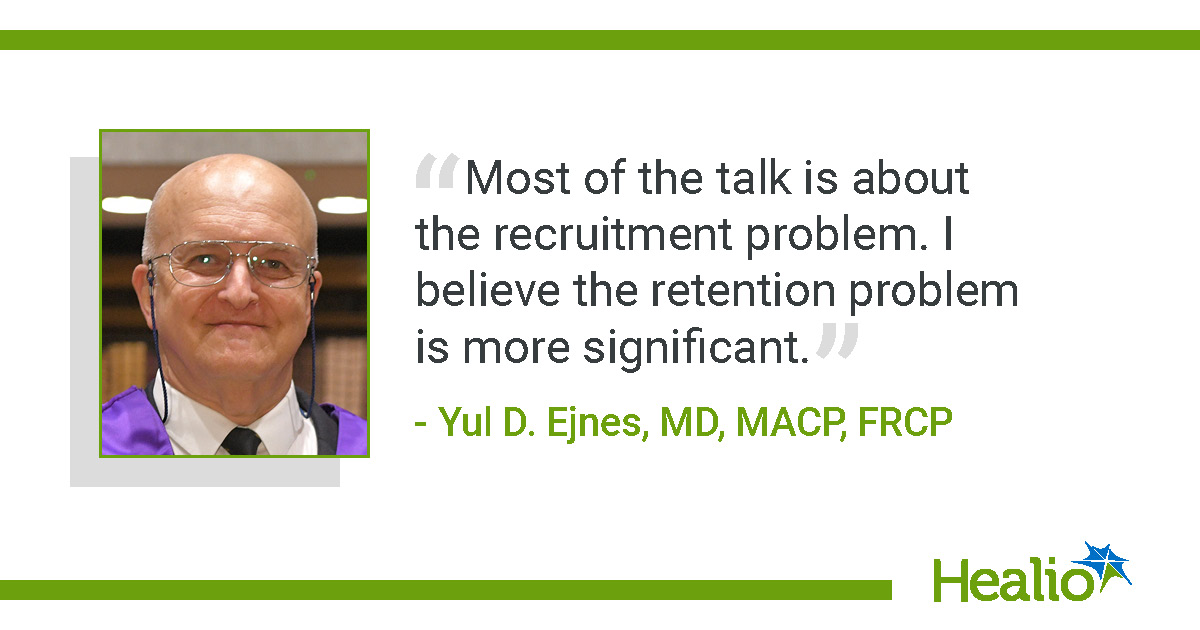
Ejnes: In many localities, including mine, most of the talk is about the recruitment problem. I believe the retention problem is more significant. My observation is that more physicians are leaving conventional practices for retainer-based practices (concierge, direct primary care, etc). There is also turnover related to relocation for the physician’s or significant other’s job or family issues, which is easier when the physician isn’t also a partner in a practice.
Regardless of the reason for the turnover, it is very disruptive to the practice, since most practices want to hold on to the patients, but the remaining clinicians are already maxed out as far as their schedules and panels go. Even if one is successful in recruiting new physicians, they are not able to absorb an entire mature practice the day they start work. I was fortunate in that when I retired, there were new hires and a few physicians who had room for more patients, so that every one of my patients had a new physician when I left. I’ve had experiences where there was no one else and patients who had to be seen were seen by different clinicians with no continuity until a new physician became available.
Leffert: What are the appropriate workload and support questions to ask the owner of the private practice group or an employed physicians’ group prior to accepting a position as physician?
Ejnes: Before getting into specifics, learning the philosophy and culture of the group is important. Large groups, regardless of ownership, often hire managers who live by what I call “the three -izes”: standardize, centralize, optimize. That may work in a factory, but is not applicable to all aspects of a medical practice. With that in mind, prospective hires should ask to what extent can physicians customize their schedules and workflows. With respect to workload, asking about visits per day is important, but so is panel size, which drives not just visit demand, but portal and phone messages and in-basket volume. Can a physician take a reduced workload for less compensation if that works better for them?
On support, having dedicated staff, whether it’s MAs or nurses, is important. What role does the physician play in selecting team members or changing them if things don’t work out? Is there a program to manage prescription refills and triage the in-basket? With whom does the physician discuss issues related to schedules, reception and staffing? Is it a physician leader or a nonphysician, and if the latter, at what level is there physician involvement?
Leffert: If your workload expectations are not matched by previous promises by the owner or administrator of the group, how would you approach this situation to work out a solution?
Ejnes: I’m a fan of working within the system before doing something that is more confrontational. Many organizations have pathways for physicians to provide input and participate in decision-making, but they are not used because the physicians may not know about them, are too busy, feel intimidated and/or don’t trust the process. Collective action with others who share your concerns is more effective than going it alone. For management, losing a doctor is a disruption; losing multiple doctors is a crisis. Work your way up the organizational chart until you get a resolution. If the situation is toxic beyond repair, there is no shortage of opportunities elsewhere and it’s time to move on.
For more information:
Yul D. Ejnes, MD, MACP, FRCP (Lon.), practiced office-based primary care internal medicine for 36 years until his retirement in January. In 1995, he cofounded Coastal Medical, at the time Rhode Island’s largest private practice, which in 2021 became part of the Brown University Health system. In addition, he has served on and chaired the board of regents of the American College of Physicians and the board of directors of the American Board of Internal Medicine. He can be reached at yul_ejnes@brown.edu.
Jonathan D. Leffert, MD, FACP, MACE, ECNU, is managing partner at North Texas Endocrine Center and past president of the American Association of Clinical Endocrinology. He is a Healio | Endocrine Today Editorial Board Member and the Putting It Into Practice column editor. He can be reached at jleffert@leffertmail.com or on X @JonathanLeffert.
Putting It Into Practice
Sources/Disclosures
Source:
Healio Interviews
Disclosures:
Ejnes and Leffert report no relevant financial disclosures.

Ask a clinical question and tap into Healio AI’s knowledge base.
- PubMed, enrolling/recruiting trials, guidelines
- Clinical Guidance, Healio CME, FDA news
- Healio’s exclusive daily news coverage of clinical data