October 15, 2026
2 min read

Key takeaways:
- At week 28, cholestatic pruritus, fatigue and sleep disturbance scores were lower with volixibat than placebo.
- Safety of the agent appeared similar to that of other IBAT inhibitors.
NASHVILLE, Tenn. — Patients with primary sclerosing cholangitis and moderate to severe pruritus reported significantly lower cholestatic pruritus and sleep disturbance with volixibat than with placebo, VISTAS trial data showed.
Patients who received volixibat (Mirum Pharmaceuticals), an investigational ileal bile acid transporter (IBAT) inhibitor, also had significantly lower serum bile acid levels and reduced fatigue, noted a presenter at ACG Annual Scientific Meeting.

“[This trial] is the largest interventional study investigating the efficacy and safety of IBAT inhibition in patients with primary sclerosing cholangitis and is the first controlled evidence of a potential therapy addressing the cholestatic symptom burden in patients,” Mitchell Shiffman, MD, director of the Liver Institute of Virginia at Bon Secours Mercy Health, said during his presentation. “Volixibat led to a rapid, significant and sustained improvement in cholestatic pruritus while showing a safety profile consistent with IBAT inhibition.”
VISTAS study
As Healio previously reported, volixibat demonstrated improvements in pruritus and Patient-Reported Outcomes Measurement Information System (PROMIS) scores for fatigue and sleep compared with placebo among patients with primary biliary cholangitis. However, no pharmacologic therapies are currently available for patients with primary sclerosing cholangitis.
Shiffman and colleagues conducted the 28-week phase 2b VISTAS trial to assess the efficacy and safety of volixibat among 111 patients aged at least 12 years with primary sclerosing cholangitis and moderate to severe pruritus.
The researchers randomly assigned patients 1:1 to receive volixibat 20 mg twice daily (n = 54; mean age, 45.2 years; 53.7% male) or placebo (n = 57; mean age, 44.3 years; 61.4% female).
Most patients in both groups had large-duct disease (90.7% and 93%, respectively). Change in pruritus by Adult ItchRo score from baseline to the average of the last 12 weeks of treatment served as the primary endpoint. Key secondary endpoints included change from baseline in serum bile acid levels and PROMIS fatigue and sleep disturbance scores.
‘Rapid and sustained reductions’
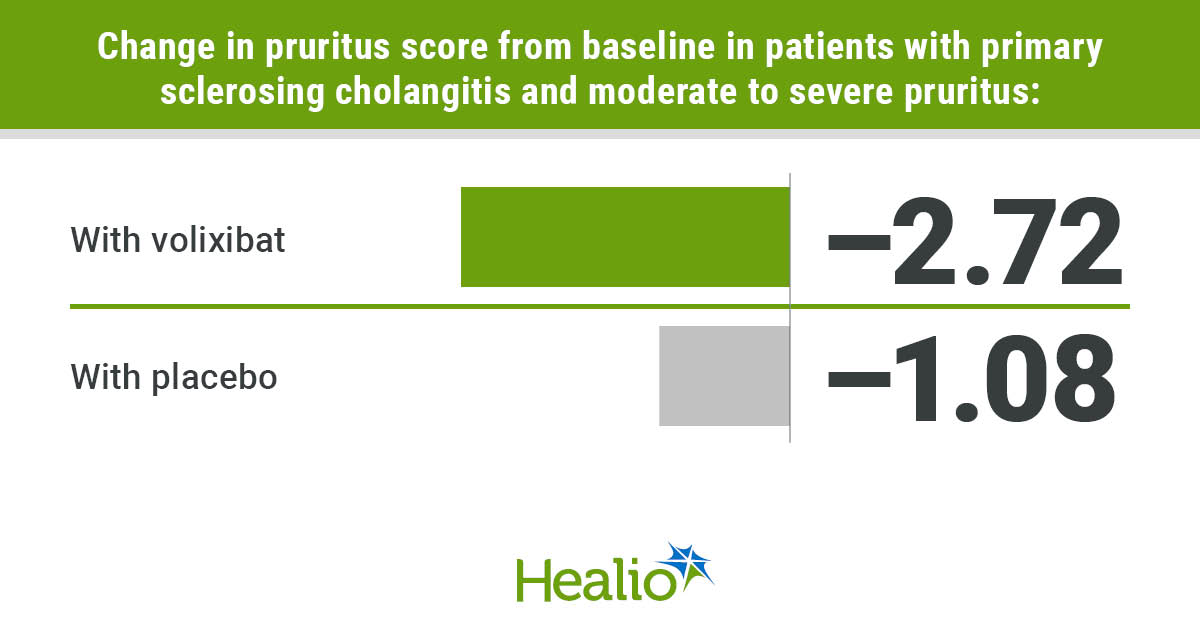
At the end of the trial, volixibat significantly improved pruritus compared with placebo (mean change from baseline, 2.72 vs. 1.08; delta = –1.64; P < .0001).
The volixibat group also showed greater improvements in fatigue (4.22 vs. 1.89; between-group difference, 2.33) and sleep disturbance (6.47 vs. 0.78; delta = 5.69; P = .0011).
“The change in fatigue score was 2.33 points greater with volixibat compared to placebo, although this fell short of significance,” Shiffman told attendees. “However, sleep disturbance improved by a whopping 5.69 points compared to placebo, and this was highly statistically significant.”
Volixibat also significantly reduced serum bile acid levels compared with placebo (mean change, –33.7 mol/L vs. 2.1 mol/L; delta = –35.8; P < .0324).
Researchers noted that volixibat had safety profile consistent with other IBAT inhibitors.
Slightly more patients in the volixibat group experienced any treatment-emergent adverse event (93.5% vs. 84%) and grade 3 or higher treatment-emergent adverse events (13% and. 11.1%, respectively).
The most common treatment-emergent adverse events with volixibat were diarrhea (40.3%), abdominal pain (18.2%), nausea (13%) and vitamin D deficiency (10.4%). One patient in the placebo group died during the study.
“The decline in pruritus was rapid, occurring within 2 weeks of starting volixibat, reaching a maximum at about 4 to 5 weeks, and remained constant throughout the duration of the study,” Shiffman said.
Sources/Disclosures
Source:
Shiffman ML, et al. Efficacy and safety of volixibat, an IBAT inhibitor, in patients with primary sclerosing cholangitis and moderate-to-severe pruritus: Results of the VISTAS trial. Presented at: ACG Annual Scientific Meeting; Oct. 12-14, 2026; Nashville, Tenn. (hybrid meeting).
Disclosures:
Shiffman reports research support and/or consulting or speaker fees from 89 Bio, Akero, Altimmune, Atea, Camurus, Exact Sciences, Fujifilm, Genentech, Gilead Sciences, Hanmi, Helio Genomics, HepQuant, Intercept, Intra-Sana Laboratories, Inventiva, Ipsen, Madrigal, Mirum Pharmaceuticals, Novo Nordisk and Pliant. Please see the study for all other authors’ relevant financial disclosures.

Ask a clinical question and tap into Healio AI’s knowledge base.
- PubMed, enrolling/recruiting trials, guidelines
- Clinical Guidance, Healio CME, FDA news
- Healio’s exclusive daily news coverage of clinical data