October 15, 2026
2 min read

Key takeaways:
- Out of 5,000 colonoscopies, two machine learning models were concordant in detection of colorectal neoplasia in 97.5% of cases.
- However, the false-positive rate was high with one of the models.
NASHVILLE, Tenn. — Two machine learning models demonstrated high accuracy in identifying adenomas and sessile serrated lesions, although more research is needed to determine their long-term performance, according to study results.
Data presented at ACG Annual Scientific Meeting showed that while a random forest model exhibited higher sensitivity, it also had a higher false-positive rate.

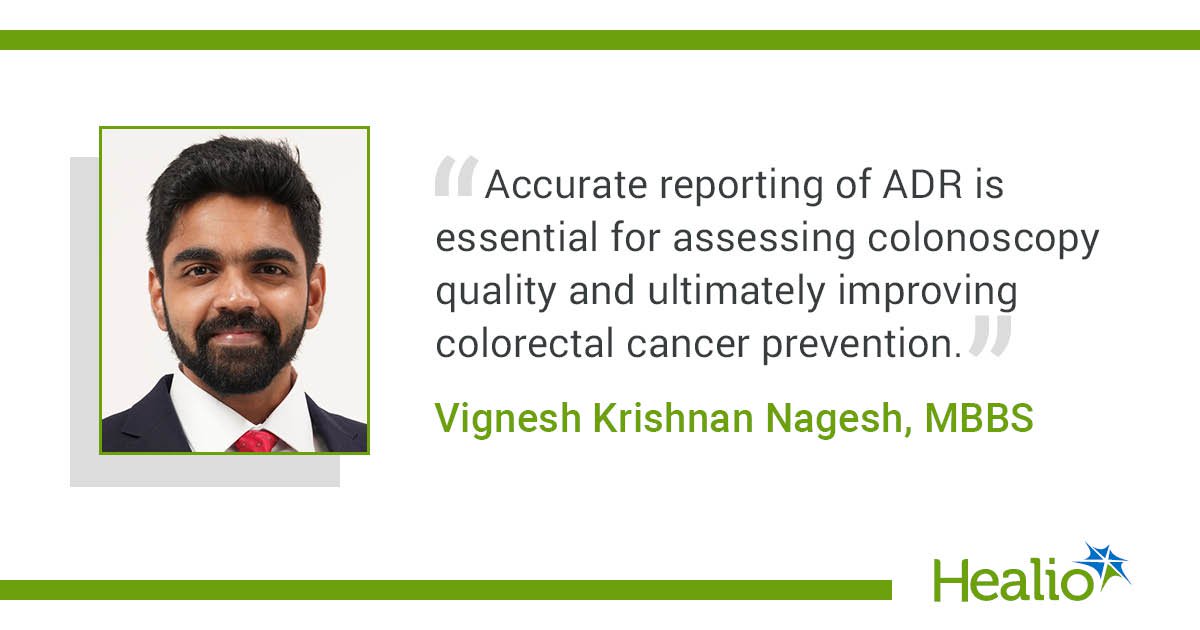
“Accurate reporting of ADR is essential for assessing colonoscopy quality and ultimately improving colorectal cancer prevention,” Vignesh Krishnan Nagesh, MBBS, a hospitalist at Aikens Regional Medical Centers, told Healio regarding his presentation. “Automated approaches may offer an efficient way to facilitate ADR reporting in clinical practice.
“However, additional studies are needed before selecting the optimal model for implementation, with consideration of accuracy, cost, time and feasibility of implementation in different practice settings,” he added.
Nagesh and colleagues conducted a retrospective study of 5,000 colonoscopy reports between 2023 and 2025 to compare the performance of a random forest model and a large language model (LLM) in automating adenoma detection rate reporting.
Both models had been validated, with reported adenoma and serrated lesion detection rates of at least 99%, according to study background.
Outcomes included adenoma and serrated lesion classification, overall neoplasia, false positives and omission rates.
According to results, both models demonstrated a high degree of concordance, with agreement in 97.5% of cases.
Manual review of the remaining discordant cases (n = 123) showed the random forest model missed two of 16 tubular adenomas vs. seven with the LLM. Both models missed four of 47 sessile serrated lesions.
However, the random forest model falsely identified 92 of 107 cases with tubular adenoma vs. eight with the LLM. The false positivity rate of sessile serrated lesions was comparable between the models: two of 76 cases with the random forest model vs. one with the LLM.
“Among the 2.5% of discordant cases, the random forest model demonstrated higher sensitivity, but this was accompanied by a higher false-positive rate compared with the large language model,” Nagesh said.
The researchers observed similar results for seven cases in which both tubular adenomas and sessile serrated lesions were present: The random forest model missed two and the LLM omitted five.
The random forest model falsely identified tubular adenomas and sessile serrated lesions in 59 of 67 cases compared with eight false positives from the LLM.
Nagesh emphasized that prospective studies across healthcare systems are necessary to assess the models’ generalizability and performance over time.
“While the random forest model demonstrated higher sensitivity, this could potentially result in overestimation of ADR if false-positive cases are incorrectly classified as adenomas,” he told Healio. “The large language model also has a higher implementation cost, which should be considered when evaluating its clinical utility.
“Further studies are needed to determine whether a single model is sufficient or whether a combination of approaches would provide the most reliable results.”
For more information:
Vignesh Krishnan Nagesh, MBBS, is a hospitalist at Aikens Regional Medical Centers and a research collaborator with Mayo Clinic Florida. He is a former gastrointestinal neoplasia fellow at Mayo Clinic Rochester. He can be reached at nagesh.vigneshkrishnan@mayo.edu.
Sources/Disclosures
Source:
Nagesh VK, et al. Comparison of random forest approach machine learning and large language models for automated detection of colorectal neoplasia: A retrospective study of 5,000 colonoscopies. Presented at: ACG Annual Scientific Meeting; Oct. 9-14, 2026; Nashville (hybrid meeting).
Disclosures:
Nagesh reports no relevant financial disclosures. Please see the study for all other authors’ relevant financial disclosures.

Ask a clinical question and tap into Healio AI’s knowledge base.
- PubMed, enrolling/recruiting trials, guidelines
- Clinical Guidance, Healio CME, FDA news
- Healio’s exclusive daily news coverage of clinical data