October 16, 2026
2 min read

Key takeaways:
- Body roundness index outperformed BMI in predicting long-term mortality in MASLD.
- Lean and nonobese individuals with elevated body roundness index had higher mortality risk despite passing BMI classification.
NASHVILLE, Tenn. — Body roundness index may improve mortality risk stratification in metabolic dysfunction-associated steatotic liver disease, identifying high-risk lean and nonobese individuals often overlooked by BMI.
Findings presented at ACG Annual Scientific Meeting indicated that, although BMI remains a useful measure of overall body size and obesity, complementing with body roundness index may help capture body shape and central adiposity risk factors that BMI alone may miss.

“We often use BMI as a shorthand for obesity and metabolic risk, yet we see patients with MASLD who have a normal or only modestly elevated BMI but still have substantial cardiometabolic disease,” Sarpong Boateng MD, MPH, resident physician at Yale New Haven Health, told Healio about his presentation. “Two individuals with the same BMI can have very different amounts of central adiposity and, potentially, very different metabolic risk. That raised a simple question for us: Are we adequately capturing the type of adiposity that matters most?”
To determine whether body roundness index, which incorporates waist circumference and height, could provide prognostic information that BMI misses, Boateng and colleagues analyzed data from National Health and Nutrition Examination Survey III for 3,466 adults with MASLD, tracking mortality over a median 29 years.
The researchers defined MASLD as ultrasound-confirmed hepatic steatosis plus at least one cardiometabolic risk criterion; individuals with viral hepatitis or significant alcohol use were excluded. They used survey-weighted Cox models adjusted for demographic and clinical risk factors, including Fibrosis-4 index score, to compare body roundness index and BMI as predictors of all-cause and cardiovascular mortality.
Restricted cubic spline analyses were completed to assess dose-response relationships, while prespecified subgroup analyses were undertaken to determine whether these associations held for nonobese individuals (BMI < 30 kg/m²) as well as those considered lean (BMI < 25 kg/m²).
Overall, 1,528 deaths occurred during follow-up. Body roundness index was more strongly associated with all-cause mortality than BMI (adjusted HR = 1.23; 95% CI, 1.12-1.34 vs. aHR = 1.15; 95% CI, 1.05-1.26), results showed.
“However, among individuals with nonobese MASLD, body roundness index remained associated with long-term mortality while BMI essentially lost its prognostic signal,” Boateng said. “We saw an even more intriguing pattern in lean MASLD.”
Among lean individuals with MASLD, body roundness index identified elevated mortality risk that BMI classification failed to capture (aHR = 1.3; 95% CI 1.05-1.6 vs. aHR = 0.95; 95% CI, 0.73-1.22).
“‘Lean’ is fundamentally a BMI-based label, and our findings suggest that a lean BMI does not necessarily mean low adiposity-related risk,” Boateng said. “Some individuals classified as lean may still carry substantial central or visceral adiposity. In our analysis, body roundness index identified mortality risk even within lean MASLD, whereas BMI did not.”
The researchers also reported that, among nonobese individuals with MASLD, those in the highest body roundness index quartile exhibited a 46% higher risk for death than those in the lowest quartile (aHR = 1.46; 95% CI 1.14-1.88), whereas BMI quartiles showed no significant association (aHR = 1.09; 95% CI, 0.78-1.53).
Kaplan-Meier analyses demonstrated clear survival differences across body roundness index quartiles (P < .001), but not BMI quartiles.
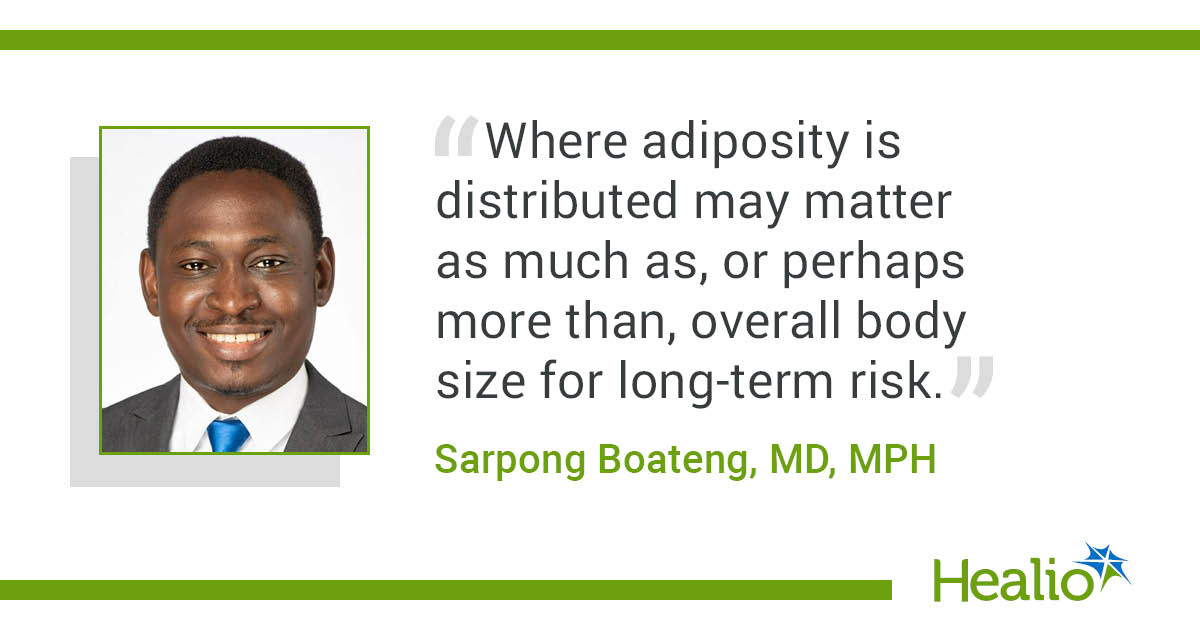
“BMI does not tell the whole story in MASLD,” Boateng told Healio. “Where adiposity is distributed may matter as much as, or perhaps more than, overall body size for long-term risk. A patient who does not meet BMI criteria for obesity should not automatically be considered metabolically low risk, and simple measures of central adiposity may help us identify those patients more effectively.”
For more information:
Sarpong Boateng MD, MPH, can be reached at gastroenterology@healio.com.
Sources/Disclosures
Source:
Boateng S, et al. Body roundness index outperforms body mass index for mortality risk stratification in U.S. adults with MASLD: A 30-year national cohort study. Presented at: ACG Annual Scientific Meeting; Oct 12-14, 2026; Nashville, Tenn. (hybrid meeting).
Disclosures:
Boateng reports no relevant financial disclosures. Please see the study for all other authors’ relevant financial disclosures.

Ask a clinical question and tap into Healio AI’s knowledge base.
- PubMed, enrolling/recruiting trials, guidelines
- Clinical Guidance, Healio CME, FDA news
- Healio’s exclusive daily news coverage of clinical data