October 16, 2026
2 min read

Key takeaways:
- Men with CRC or advanced precancerous lesions had higher fecal hemoglobin levels than women.
- The FIT threshold for women would need to be lowered to match CRC sensitivity in men.
NASHVILLE, Tenn — Fecal immunochemical tests appear more sensitive to colorectal cancer and advanced precancerous lesions in men than women, according to a retrospective study presented at ACG Annual Scientific Meeting.
“FIT is the most commonly used colorectal cancer screening test in the world, with an average sensitivity of 79% and specificity of 94%,” Thomas F. Imperiale, MD, Lawrence Lumeng Professor of Gastroenterology and Hepatology at Indiana University School of Medicine, told attendees. “Its test characteristics vary based on threshold and the brand, but whether performance varies by sex is less clear.

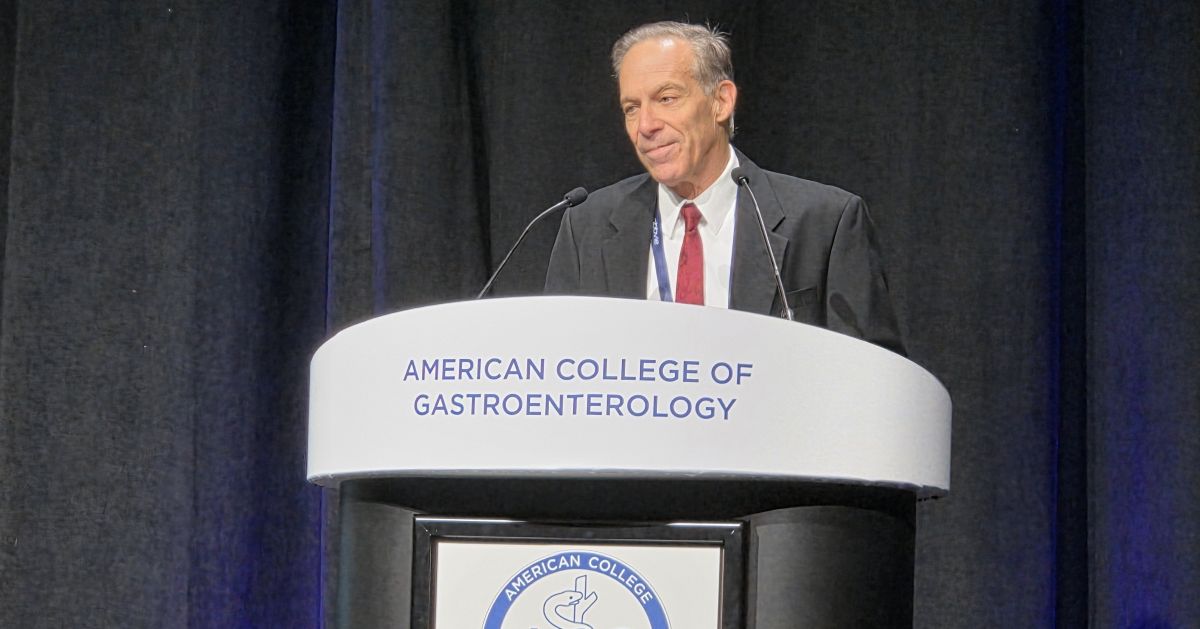
Thomas F. Imperiale, MD, speaks at the podium during ACG Annual Scientific Meeting. Photo: Octavia Feliciano.
“We know the prevalence and distribution of colorectal cancer and advanced precancerous lesions differ between males and females, but do these differences warrant different FIT thresholds?” he asked.
Imperiale and colleagues analyzed cross-sectional data from DeeP-C and BLUE-C, two validation studies for original and next-generation multitarget stool DNA tests. Both studies used the same independent, quantitative comparator FIT, which had a threshold of 100 ng/mL, or approximately 20 µg/g of feces.
The researchers compared fecal hemoglobin levels between men and women, as well as sex-specific FIT sensitivity and specificity for CRC and advanced precancerous lesions at the recommended threshold. They also identified sex-specific sensitivity thresholds at 95% specificity.
Final analysis included 30,165 individuals (mean age, 63.4 years; 46.6% men), of whom 163 had CRC and 2,901 had advanced precancerous lesions.
According to results, men had significantly higher fecal hemoglobin levels compared with women for CRC (1,541 ng/mL vs. 955 ng/mL, P = .03), as well as for advanced precancerous lesions (230 ng/mL vs. 174 ng/mL, P < .001).
“Consistent with previous studies, for colorectal cancers and [advanced precancerous lesions], males have higher fecal hemoglobin levels than females,” Imperiale said.
Additionally, FIT sensitivity was significantly higher among men than women for CRC (77.4% vs. 62%, P = .03) and advanced precancerous lesions (25.8% vs. 20.2%, P < .001).
Attaining specificity of 95% for CRC required thresholds of 120 ng/mL and 94 ng/mL for men and women, respectively.
“To equal the cancer sensitivity in males, the threshold in females would have to be lowered,” Imperiale said.
Analysis also showed that distal CRC and advanced precancerous lesions were more common in men than women. However, the researchers observed no difference in CRC and advanced precancerous lesion size distribution by sex.
Imperiale and colleagues identified factors independently linked to FIT sensitivity for advanced neoplasia, including histology and size of the lesion, male sex (OR = 1.22; 95% CI, 1.02-1.47), being a current or former smoker (OR = 1.36; 95% CI, 1.14-1.63), BMI of at least 30 kg/m2 (OR = 1.39; 95% CI, 1.17-1.67) and distal or rectal lesion location (OR = 2.41; 95% CI, 2.01-2.89).
The researchers acknowledged study limitations, including use of one FIT brand and a single threshold and application of FIT.
“If the goal were to equal cancer sensitivity detection [in men], then the threshold should be different [for women],” Imperiale said. “Exactly what the threshold should be would depend on which test is used, because there is going to be variation.”
Sources/Disclosures
Source:
Imperiale TF, et al. Performance characteristics of fecal immunochemical tests in males and female: Should the threshold vary? Presented at ACG Annual Scientific Meeting; Oct 12-14; Nashville, Tenn. (hybrid meeting).
Disclosures:
Imperiale reports a consulting role with Cook Medical and research support from Exact Sciences. Please see the study for all other authors’ relevant financial disclosures.

Ask a clinical question and tap into Healio AI’s knowledge base.
- PubMed, enrolling/recruiting trials, guidelines
- Clinical Guidance, Healio CME, FDA news
- Healio’s exclusive daily news coverage of clinical data