October 19, 2026
10 min read

Key takeaways:
- Musculoskeletal pain and injuries are common among ophthalmologists.
- Office layout, exercise and equipment all can improve physician ergonomics.
For ophthalmologists, occupational pain can start early.
For Cynthia Matossian, MD, FACS, discomfort arose fewer than 5 years into her career. She said surgeons often find themselves in similar positions over the course of their routine work, and repeated motions can wear people down.

Image:
Courtesy of
Sunir
J. Garg, MD, FACS, FASRS
“There were two areas that I noticed were bothering me after being hunched over the slit lamp day in, day out, week in, week out, and after being in the OR for long days of surgery,” she said. “Those two areas were my neck and upper back area around my shoulder blades.”
The discomfort got so bad that she knew if she did not address it, it could have a significant impact on her career.
“I told myself, ‘I can’t go on like this,’” she said. “I need to help my body so that I can be an effective and healthy ophthalmologist for as long as possible.”
Musculoskeletal pain and injuries are common among ophthalmologists. A 2025 literature review that included data from more than 3,200 ophthalmologists found that the average prevalence of work-related musculoskeletal disorders was about 63%, with neck, lower back and shoulder disorders most affected. The authors also found that more than 7% of ophthalmologists require spine surgery because of cervical spine disease related to disc herniation. Additionally, these disorders push about 13% of ophthalmologists to early retirement, according to the study.

Cynthia Matossian
When Matossian looked for solutions for her discomfort about 30 years ago, there was not much to work with because not many people talked about the problem, she said.
“I started to do some research about it, and ergonomics was not a common topic back in the day,” she said. “It wasn’t discussed, it wasn’t talked about, and you just slouched over and did what you had to do to examine patients. Nobody paid attention to this area.”
Deepinder K. Dhaliwal, MD, LAc, said ergonomic problems trace back to the physician’s mindset to put the patient and their comfort first.
“We tell ourselves that the patient has to be comfortable, and we’ll withstand an uncomfortable position,” she said. “The problem is that because we do so many exams and so many surgeries in a career, all that poor posture and habits come back to haunt us.”
Matossian agreed, saying physicians are taught to push through tough times, exhaustion and pain.
“You’re sleepless, but you get through the night,” she said. “We just try to tough it out and power through whatever aches and pains we may be having. These are signs of your body telling you that it is not happy, and perhaps there are simple adjustments that can be made to alleviate those issues completely if you pay attention to them.”
The early career experience of Eric D. Rosenberg, DO, was no different. When he started his internship, his first goals were not to hurt anyone else and to help patients.
“From day 1 coming out the gate, we’re always inclined to take care of the person in front of us, never ourselves,” he said. “We frequently do it at the cost of ourselves. We don’t care about ourselves because we’ve been trained not to care about ourselves. All aspects of our lives have been trained and geared toward making sure that the people around us are better off than we are.”
Common Mistakes
When Dhaliwal works with young physicians, there are a few ergonomic issues that she spots right away, including their posture at the slit lamp, which was an issue early in her career.
“I used to crane my neck forward, and it’s such a common thing that I see people do because they try to reach the patient,” she said. “The critical thing I do now is lift the patient’s chair up and slide my stool under the footrest so I can get close. I have the patient move to the edge of their seat so that they are leaning forward into the slit lamp, and I can keep my spine and neck straight. That has changed my life.”
Dhaliwal said her goal is to keep her ears over her shoulders and ensure she is properly supporting her head when she is examining patients.
“The typical head weighs 10 to 12 pounds, but if we flex forward 30°, which is not a lot, that effective weight on our cervical spine is 40 pounds” she said. “You can understand why even when you’re looking down at your phone for a long time, your neck can start to feel uncomfortable.”
Sunir J. Garg, MD, FACS, FASRS, said a lot of ergonomic mistakes are caused by environmental factors, including a poor office setup.
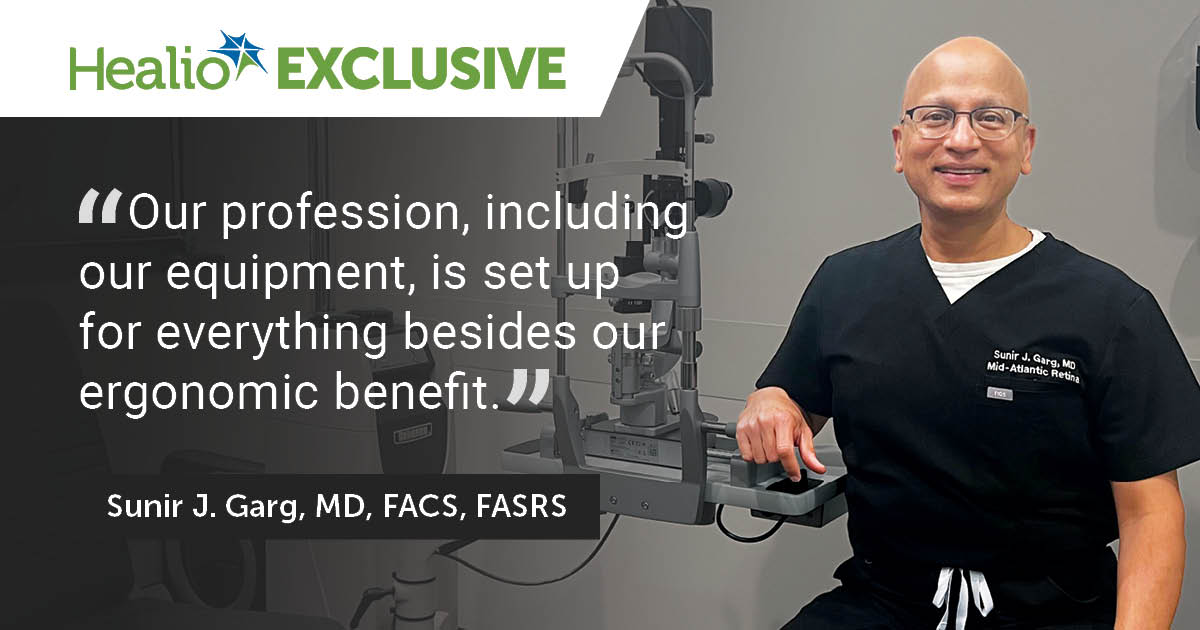
“Our profession, including our equipment, is set up for everything besides our ergonomic benefit,” he said. “If you walk into one of my exam rooms, I have the computer parallel to the wall on one side, and I have the patient chair at 90° in front of me; that setup is ergonomically not good. I’m trying to type while I rotate and turn my head toward the patient, which causes unnecessary stress on our neck and our back. That twisting motion is bad for a person’s spine.”
Garg said common slit lamp setups are wrong as well. The tables are often too deep, and patient seats are too deep, causing ophthalmologists to sit too far away. That forces them to lean too far forward, he said.
“Then, our shoulders and elbows aren’t supported when we are holding the lenses out in front of us,” he said. “That’s stressful on the neck, upper back and shoulders.”
Practice changes
Garg said, as a profession, ophthalmologists need to rework how they set up their clinics to better support ergonomics. While changes to slit lamp design or office layout might take time, he said there are small changes ophthalmologists can make to improve their situation, such as asking the patient to sit forward in their chair or using foam elbow supports at the slit lamp.
“Nobody told me this stuff, and I ended up learning it because I was in pain and needed to find a better way forward,” Garg said. “If you’re a 28-year-old resident, your body can handle a lot. But once you become a 53-year-old individual like I am, your body doesn’t put up with that so well.”
When Matossian started making changes, one of the first things she did was find a new chair. It was clear that none of the chairs in her surgical center were designed for women, so she set out to find one that fit.
“At a conference, I went around to different booths on the exhibit floor and tested all kinds of surgeon chairs,” she said. “I finally found one that fit my body and put in a request at my ASC to purchase it. The male surgeons didn’t like the new chair. It didn’t work for them, just like their chairs didn’t work for me. But in the end, I had my own chair that worked out great.”
Matossian said physicians should not be afraid to make requests that will improve their comfort and urged practice and surgical center administrators to be receptive to those concerns.
“If a surgeon needs a different surgical stool or an OR table that goes down lower because they are short, it would be great if administrators could hear these types of requests and accommodate their surgeons,” she said. “Perhaps that surgeon could do more cases because they aren’t as tired nor in discomfort. Extending the number of years a physician can remain a productive and active surgeon benefits everyone, most importantly, the patients.”
New technology is changing how physicians perform surgery, according to Rosenberg. Heads-up displays and digital systems offer solutions to ergonomic problems posed by traditional, fixed surgical microscopes.

Eric D. Rosenberg
“It’s just a function of what we do,” he said. “We’re always fixated at three points. Our feet have to be on the ground or on the pedals, we have to be in a seated position, and our eyes are fixed on the oculars.”
The addition of heads-up displays removes one of those fixations, which Rosenberg said has made working on complex cases more comfortable.
“Adopting some of these digital technologies that are making their way into the OR is going to be important for ophthalmologists from a surgical standpoint,” he said. “The less we are three-point fixated in the OR or in the office, the better off we’re going to be.”
Rosenberg thinks patients will also be better off because the systems allow for full integration of surgical information such as digital markings and torics. They can also facilitate easier surgery for patients who may have been more difficult to accommodate in the past. He said he receives patients with comorbid conditions who have difficulty getting cleared by anesthesiologists in hospitals.
“At the surgery center, surgeons don’t want to do it because patients are not ambulatory. They can’t get out of their wheelchair,” he said. “I do the cataract surgery right in their wheelchair. I lower the seat as low as it can go. I spread my legs a bit, and I put a pedal under each one. Because I’m heads up, I’m not fixated to a microscope. I’m not hunched over trying to look in the oculars to be able to do the surgery.”
Rosenberg is chief medical officer for ScopeXR, an app for Apple Vision Pro that he helped develop. He estimated that he has completed about 300 cases using the program and said it has made an immediate difference in his comfort.
“Right around when I was adopting the heads-up display, I actually got a car that had a massage feature in it because when I was coming home from the OR, my back was hurting me,” he said. “Now I hardly ever use that feature. It’s funny because now I feel like I wasted money getting a new car. That was one of the rationales for doing what I did. It’s nice coming home feeling like a million bucks and being able to run around with my daughter like I should be able to.”
Lifestyle changes
The next part of Matossian’s ergonomic journey was to find ways to take care of herself despite her busy schedule.
“I started working with a personal trainer,” she said. “I didn’t have time to go to the gym. I didn’t want to waste time driving there and back. I knew it would be a hurdle. The alternative was for the trainer to come to me once a week. He knew my occupation, and he would give me exercises so that I could keep my back and neck strong. It was a great way to keep in shape, be able to do all these procedures and see patients.”
Then, in the evenings after days in the operating room, Matossian hired a masseuse who came to her home to do a deep tissue massage.
“The combination of weekly sessions with each, a personal trainer and a masseuse, eliminated my neck and back issues,” she said. “It helped me be a healthy surgeon with no pain and no aches.”
When Garg was still a resident, he told a neighbor about his work-related back pain, and the neighbor suggested he try yoga. Garg has been doing Iyengar yoga ever since, for 25 years.
“It was transformational for me, and even within a few classes, my back pain went away,” he said. “If I skip my yoga practice for even a week, my back pain starts up again. It’s been helpful not only in the physical aspect of my work, but the mindfulness part of yoga has helped me as well. It helps both in terms of being aware of my body position during cases and during patient examinations but also during surgery. It’s helped me remain present during a case even if things start to go not the way I had intended. Yoga practice has been useful to me in a lot of different ways.”
Dhaliwal said she had a wake-up call when she developed a serious disc herniation in her back. For a few weeks, she was not sure if she would be able to continue her career, but when she came back, she knew ergonomics and taking care of herself had to be front of mind. In addition to the changes Dhaliwal made in the office, she now meditates and does yoga, core strength exercises and weight training.

Deepinder K. Dhaliwal
“The key is to stay fit and remember to unplug,” she said. “You need balance in your life, and it’s hard to think about that when there are so many demands on your time. I try hard to make time to exercise, meditate, be spiritual, and reset and focus.”
Before every surgery, Dhaliwal takes time to stretch, recenter and think about the case.
“Even in the office, I do stretches,” she said. “When I’m talking to a patient, I’ll sometimes stand in the doorway and put my arms up and lean forward against the door frame so that I’m stretching my arms behind my back. Patients probably think I’m a little kooky, but that’s OK.”
Start early
Dhaliwal believes she would have benefited by learning about proper ergonomics early in her career, and she wants to ensure young and future physicians have that chance.
“I teach our residents and fellows proper ergonomic techniques at the slit lamp and in surgery from day 1,” she said. “We try to incorporate this into didactics and in terms of teaching on the fly.”
In a study published in International Journal of Research and Review, researchers compared outcomes between ophthalmologists who had received ergonomic advice vs. those who had not. They found that the intervention group experienced significant reduction in pain and improvement in function.
To raise awareness and promote ergonomics as part of a medical curriculum, Dhaliwal said the effort needs funding as well as support from industry.
“I’m excited about future innovation,” she said. “But I think industry needs to look at existing equipment to make it more ergonomic for surgeons and physicians so that we don’t have to wait long into the future to be more comfortable as we’re doing our current jobs.”
For more information:
Deepinder K. Dhaliwal, MD, LAc, of University of Pittsburgh Medical Center, can be reached at dhaliwaldk@upmc.edu.
Sunir J. Garg, MD, FACS, FASRS, of the Retina Service at Wills Eye Hospital and Thomas Jefferson University, Philadelphia, can be reached at sgarg@midatlanticretina.com.
Cynthia Matossian, MD, FACS, a Healio | OSN Cataract Surgery Board Member and founder and past medical director of Matossian Eye Associates, can be reached at cmatossianmd@icloud.com.
Eric D. Rosenberg, DO, of SightMD in New York, can be reached at ericr29@gmail.com.
Sources/Disclosures
Source:
Healio Interviews
References:
Disclosures:
Dhaliwal, Garg and Matossian report no relevant financial disclosures. Rosenberg reports being chief medical officer of ScopeXR.

Ask a clinical question and tap into Healio AI’s knowledge base.
- PubMed, enrolling/recruiting trials, guidelines
- Clinical Guidance, Healio CME, FDA news
- Healio’s exclusive daily news coverage of clinical data