October 19, 2026
2 min read

Key takeaways:
- An updated version of SimpleScreen CRC achieved 18.2% sensitivity for advanced precancerous lesions vs. 13.7% with the original.
- A model indicated the improved test could cut CRC incidence and mortality by 9.5%.
NASHVILLE, Tenn. — An updated version of the blood-based SimpleScreen CRC screening test improved detection of advanced precancerous lesions while maintaining high sensitivity for colorectal cancer in an average-risk adult population.
Data presented at ACG Annual Scientific Meeting showed the largest improvement in sensitivity for lesions with high-grade dysplasia — an increase of 11.5 percentage points from the original test.

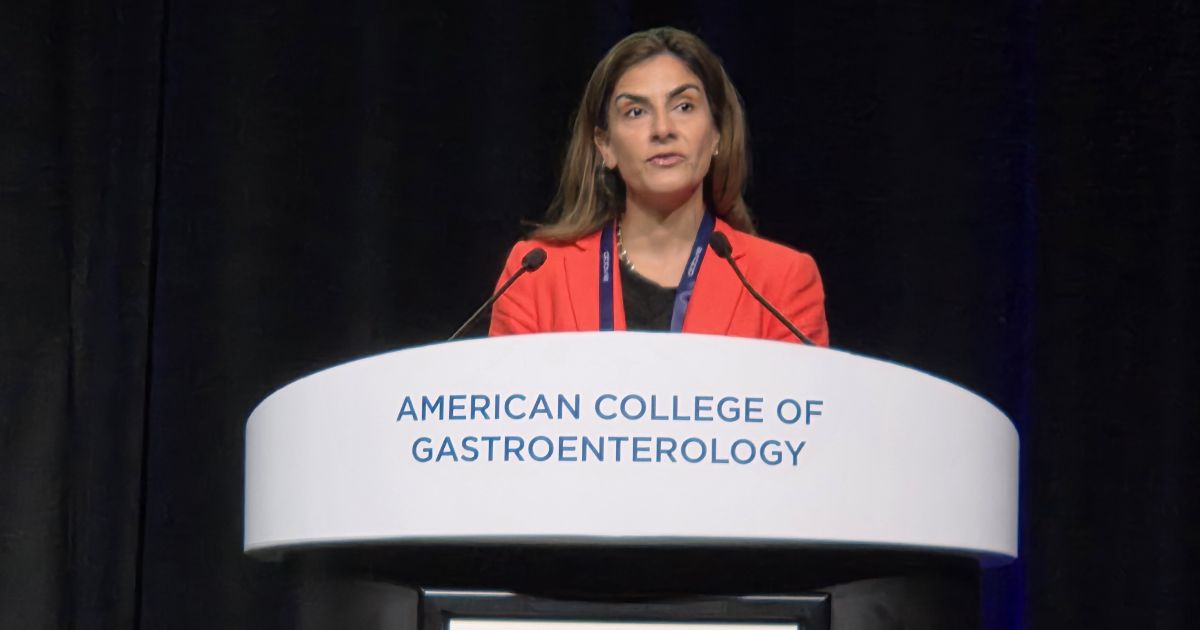
Aasma Shaukat, MD, MPH, FACG, speaks at the podium during ACG Annual Scientific Meeting. Photo: Octavia Feliciano.
“Our goal is to maximize the detection of advanced precancerous lesions and early-stage cancers, particularly stage I, and you can see that’s what these efforts are directed towards,” Aasma Shaukat, MD, MPH, FACG, Robert M. and Mary H. Glickman Professor of Medicine at NYU Grossman School of Medicine, told attendees. “Version one of SimpleScreen CRC is actually already [FDA] approved, but this effort was in response to the fact that we want to maximize sensitivity.”
Shaukat and colleagues applied assay and algorithm enhancements to the existing test and evaluated its performance using data from the prospective, multicenter PREEMPT CRC trial, which served as the validation study for the FDA’s approval of SimpleScreen CRC (Freenome).
The researchers used previously untested samples collected before and after the cutoff for the prior validation study in April 2021.
Final analysis included 9,001 average-risk adults (mean age, 59.9 years; 51.3% women; 76.3% white) with evaluable blood test results. Of those, 89 had CRC, 1,570 had advanced precancerous lesions and 7,342 did not have CRC or advanced precancerous lesions.
“Our coprimary endpoints were sensitivity for colorectal cancer, as well as sensitivity for advanced precursor lesions,” Shaukat said. “These were weighted and adjusted for U.S. census age and weight distribution.”
Sensitivity for high-grade dysplasia served as a secondary endpoint.
With a 90% specificity threshold, the original SimpleScreen CRC test had a sensitivity of 13.7% (95% CI, 12.4%-15%) for advanced precancerous lesions, whereas the updated test had a sensitivity of 18.2% (95% CI, 16.3%-20.4%).
The researchers noted sensitivity improved across all advanced precancerous lesion subtypes with the updated test compared with the original.
“Continued assay and algorithm improvements may further enhance CRC blood test performance, including performance and sensitivity for advanced precursor lesions and patients with high-grade dysplasia, further supporting blood-based testing as an important CRC screening modality,” Shaukat said.
The updated test achieved a sensitivity of 80.4% (95% CI, 70.2%-87.7%) for CRC overall, comparable with that of the original test (81.1%), as well as 52% sensitivity for stage I cancer, 100% for stage II, 97.3% for stage III and 100% for stage IV.
Sensitivity for lesions with high-grade dysplasia reached 41.9% (95% CI, 34%-50.3%) — an improvement of 11.5 percentage points over the original test.
A validated microsimulation model indicated the updated test could reduce both CRC incidence and mortality by 9.5%.
Shaukat noted that she and colleagues plan to submit the updated SimpleScreen CRC test to the FDA for approval.
“We have made some incremental gains,” she told attendees. “However, we can’t stop here, and I think as we learn, we’re going to [develop] version three and beyond to continue to improve the sensitivity for advanced lesions and stage one [cancers], where we truly think the benefit of prevention lies.”
Sources/Disclosures
Source:
Shaukat A, et al. Improved sensitivity for advanced precancerous lesions demonstrated in clinical validation of an updated colorectal cancer screening blood test in an average-risk population. Presented at: ACG Annual Scientific Meeting; Oct. 12-14; Nashville, Tenn. (hybrid meeting).
Disclosures:
Shaukat reports consulting roles with Freenome, Geneoscopy, Iterative Health and Universal Diagnostics. Please see the study for all other authors’ relevant financial disclosures.

Ask a clinical question and tap into Healio AI’s knowledge base.
- PubMed, enrolling/recruiting trials, guidelines
- Clinical Guidance, Healio CME, FDA news
- Healio’s exclusive daily news coverage of clinical data