October 21, 2026
3 min read

Key takeaways:
- Icotrokinra 400 mg improved clinical, symptomatic and endoscopic outcomes in UC at week 12.
- At week 76, 97% of patients in remission remained steroid-free, with favorable tolerability.
NASHVILLE, Tenn. — Investigational oral interleukin-23 inhibitor icotrokinra sustained efficacy and favorable tolerability through week 76 in patients with moderately to severely active ulcerative colitis, according to data presented here.
Findings from a long-term extension of the phase 2b ANTHEM-UC trial, presented at ACG Annual Scientific Meeting and simultaneously published in The New England Journal of Medicine, indicated that icotrokinra (Johnson & Johnson) — especially the 400 mg dose —bested placebo for clinical remission, symptomatic remission and endoscopic improvement as early as week 12.

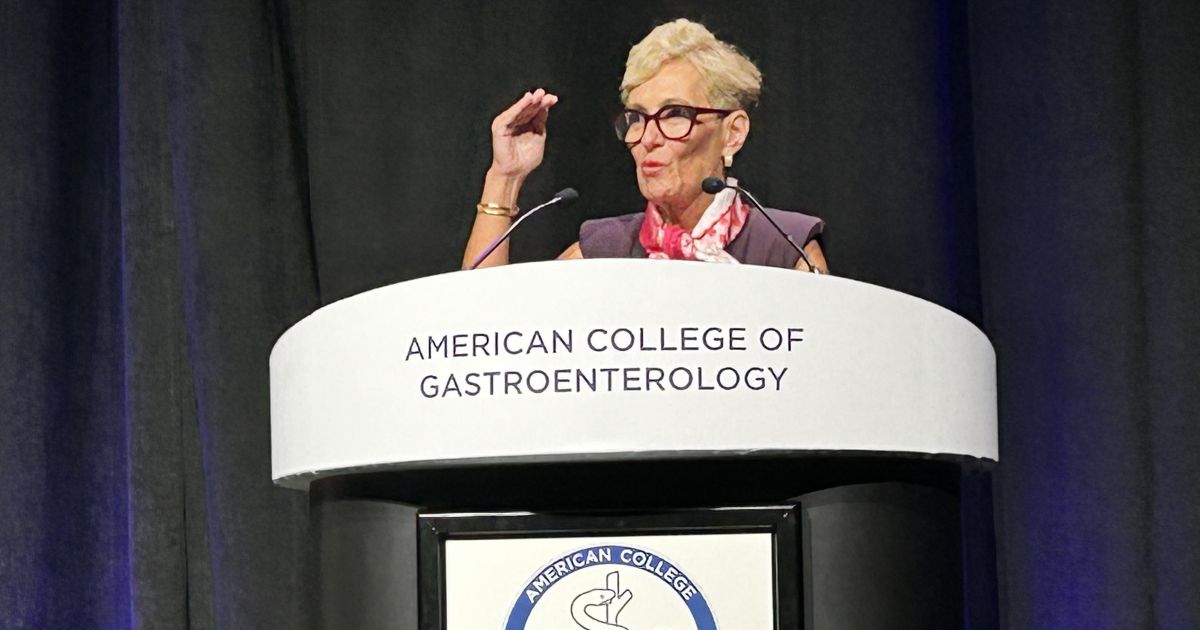
Maria T. Abreu, MD, speaks at the podium during ACG Annual Scientific Meeting. Photo: Robert Stott.
“Icotrokinra is a first-in-class oral peptide and, unlike the currently available IL-23 inhibitors, this actually inhibits the binding of IL-23 to the IL-23 receptor,” Maria T. Abreu, MD, executive director of the F. Widjaja Inflammatory Bowel Disease Institute at Cedars-Sinai Medical Center, told attendees. “Previously, the data from week 12 [showed icotrokinra] met all the endpoints for clinical response at the three doses that were tested, as well as a significant improvement in clinical remission — especially at the highest dose — as well as meaningful responses at week 12 and continued improved response at week 28.”
In the long-term extension for ANTHEM-UC, Abreu and colleagues enrolled patients with moderately to severely active UC who had a modified Mayo score of 5 to 9, a Mayo endoscopy subscore of at least 2, and prior inadequate response or intolerance to advanced therapies or conventional treatments, including corticosteroids, azathioprine or 6-mercaptopurine.
Patients were randomized 1:1:1:1 to once-daily oral icotrokinra at doses of 100, 200 or 400 mg or placebo, with stratification based on inadequate response or intolerance and baseline endoscopic severity (Mayo endoscopy subscore 2 vs. 3) to ensure balanced comparisons across subgroups.
At week 16, patients with an inadequate response underwent a blinded treatment adjustment: Placebo recipients were switched to icotrokinra 400 mg once daily, while icotrokinra recipients received a sham adjustment.
The researchers allowed patients who achieved clinical response at week 28 to continue their assigned study treatment in the long-term extension. Dose adjustments and initiation of 5-aminosalicylic acid, corticosteroids or immunomodulators were permitted. After week 28 analyses were completed, treatment was unblinded, and patients receiving placebo discontinued treatment.
Abreu and colleagues continued to assess clinical response, clinical remission and endoscopic improvement at week 76, with symptomatic remission evaluated at every visit.
According to study results, all three doses of icotrokinra outperformed placebo in achieving a clinical response at week 12. Response rates were 63% with the 400 mg dose, 58% with 200 mg, and 55% with 100 mg vs. 27% for placebo (P < .001 for all comparisons).
The 400 mg dose also delivered significantly higher rates of clinical remission than placebo (30% vs. 11%; P = .006), symptomatic remission (46% vs. 19%; P < .001) and endoscopic improvement (37% vs. 14%; P = .002). Clinical remission occurred in 24% of patients receiving 200 mg, but this did not reach statistical significance.
Through week 28, adverse event rates were similar across the treatment groups, ranging from 60% to 66%, compared with 62% for placebo. Serious adverse events were less frequent in all three icotrokinra groups: 2% with 400 mg, 5% with 200 mg, and none with 100 mg vs. 10% with placebo.
Among 136 patients with UC who entered the long-term extension, the majority achieved clinical response, clinical remission, and endoscopic improvement at week 76.
Notably, 97% of patients in clinical remission were still corticosteroid-free at week 76. Symptomatic remission, observed as early as week 4, was also sustained or improved through week 76.
“The rates of remission were quite high, about 60% overall, especially among patients not previously on any advanced therapies vs. 52% on those who had previous advanced therapy experience,” Abreu told Healio. “And these patients were also off steroids for all intents and purposes by the end of 76 weeks.”
Abreu noted that findings from the long-term extension highlight the potential of icotrokinra as a once-daily oral treatment option for UC, with efficacy and safety being evaluated in ongoing phase 3 trials.
“What’s really nice about this is that for the first time we’re going to have an oral medication that patients can start taking once a day and get them on the road to recovery pretty early,” Abreu told Healio. “Many of our patients are still reluctant to go on advanced therapies, especially if they’re injectables or infusions. I imagine that this is going to be an easier sell.”
For more information:
Maria T. Abreu, MD, can be reached at gastroenterology@healio.com.
Sources/Disclosures
Source:
Abreu MT, et al. Long-term efficacy and safety of icotrokinra, a first-in-class targeted oral peptide that precisely blocks the IL-23 receptor, in ulcerative colitis: Results from the ANTHEM-UC long-term extension. Presented at: ACG Annual Scientific Meeting; Oct 12-14, 2026; Nashville, Tenn. (hybrid meeting).
Reference:
Disclosures:
Abreu reports consulting relationships with AbbVie, Alimentiv, Bristol Myers Squibb, Eli Lilly & Co., Genentech, Johnson & Johnson and Pfizer. Please see the study for all other authors’ relevant financial disclosures.

Ask a clinical question and tap into Healio AI’s knowledge base.
- PubMed, enrolling/recruiting trials, guidelines
- Clinical Guidance, Healio CME, FDA news
- Healio’s exclusive daily news coverage of clinical data