October 22, 2026
4 min read

Key takeaways:
- Adults ages 45-49 years are less likely to have discussed colorectal cancer screening with a healthcare professional than older adults.
- Communication about different screening options also lags in this group.
Clinician counseling may be inadequate for younger adults newly eligible for colorectal cancer screening, according to study findings presented at this year’s AACR Conference on The Science of Cancer Health Disparities.
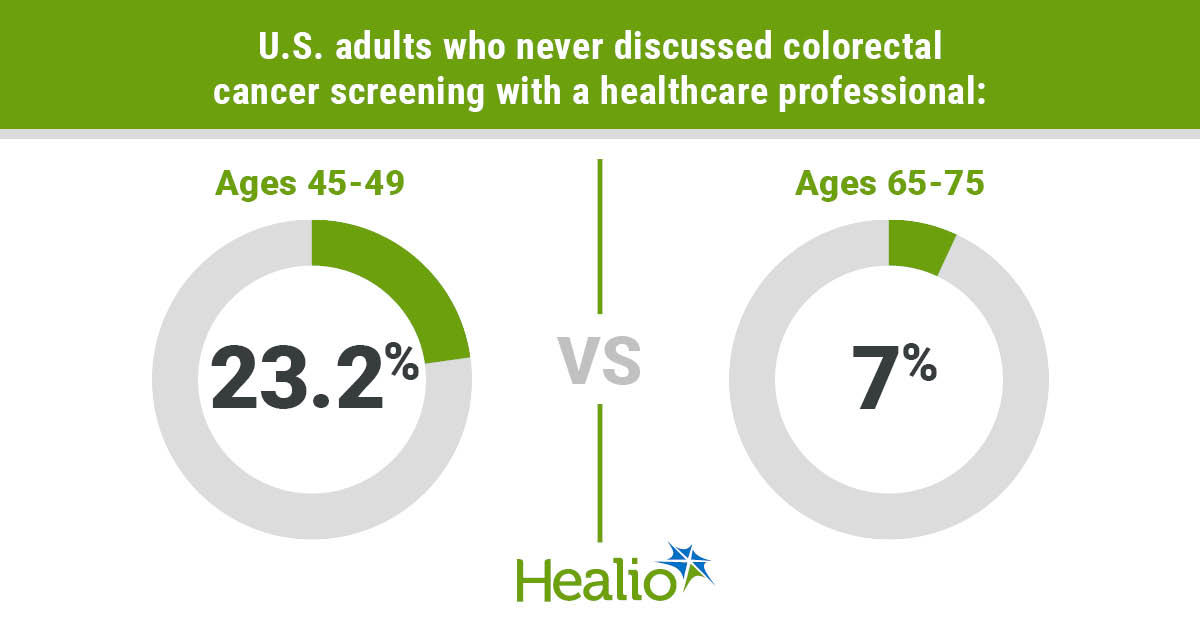
A survey of screening-eligible individuals in the U.S. showed those aged 45 to 49 years were approximately three times more likely than older adults to report that they have never discussed colorectal cancer screening tests with a healthcare professional.

Data derived from Baeker Bispo J, et al. Age-related differences in clinician communication about colorectal cancer screening in the US. Presented at: AACR Conference on The Science of Cancer Health Disparities; Oct. 18-21, 2026; Atlanta.
In addition, a considerably lower percentage of younger adults reported that a clinician had spoken with them about the multiple screening modalities available, including alternatives to colonoscopy.
“We expected there would be differences by age, but the magnitude of those differences was quite large,” lead author Jordan Baeker Bispo, PhD, MPH, principal scientist of cancer disparity research at American Cancer Society, told Healio. “The high proportion of adults in the younger age group who reported they had never discussed colorectal cancer screening tests with their healthcare professional certainly was alarming, and it should be a wake-up call given the increasing burden of early-onset colorectal cancer.”
‘One piece to this puzzle’
Approximately 10% to 12% of colorectal cancers in the U.S. are classified as early onset, meaning they occur among individuals aged younger than 50 years.
Incidence of early-onset colorectal cancer rose by 2.9% per year from 2013 to 2022, according to American Cancer Society statistics, a stark contrast to the approximate 1% annual decline in new diagnoses overall. Meanwhile, the mortality rate is increasing among people aged younger than 65 years.
The U.S. Preventive Services Task Force updated its colorectal cancer screening guidance in 2021, lowering the age at which average-risk adults are recommended to begin screening from 50 to 45 years. However, only about 37% of adults ages 45 to 49 are up-to-date with colorectal cancer screening, Baeker Bispo said.
“There has been a lot of interest in screening in that younger age group as a way to offset the burden of early-onset colorectal cancer, but uptake has been slow,” she said. “Part of that is expected because there is lag time between guideline updates, dissemination of the changes to clinicians and integration into clinical care. However, we wanted to understand to what extent adults in that age group are getting information about colorectal cancer screening because that might be one piece to this puzzle.”
Communication ‘essential’
Baeker Bispo and colleagues examined data from the 2024 Health Information National Trends Survey (HINTS), a nationally representative survey that assesses the public’s knowledge of and attitudes toward cancer and other health topics.
The survey included this question: “Has a doctor or other health professional ever told you there are a few different tests to detect colorectal cancer?” Response options included “Yes,” “No” or “I have never discussed these tests with a doctor or other health professional.”
The researchers analyzed responses from 3,626 colorectal cancer screening-eligible adults aged 45 to 75 years with no history of the disease.
Respondents aged 45 to 49 appeared more than three times as likely as those aged 65 to 75 to report never having discussed colorectal cancer screening with a clinician (23.2% vs. 7%; adjusted prevalence ratio [aPR] = 2.71; 95% CI, 1.64-4.46).
A significantly lower percentage of respondents in the younger vs. older age group reported that a clinician had told them about different colorectal screening tests (50.3% vs. 72.5%; aPR = 0.73; 95% CI, 0.63-0.85).
Because the survey asked respondents if they “ever” had been told about different screening tests, older individuals understandably would have had more opportunities to discuss the topic with healthcare professionals, Baeker Bispo said.
However, the gaps in the younger age group are concerning for multiple reasons.
“A doctor’s recommendation is one of the strongest determinants of a patient’s decision to get screened, so making sure healthcare professionals are talking with their patients about it is essential,” Baeker Bispo said. “Discussions about different screening options is an important piece, too, given people have different preferences. A person averse to colonoscopy who is not aware of other modalities may not get screened. We want to be sure that they are aware of the options that are available so they can choose the test that works for them.”
Age-stratified analyses showed non-Hispanic Black individuals aged 45 to 49 years were significantly less likely than non-Hispanic white individuals in the same age group to report receiving information about different screening options from a healthcare professional (33.2% vs. 60.7%; aPR = 0.58; 95% CI, 0.37-0.91).
Differences by race or ethnicity did not reach statistical significance in older age groups, a finding Baeker Bispo said may indicate race-associated barriers to screening or other aspects of healthcare access become less pronounced as patients age and become eligible for Medicare.
A patient-centered approach
The researchers acknowledged study limitations, such as the small sample size and use of self-reported survey data.
However, the findings highlight “a major opportunity” to improve screening uptake in this age group, Baeker Bispo said.
Strategies at the clinician and practice levels may help, she said.
For example, automated prompts that appear in the electronic health record during clinical encounters could ensure screening recommendations are delivered in a more routine — and equitable — manner. Health systems could consider direct patient outreach, such as mailing fecal immunohistochemistry tests to people who may be less engaged in regular preventive care.
Clinician education and empowerment may also yield a major benefit, Baeker Bispo said.
“There certainly is room to enhance clinician education about the screening guidelines and the evidence related to the pros and cons of alternative modalities,” she said. “This can help ensure they are delivering patient-centered care and shared decision-making that incorporates their preferences.”
For more information:
Jordan Baeker Bispo, PhD, MPH, can be reached at jordan.baeker@cancer.org.
Sources/Disclosures
Source:
Baeker Bispo J, et al. Age-related differences in clinician communication about colorectal cancer screening in the US. Presented at: AACR Conference on The Science of Cancer Health Disparities; Oct. 18-21, 2026; Atlanta.
References:
Disclosures:
Baeker Bispo reports no relevant financial disclosures. Please see the study for all other authors’ relevant financial disclosures. American Cancer Society funded the study.

Ask a clinical question and tap into Healio AI’s knowledge base.
- PubMed, enrolling/recruiting trials, guidelines
- Clinical Guidance, Healio CME, FDA news
- Healio’s exclusive daily news coverage of clinical data