October 22, 2026
3 min read

Key takeaways:
- Tezepelumab outperformed placebo in histologic and endoscopic outcomes at weeks 24 and 52.
- Improvement in dysphagia symptoms also was higher through week 52 in the treatment group.
NASHVILLE, Tenn. — Tezepelumab significantly improved histologic remission and dysphagia symptoms at 24 and 52 weeks compared with placebo among individuals with eosinophilic esophagitis, according to a presenter.
Thymic stromal lymphopoietin (TSLP), an antibody, is associated with EoE pathogenesis.

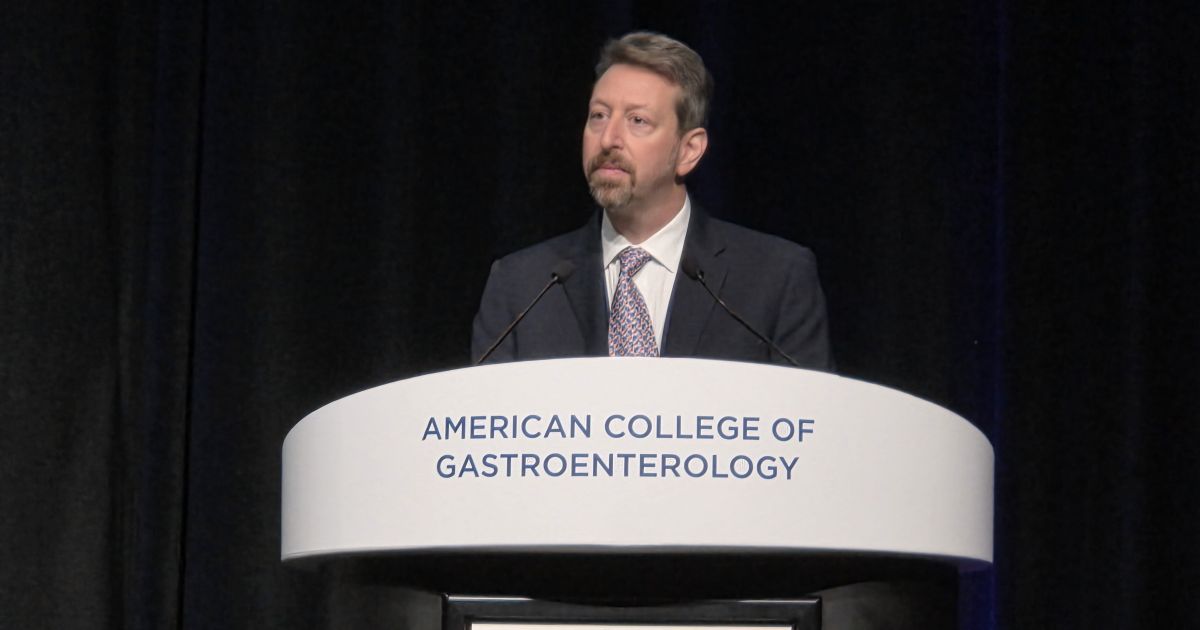
Evan S. Dellon, MD, MPH, FACG, discusses study results at ACG Annual Scientific Meeting. Photo by: Octavia Feliciano.
“Food allergens and environmental factors interact with the epithelium of the esophagus and release alarmins, of which TSLP is one,” Evan S. Dellon, MD, MPH, FACG, director of the Center for Esophageal Diseases and Swallowing at University of North Carolina at Chapel Hill, told attendees at ACG Annual Scientific Meeting. “TSLP then polarizes T cells and other new cells to start the typical T2 inflammatory cascade with cytokines like [interleukin]-4 and IL-13, that ultimately lead to the downstream effector cells that cause the clinical manifestations and esophageal changes.
“Elevated expression of TSLP has been observed in patients with EoE,” Dellon added. “Tezepelumab is a human monoclonal antibody that blocks the activity of TSLP and is approved for treatment of asthma and chronic rhinosinusitis with nasal polyposis, but it’s never been studied for EoE.”
Dellon and colleagues enrolled 365 individuals aged 12 to 80 years (mean age, 35.3 years; 68.8% male) with symptomatic and histologically active EoE in a multicenter, randomized, double-blind, placebo-controlled phase 3 study to evaluate efficacy and safety of tezepelumab (Tezspire; AstraZeneca, Amgen) in this patient population.
All participants had documentation of previous standard of care therapy.
“This was a highly inflamed group,” Dellon said. “They were highly symptomatic by the [Dysphagia Symptom Questionnaire], and they had high degrees of endoscopic and histologic severity.”
The researchers randomly assigned patients to receive placebo (n = 121) or tezepelumab 210 mg (n = 122) or 420 mg (n = 122) subcutaneously every 4 weeks for 52 weeks.
Histologic remission and change from baseline in Dysphagia Symptom Questionnaire (DSQ) score at week 24 served as primary endpoints, while change from baseline in EoE Endoscopic Reference Score (EREFS) at week 24 was a key secondary endpoint.
Prior treatments and baseline characteristics were balanced between groups, with DSQ scores ranging from 37.2 to 37.9, and EREFS from 7.5 to 7.6.
Tezepelumab outperformed placebo at week 24, with more patients achieving histologic remission in the 210 mg (64.8% vs 3.5%; difference = 60.5; 95% CI, 51.1-69.8) and 420 mg groups (68.9% vs 3.5%; difference = 65.8; 95% CI, 56.8-74.7).
Results were sustained through week 52 (tezepelumab 210 mg: 67.8% vs. 5.4%; tezepelumab 420 mg: 63.3% vs. 5.4%).
Tezepelumab also improved dysphagia symptoms compared with placebo at week 24, with a difference of –4.1 (95% CI, –8.12 to 0) in the 210 mg group and –7.3 (95% CI, –11.3 to –3.3) in the 420 mg group. These results were sustained through week 52 (210 mg: difference, –8.9; 420 mg: difference, –10.8).
“There was a significant, statistically and clinically meaningful improvement in dysphagia symptoms for both doses compared to the placebo,” Dellon said. “And as we continue on through the 52-week double-blind phase, there is ongoing improvement in symptoms.”
Tezepelumab significantly improved EREFS compared with placebo at week 24, as well, with differences of –3.4 (95% CI, –4 to –2.7) in the 210 mg group and –3.4 (95% CI, –4.1 to –2.8) in the 420 mg group.
Data presented the following week at United European Gastroenterology Week showed that these benefits were sustained through week 52.
Tezepelumab also appeared well tolerated, with similar incidences of adverse events between treatment and placebo groups.
“Tezepelumab provides clinical benefit in adults and adolescents with active EoE,” Dellon told attendees. “Specifically, the CROSSING trial met both coprimary endpoints, with tezepelumab every 4 weeks demonstrating statistically significant and clinically meaningful improvements in histologic remission and dysphagia symptom scores vs. placebo at weeks 24 and 52.”
Sources/Disclosures
Source:
Dellon ES, et al. Efficacy and safety of tezepelumab in adults and adolescents with eosinophilic esophagitis: Results from the phase 3 CROSSING study. Presented at: ACG Annual Scientific Meeting; Oct. 12-14; Nashville, Tenn. (hybrid meeting).
Reference:
Disclosures:
Dellon reports consulting roles with and/or research support from AbbVie, Adare Pharma Solutions, Alfasigma, Alimentiv, ALK, Allakos, Amgen, AnaptysBio, Apogee Therapeutics, Apollo, Aqilion, Arena Pharmaceuticals, AstraZeneca, Bethanamist, BioCryst, Bristol Myers Squibb, Bryn, Calypso, Calyx, Celgene, Celldex, Cyted, Domain, Dr. Falk Pharma, Eli Lilly & Co., Ellodi Pharmaceuticals, EsoCap Biotech, Eupraxia, Ferring Pharmaceuticals, First Tracks Biotherapeutics, GI Reviewers, GSK, Holoclara, Immunology Uniquity, Johnson & Johnson, Knightpoint, Kymera, Lucid Diagnostics, Meritage, Miraca Life Sciences, NexStone Innovation, Noa, Nutricia, Parexel, Pfizer, Phathom Pharmaceuticals, Receptos, Regeneron Pharmaceuticals, Revolo, Robarts, Roivant, Sanofi Pharmaceuticals, Shire, Takeda Pharmaceuticals, Target RWE, Third Harmonic Bio and Uniquity Bio. He also reports educational grants from Allakos, Aqilion, Holoclara and Invea. Please see the study for all other authors’ relevant financial disclosures.

Ask a clinical question and tap into Healio AI’s knowledge base.
- PubMed, enrolling/recruiting trials, guidelines
- Clinical Guidance, Healio CME, FDA news
- Healio’s exclusive daily news coverage of clinical data