October 23, 2026
2 min read

Key takeaways:
- Rates of clinical remission and endoscopic response and remission were higher with subcutaneous vs. IV infliximab in ileal-dominant CD.
- Additional prospective studies could confirm results.
NASHVILLE, Tenn. — Patients with ileal Crohn’s disease had significantly better clinical and endoscopic outcomes at week 54 with subcutaneous vs. IV infliximab therapy, according to a presenter at ACG Annual Scientific Meeting.
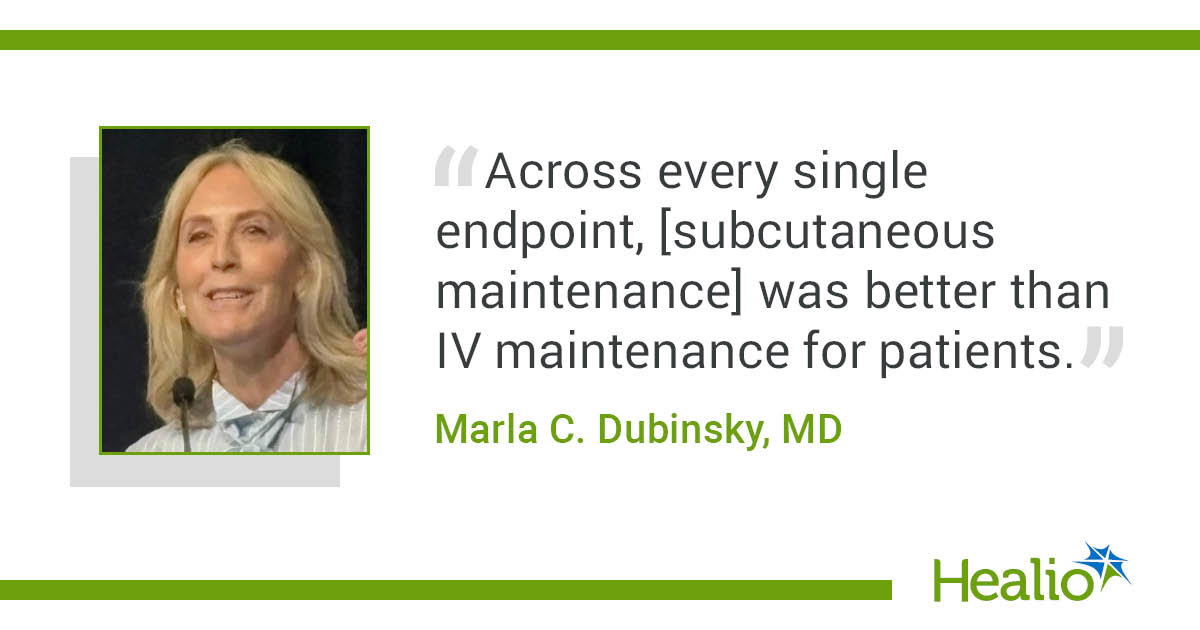
“Across every single endpoint, [subcutaneous maintenance] was better than IV maintenance for patients,” Marla C. Dubinsky, MD, codirector of the Susan and Leonard Feinstein Inflammatory Bowel Disease Clinical Center at Icahn School of Medicine, told attendees.

Dubinsky emphasized the difficulties clinicians face when treating the ileal CD phenotype. Although surgical rates have decreased among patients with other types of inflammatory bowel disease — like ulcerative colitis — surgical rates for patients with ileal CD have yet to “catch up,” she said.
“This is a very difficult-to-treat population, particularly [patients with] isolated ileal disease, just because of the [disease’s] fibrotic nature,” Dubinsky said. “We are typically operating.”
Dubinsky and colleagues compared the efficacy of subcutaneous infliximab (Zymfentra, Celltrion) and IV infliximab (Remicade; Janssen, Johnson & Johnson) to determine whether patients with ileal CD “may preferentially respond better to one type of infliximab delivery over the other.”
They collected data from four registrational trials for both subcutaneous and IV infliximab.
A total of 200 patients across the trials met inclusion criteria, which included ileal or ileocolonic disease and treatment with IV infliximab 5 mg/kg every 8 weeks (n = 104) or subcutaneous infliximab at 120 mg every 2 weeks (n = 96).
The pooled dataset was generally balanced by demographics and disease characteristics, although more patients treated with IV infliximab received immunomodulators at baseline (54.8% vs. 33.3%).
The dataset remained well balanced after 1:1 propensity-score matching (total, n = 140).
Dubinsky and colleagues assessed clinical remission and endoscopic response and remission in both unmatched and matched populations.
Week 54 data showed patients in the unmatched population who received subcutaneous infliximab achieved significantly higher rates of clinical remission (76% vs. 55.8%, P = .003), endoscopic response (66.7% vs. 32.7%, P < .001) and endoscopic remission (41.7% vs. 18.3%, P < .001) than those who received IV infliximab.
Outcomes were similar in the matched population, with subcutaneous infliximab achieving higher rates of clinical remission (71.4% vs. 51.4%, P = .023), endoscopic response (65.7% vs. 27.1%, P < .001) and endoscopic remission (41.4% vs. 17.1%, P = .003).
Subgroup analysis of patients with ileal disease in the matched population showed subcutaneous infliximab outperformed IV infliximab in endoscopic response (52.2% vs. 18.2%, P = .029) and endoscopic remission (47.8% vs. 18.2%, P = .057). Rates of clinical remission also were higher with subcutaneous delivery, but did not meet statistical significance.
Serum concentrations of infliximab were significantly higher among endoscopic responders than nonresponders with both subcutaneous and IV delivery.
“This requires a lot more exploration and bigger [study populations],” Dubinsky said. “It was nice to see that we may have something that may have improved efficacy in isolated ileal disease when it comes to endoscopy, which is our most objective endpoint.”
Additional prospective studies are needed to validate these results, the researchers noted.
“As we think about how to position therapies, we need to think about phenotypes that may drive which treatment you should choose first or second based on [patients’] disease characteristics,” Dubinsky told attendees.
Sources/Disclosures
Source:
Colombel J, et al. Comparative efficacy of subcutaneous vs intravenous infliximab in Crohn’s disease with ileal involvement: A pooled analysis and propensity score-matched analysis of infliximab registrational studies. Presented at: ACG Annual Scientific Meeting; Oct. 12-14, 2026; Nashville, Tenn. (hybrid meeting).
Disclosures:
Dubinsky reports advisory or consulting roles with AbbVie, Abivax, Amgen, AstraZeneca, Boehringer Ingelheim, Bristol Myers Squibb, Celltrion, Eli Lilly & Co, Genentech, Janssen, Johnson & Johnson, Merck, Novartis, Pfizer, Prometheus Labs, Sanofi, Spyre Therapeutics, Takeda Pharmaceuticals and Tentarix Biotherapeutics. Please see the study for all other authors’ relevant financial disclosures.

Ask a clinical question and tap into Healio AI’s knowledge base.
- PubMed, enrolling/recruiting trials, guidelines
- Clinical Guidance, Healio CME, FDA news
- Healio’s exclusive daily news coverage of clinical data