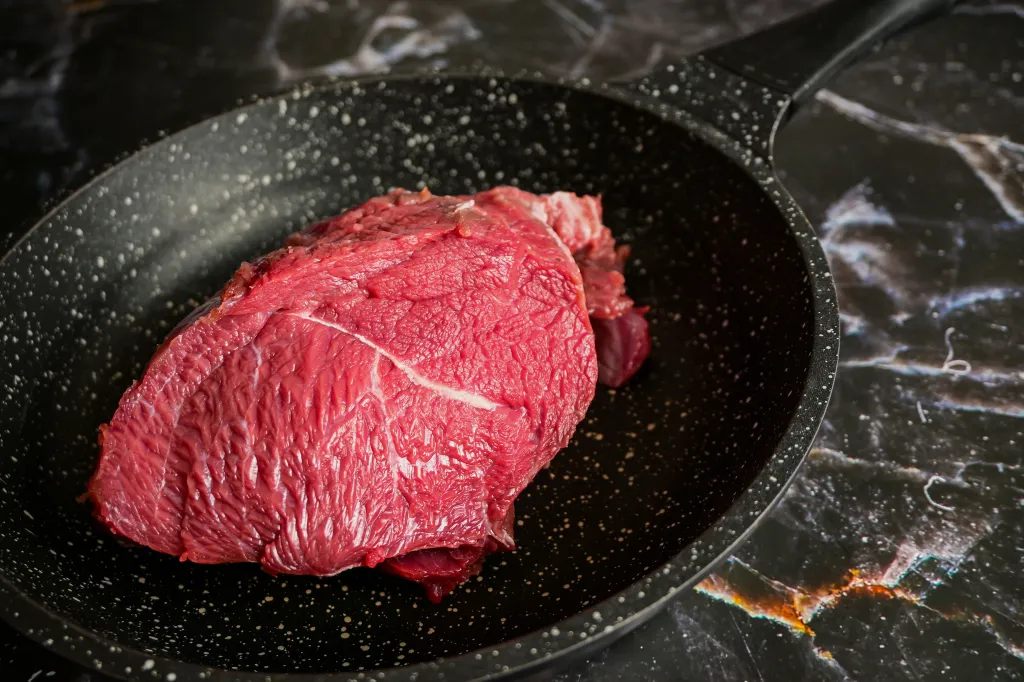
A sugar in red meat? That’s probably not what comes to mind when you think about steak. But preliminary research linked a little-known sugar called Neu5Gc to a 63% higher risk of type 2 diabetes.
In the observational study, presented at the European Association for the Study of Diabetes meeting in Milan and covered by ScienceDaily on Oct. 18, researchers tracked the diets and health of nearly 90,000 French adults for about seven years.
What Is Neu5Gc?
Neu5Gc stands for N-glycolylneuraminic acid, a sugar molecule most mammals (except for humans) naturally produce. An ancient mutation in the CMAH gene left us unable to make it ourselves, but we can still absorb it when we eat foods from animals that do. That includes beef and lamb, which are particularly rich sources, as well as dairy products, which contain smaller amounts.

Related story
Octavia Spencer Found Out She Had Type 2 Diabetes at a Routine Physical in Her 30s, and Here’s What She Changed
For this study, researchers looked at Neu5Gc from meat and dairy separately to see whether its source made a difference in diabetes risk.
What Did the Study Find?
The researchers analyzed data from 89,953 adults in NutriNet-Santé, a French study that follows people’s diets, lifestyles, and health over time. Participants were 42 years old on average, and 79% were women. None had type 2 diabetes or cancer when they joined, but over a median follow-up of 7.2 years, 966 developed type 2 diabetes.
Researchers divided participants into five groups based on how much Neu5Gc they got from meat. Compared with those consuming the least, the highest group had a 63% higher diabetes risk, and the second-highest had a 41% higher risk. Neither middle group showed a statistically significant increase.
That doesn’t mean 63% of people in the highest group developed diabetes. Their risk was higher compared with people consuming the least.
How much red meat does that translate to on a plate? The median daily amounts were:
- Men in the highest group: 97 grams (3.4 ounces), or 136 grams (4.8 ounces) including processed meat.
- Women in the highest group: 73 grams (2.6 ounces), or 96 grams (3.4 ounces) including processed meat.
- People in the lowest group: Men ate 5 grams (0.2 ounces); women ate none.
These were typical amounts within each group, not a guide to how much red meat someone can eat without increasing their risk.
The findings were also different for dairy. Getting more Neu5Gc from dairy products wasn’t associated with higher diabetes risk, possibly because cow’s milk contains much less of the sugar. Across all sources, the highest group had 37% higher risk, mainly driven by meat.
“Our findings support chronic inflammation as a specific mechanism linking red meat consumption with T2D, partly beyond the amount of red meat a person eats and partly independent of body fat,” lead author Dr. Leopold Fezeu of Université Sorbonne Paris Nord said in the study release.
How Was Intake Measured?
Participants recorded everything they ate and drank over three separate 24-hour periods. Researchers used a validated food database to estimate daily Neu5Gc from meat versus dairy. Red meat included beef, lamb, pork, rabbit, goat, and game. They tracked processed meats, such as bacon, sausages, and cured meats, separately.
What Could Explain the Link?
Neu5Gc can become part of our tissues, but our immune system may still recognize it as foreign. Dr. Hana Kahleova, director of clinical research at the Physicians Committee for Responsible Medicine, compares the proposed response to a smoke alarm that keeps going off.
“One false alarm does no harm. When it beeps meal after meal, year after year, the body lives in a state of low-grade alert,” she tells SheKnows. “Researchers call this xenosialitis: inflammation triggered by a foreign sugar sitting in our own tissues.”
Researchers have linked this response to heart disease and cancer. They suspect it could also make the body less responsive to insulin and put extra stress on the cells that produce it, but that explanation is still a hypothesis.
“We have not yet shown in people that Neu5Gc inflames the pancreas or other insulin-sensitive tissues directly,” says Dr. Kahleova.
Other factors could contribute, too:
- Age, sex, activity, diet, smoking, and existing conditions didn’t fully explain the link. Accounting for body mass index (BMI) weakened the association, though it remained statistically significant.
- Developing obesity explained an estimated 13% of the association.
Would swapping beef or lamb for poultry or plant proteins help? This study didn’t test that. Researchers plan to measure anti-Neu5Gc antibodies and examine interactions with heme iron, a form of iron in meat.
There’s no peer-reviewed paper yet; the authors say their estimates could change, and researchers don’t know how much Neu5Gc it takes to trigger an immune response. Until the full study is published and other researchers can weigh in, these findings are best seen as a reason to keep watching the research, not a reason to panic.
If you’re worried about your own diabetes risk or how much red meat you eat, talk with your doctor or a registered dietitian.