October 30, 2026
3 min read
Key takeaways:
- The healthcare industry contributes approximately 10% of greenhouses gases produced annually in the U.S.
- Making changes to supply chain procurement is an efficient way to reduce environmental impact.
Dermatology clinics contribute to climate change, but targeting supply chain practices can decrease their environmental impact, according to a study published in the International Journal of Dermatology.

Eva Rawlings Parker
“A substantial amount of evidence indicates that climate change and pollution broadly harm health and specifically play a role in many skin diseases, often disproportionately affecting our most vulnerable and marginalized patients,” Eva Rawlings Parker, MD, DTMH, FAAD, assistant professor of dermatology at Vanderbilt University Medical Center, told Healio. “Healthcare is a notable part of that problem, generating approximately 10% of greenhouses gases produced annually in the U.S.”

Of healthcare-related greenhouse gas emissions, more than half come from upstream and downstream sources, with approximately up to 80% originating from supply chains, the researchers reported. To identify intervention targets, the researchers analyzed procurement across one academic practice and one private practice in the Mid-Atlantic U.S. during the fall of 2025.
Academic vs. private clinics
Both the academic clinic and private practice had high restocking frequencies and volume but in different areas. The academic practice restocked a greater number of units per year in dressings, miscellaneous supplies, procedures, chemicals/solutions, personal protective equipment and pharmaceuticals. However, the private practice more frequently restocked linens.
Results showed that, in the academic practice, injectable pharmaceutical supplies had the highest annual restocking frequency, averaging 33 times a year, with approximately 75,000 mL purchased per year. Restocking volume was highest for dressings/wound care at 80 units per year, procedures at 63 units per year and chemicals/solutions at 54 units per year.
In the private practice, the most frequently restocked items were miscellaneous supplies (19 times per year) followed by procedural materials (17 times per year) and dressings/wound care (12 times per year). However, the materials that were scored the highest in average volume restocked per year were linens at 82 units, dressings/wound care at 22 units, personal protective equipment at 19 units and miscellaneous supplies at 19 units. Approximately 17,000 mL of pharmaceuticals were purchased annually in private practices.
Pursuing ‘resource stewardship’
The greatest discrepancies between the academic and private practices’ restocking patterns were in pharmaceuticals and linens, with the academic clinic restocking four times the number of medications than that of the private practice, and the private practice restocking 40-times the quantity of linens than the academic clinic, according to the study.
“This is not to say that this is a trend that persists across all private and all academic settings,” Genevieve S. Silva, MD, MBA, a dermatology resident at the University of Colorado Anschutz, told Healio. “But what was interesting is that we could see that when the two practices differed in a procurement trend or frequency of purchasing a specific product, we could trace that back to a specific policy or practice within the clinic that related to environmental sustainability and resource stewardship.”
Based on these findings, the researchers recommended several interventions to promote environmental stability:
- customize vendor-compiled kits to remove items that are consistently thrown out or customize kits in-house that only include items to be used for each case;
- convert to majority launderable patient gowns and drapes;
- utilize multi-use lidocaine and triamcinolone vials, disinfect vial surfaces with alcohol wipes and use sterile needles for each patient; and
- employ a multifactorial grading system for vendor selection that includes environmental sustainability performance metrics along with cost.
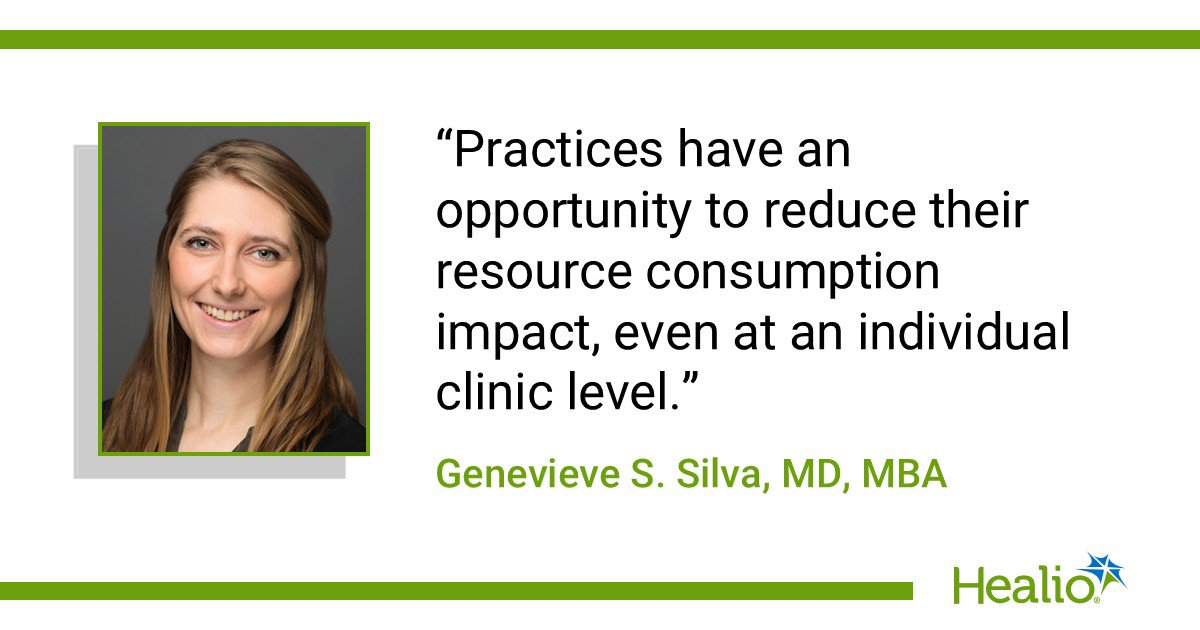
“Practices have an opportunity to reduce their resource consumption impact, even at an individual clinic level, and also on a broader practice group or health system level just by taking a look at certain policies that underlie their supply utilization practices,” Silva told Healio. “Whether it is switching to a reusable linen supplier or using multi-use vials, these are levers that can be pulled in certain settings to reduce environmental impact.”
For more information:
Eva Rawlings Parker, MD, DTMH, FAAD, can be reached at eva.r.parker@vumc.org or on Instagram @DrEvaParker.
Genevieve S. Silva, MD, MBA, can be reached at genevieve.silva@alumni.upenn.edu.
Perspective

We increasingly see how air pollution and climate change affect our patients’ skin, so it matters that we understand our own practices’ contribution through what we purchase. This study shows that informed purchasing, such as multi-dose vials where appropriate, reusable textiles and vendor sustainability scoring, are among the most accessible ways for dermatology providers to reduce that impact without compromising patient care.
Hannah Rodriguez, MPAS, PA-C
Disclosures: Rodriguez reports financial relationships with AbbVie and Novartis.

Ask a clinical question and tap into Healio AI’s knowledge base.
- PubMed, enrolling/recruiting trials, guidelines
- Clinical Guidance, Healio CME, FDA news
- Healio’s exclusive daily news coverage of clinical data