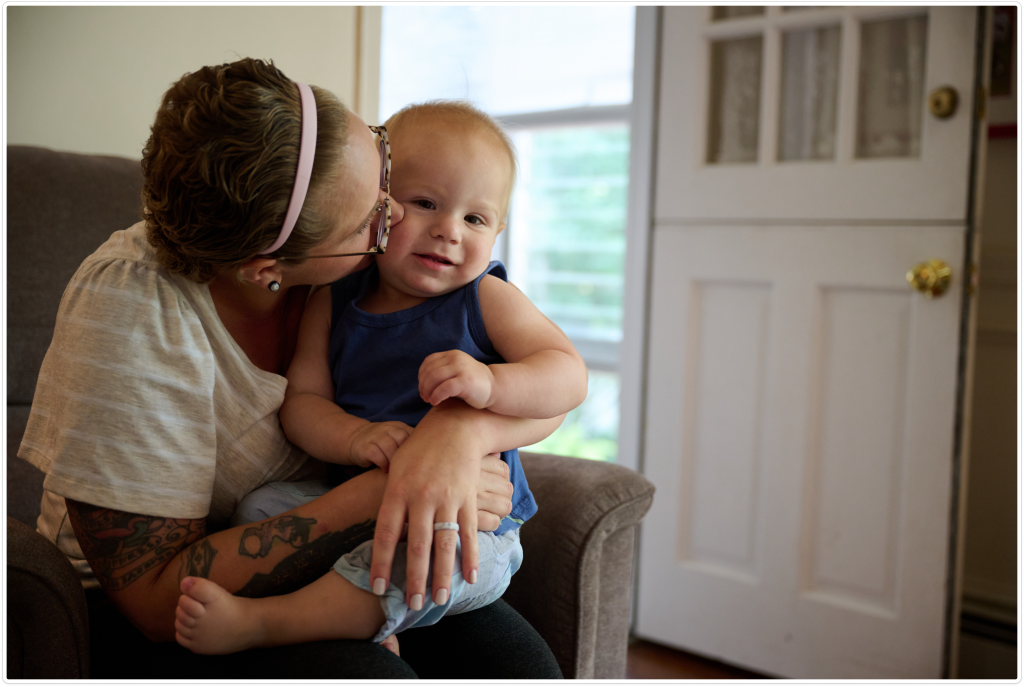
Dana Sherer says the lump appeared almost overnight. Hard to the touch, painful, and about the size of a kiwi — big enough to hold in her hand.
As a breastfeeding mom, it’s not unusual to notice changes in your breast, but this wasn’t Sherer’s first rodeo. She’d given birth to her first son, Dallas, 28 months before her second, Hudson, and she could tell something was different. “I don’t think this is, like, a clogged duct,” Sherer, now 40, remembers thinking. “I just had this weird feeling.”

Related story
Olivia Munn Is Pushing to Make Breast Cancer Risk Assessments Part of Your Next Checkup
It was January 2025. Just two weeks postpartum from giving birth to Hudson, Sherer started to press her doctors for answers. Her OB/GYN referred her to Dr. Ashley Newman, a breast surgeon at Penn Medicine Princeton Health — and, Sherer says, “all of life changed from that point on.”
“This is cancer”
During their first appointment, it didn’t take long for Newman to get an idea of what was going on. “When we did her exam, I just remember thinking, like, this is cancer,” she recalls.
Dr. Ashley Newman
Courtesy of Penn Medicine
That’s not always the case, she emphasizes, especially for women who come in right after having a baby. With Sherer, though, it was “so clear”: the lump had been there since she’d given birth, and it hadn’t gotten smaller. It felt different from the other breast, and it didn’t change when she breastfed. “Her intuition made me more suspicious immediately, because I knew this was somebody who recognized a change in their own body,” Newman says. “And when women come in saying they think there’s something wrong, I always believe them.”
How do we prove this?
Newman’s next thought: how was she going to prove what her intuition was sensing? The standard procedures for investigating a breast lump become “really, really challenging” during the immediate postpartum period, she explains. But the immediate trust and rapport Newman and Sherer built from that first appointment was something both could lean on in the coming months. Sherer says, “I knew, the moment I met her, I was in good hands.”
Dr. Newman and Dana sharing a heartfelt moment.
Courtesy of Penn Medicine
They started with an MRI that was “horrible to interpret,” Newman remembers, due to postpartum hormones. Typically, MRIs are done at a specific point in the menstrual cycle when the level of hormonal “background noise” inherently present in the breast is at a low point. That wasn’t possible during Sherer’s postpartum period, but with the difficult interpretation, the tumor area stood out.
After a targeted ultrasound and a biopsy of the area, Sherer’s preliminary diagnosis was ductal carcinoma in situ (DCIS), but Newman felt right away that this was “the tip of the iceberg.” DCIS, she explains, is “essentially pre-invasive cancer trapped in the milk ducts. It can’t go anywhere.” It’s not an invasive cancer (though it can progress to that stage), but based on Sherer’s exam — how “huge” the lump felt — Newman thought they were dealing with something more. She just couldn’t prove it based on the imaging and biopsy alone.
She knew a mastectomy was the best way forward, but it wasn’t the news she wanted to give Sherer, with whom she already felt a deep bond. “Nobody wants to put a woman who is less than a month out from having a baby through surgery of any kind,” Newman says. The conversation with Sherer was “one of the hardest conversations I’ve ever had with a patient,” she adds, because she knew how important breastfeeding was to Sherer.
“I loved it,” Sherer agrees. “I was obsessed with breastfeeding… I think I was more devastated about [stopping breastfeeding] than the cancer.”
And yet, Newman says, “I really, really felt strongly [that a mastectomy] was going to save your life.”
For Sherer, it meant starting to go through the phases of grief. She was in denial at first, she says — none of it felt real until she went in for that surgery. Then she was angry, and mourning the “beautiful experience” of breastfeeding that she wouldn’t get to have any longer.
Dana with her newborn son.
Courtesy of Dana Sherer
At this point, she says, she was leaning on her tools: yoga, Reiki, practicing gratitude. “Being happy for what I have, and not dwell on what is being taken away from me,” she says, “because there’s so much more good than negative.” In the end, she got five months of breastfeeding with Hudson. “That’s a beautiful thing,” she says. “It’s still a gift.”
The mastectomy, they found out, was the right choice. Sherer’s cancer had already reached Stage 1. “It was everywhere,” Newman says. “It wasn’t big, but it was what we call multifocal and microinvasive. So it was all over the breast.” Even with a mastectomy, the margins were close; they just barely removed all the cancerous tissue.
The doctors also discovered that the cancer was HER2-positive, an aggressive form of breast cancer that would have continued to metastasize. Since they caught it before it hit Sherer’s lymph nodes, she was able to undergo a “gentler” course of chemotherapy and immunotherapy. “Had we let this go another 6 months,” Newman says, “we would have been in a very different circumstance.”
Parenting through treatment
After her mastectomy, Sherer underwent 12 weeks of Taxol chemotherapy and about a year of targeted therapy, called Herceptin. She calls that period the hardest time of her life. “I did not realize how crummy I felt until I started to feel better,” she says, which was only recently — when her Herceptin course finished.
Not only was she dealing with the physical and mental drain of cancer treatment — Sherer was also parenting two very young children. Her husband was often traveling for work so Sherer would be single-parenting for weeks at a time, relying on her parents and stepmom nearby for help. She would roll her double-stroller up to the oncology floor with bottles and snacks, and just “hope to God they wouldn’t injure one another until I had all my vitals checked,” she says.
Dana receiving treatment in the hospital
Courtesy of Dana Sherer
“I would always joke with the nurses that like I loved going to the hospital,” Sherer recalls now. “Those four hours I was getting my infusions, I was like, ‘oh, man. Just bring me the Cheez-Its. Bring me the ginger ale. Let me put my feet up. This is heaven.’”
She struggled with the guilt, too, of not having energy or patience to be fully with her kids, something she admittedly still beats herself up about. “You want to be the perfect parent,” Sherer says. “But you don’t even have time to be a patient.”
Reflecting on it now, Sherer says, “it challenged how I feel about myself as a mom. I really had to tell myself, ‘you need to give yourself grace.’”
“Be your own advocate”
Now, on the other side of treatment, Sherer and Newman both want to send the same message: advocate for yourself.
“if you feel like there’s something wrong, don’t let somebody tell you, ‘It’s fine, you’re too young,’” Newman says. “I treat women in their 20s with breast cancer. This can happen to anybody, at any time, for any reason.”
And continuing to check yourself and pay attention to your body is critically important. “Take care of your breasts even during and after pregnancy,” Sherer emphasizes. “Make that a part of your postpartum checkup.” Most women aren’t thinking about a mammogram after they have a baby, but Sherer was vigilant, didn’t procrastinate and made sure her voice was heard. “If I had put this off,” she says, “I don’t know what would have happened.”
And there’s a positive side too, Newman says: imaging, treatment, and outcomes after breast cancer are better than they’ve ever been. With good screenings and treatments, “women live normal lifespans after breast cancer,” she says. “This is not something that has to define you. It doesn’t have to be the end of anything.”