
November 02, 2026
2 min read
Key takeaways:
- In addition to GERD and pulmonary-related hospitalizations, more patients with bronchiectasis plus Sjögren’s vs. control patients had Staphylococcus aureus.
- More control patients had Pseudomonas aeruginosa.
PHOENIX — More patients with bronchiectasis and Sjögren’s syndrome vs. only bronchiectasis had gastroesophageal reflux disease, a pulmonary-related hospitalization and Staphylococcus aureus, according to a presentation here.
“Patient with Sjögren’s and bronchiectasis represent a unique population,” Adrienne Strait, MD, pulmonary and critical care medicine fellow at Stanford Medicine, said during her presentation at the CHEST Annual Meeting.

Data derived from Strait A, et al. Bronchiectasis in Sjögren’s syndrome: Data from the US bronchiectasis and NTM research registry. Presented at: CHEST Annual Meeting; Oct. 18-21, 2026; Phoenix.
In this study, Strait and colleagues analyzed 71 patients with bronchiectasis and Sjögren’s syndrome and 5,649 patients with bronchiectasis and no coexisting conditions known to affect immune function or airway pathogen profiles (control) — all from the U.S. Bronchiectasis and NTM Research Registry — to uncover how demographic, clinical and microbiological features differ between the groups.
“Sjögren’s is an established cause of bronchiectasis, and bronchiectasis is one of the most common pulmonary manifestations of Sjögren’s,” Strait said. “Yet despite this, little is known about the bronchiectasis phenotype in these patients.”
Researchers used propensity scores to match the Sjögren’s group to the control group according to three characteristics: age, sex and FEV1 percent predicted.
Following matching, two of six clinical features and two of five microbiological features crossed the standardized mean difference (SMD) threshold of 0.2.
“We chose an SMD threshold of 0.2 or higher to identify results that may represent meaningful differences,” Strait said.
“We used SMDs to compare our groups since the study population was too small to detect statistically significant differences,” she added.
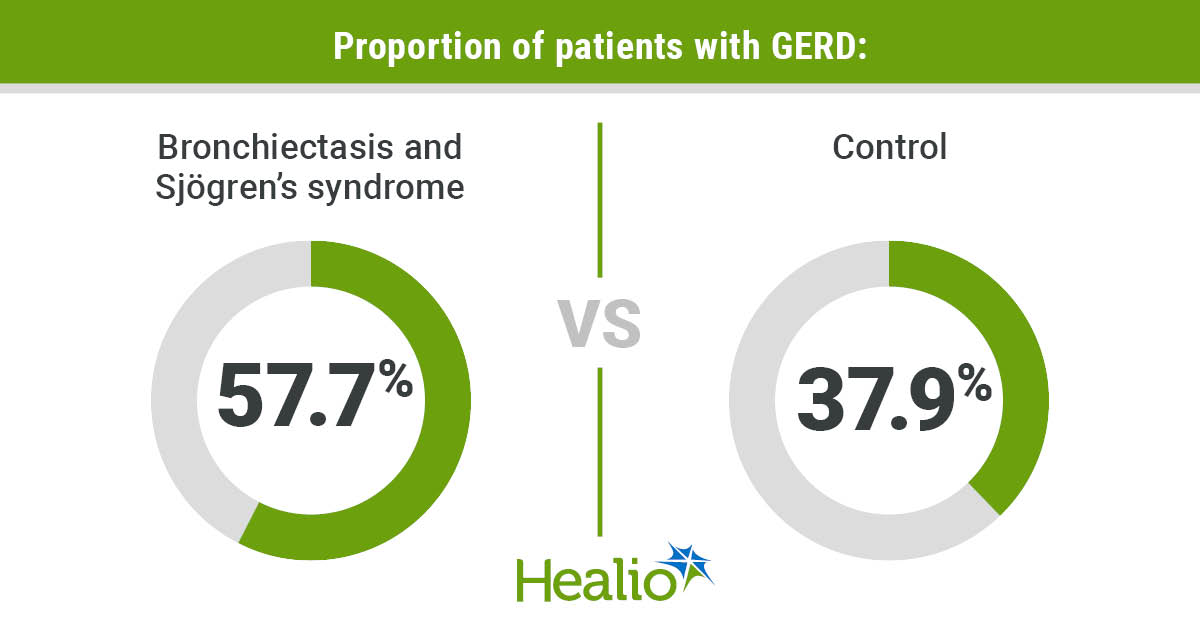
The proportion of patients with GERD was greater among those with bronchiectasis and Sjögren’s syndrome vs. control patients (57.7% vs. 37.9%; SMD = 0.25), as was the proportion with at least one pulmonary-related hospitalization in the 2 years before enrollment (21.1% vs. 19.9%; SMD = 0.24).
Switching to microbiological features, researchers observed a larger proportion of patients with at least one positive S. aureus culture in the bronchiectasis plus Sjögren’s syndrome group vs. the control group (22.5% vs. 9.6%; SMD = 0.37). In contrast, the proportion of patients with at least one positive Pseudomonas aeruginosa culture was smaller in the bronchiectasis plus Sjögren’s syndrome group (14.1% vs. 24.8%; SMD = 0.29).
Strait noted that “the NTM burden was similar between the groups.”
When examining treatment, patients with bronchiectasis plus Sjögren’s syndrome and the control patients had similar inhaled corticosteroid use.
“We are currently working on a study to evaluate whether the presence of GERD in patients who have Sjögren’s and bronchiectasis is associated with distinctive clinical features and micro[biological] features,” Strait said.
“It would also be interesting to better understand the mechanisms underlying the specific airway pathogen profile we identified and to better understand optimal treatment strategy,” she continued.
Sources/Disclosures
Source:
Strait A, et al. Bronchiectasis in Sjögren’s syndrome: Data from the US bronchiectasis and NTM research registry. Presented at: CHEST Annual Meeting; Oct. 18-21, 2026; Phoenix.
Reference:
Disclosures:
Strait reports no relevant financial disclosures.

Ask a clinical question and tap into Healio AI’s knowledge base.
- PubMed, enrolling/recruiting trials, guidelines
- Clinical Guidance, Healio CME, FDA news
- Healio’s exclusive daily news coverage of clinical data