
November 03, 2026
2 min read

Key takeaways:
- Individuals with IBD and at least two immediate relatives with CRC had the greatest increase in absolute risk for CRC.
- A family history of early-onset CRC was linked to a more modest increase in risk.
Individuals with inflammatory bowel disease who have at least two first-degree relatives with colorectal cancer appear to have the greatest increase in risk for CRC, according to results of a Swedish cohort study.
Analysis also showed that having a relative with early-onset CRC was associated with a more modest risk, a finding that diverges from prior research.

“In an earlier Swedish study, this group was reported to have a ninefold relative risk compared with patients with IBD without such a family history,” Åsa Hallqvist Everhov, MD, PhD, clinical researcher at Karolinska Institutet and colorectal surgeon at Södersjukhuset Hospital in Sweden, told Healio.
Individuals with colonic Crohn’s disease and ulcerative colitis are at elevated risk for CRC, according to study background, as are those who have a first-degree relative with early-onset CRC.
“According to international guidelines, patients with IBD who are eligible for colorectal cancer surveillance and have a first-degree relative diagnosed with early-onset colorectal cancer are recommended to undergo annual colonoscopy,” Everhov said. “This is a very intensive surveillance strategy and substantial burden for patients and healthcare systems.”
Associations between family history and risk for CRC have not been studied extensively among patients with IBD, and research informing the latest screening guidance is dated, according to Everhov and colleagues.
“Evidence underlying current recommendations comes from a time when both IBD treatment and colorectal cancer surveillance were different from today,” she said. “We wanted to revisit this question in a more contemporary cohort.”
Investigators used data from national Swedish registries to track CRC incidence and family history of CRC among 124,387 individuals with IBD (median age at diagnosis, 41 years; 49% women; 59.6% ulcerative colitis) and 1,213,641 matched comparators without IBD. The study period spanned 1996 to 2023.
Family history encompassed number of first-degree relatives — including parents, siblings or children — diagnosed with CRC, as well as their age at diagnosis.
Over median follow-up of 11 years, 1,882 individuals with IBD developed CRC, as did 14,177 individuals without IBD.
Among those with IBD, the greatest rise in CRC risk was observed for those with at least two relatives diagnosed with CRC. The incidence rate for CRC in this subgroup was 3.84 (95% CI, 1.77-6.2), which corresponded to 2.69 additional cases of CRC per 1,000 person-years when compared with those with no family history (RR = 2.59).
Early-onset CRC in at least one immediate family member was associated with a more “modest,” and nonsignificant, risk increase — 0.42 additional cases (95% CI, –0.47 to 1.31) per 1,000 person-years (RR = 1.47) — according to the researchers.
“Our study did not confirm the large increase in relative risk previously reported among patients with a first-degree relative with early-onset colorectal cancer,” Everhov said. “Instead, the highest colorectal cancer risk was consistently observed among patients with two or more first-degree relatives with colorectal cancer.
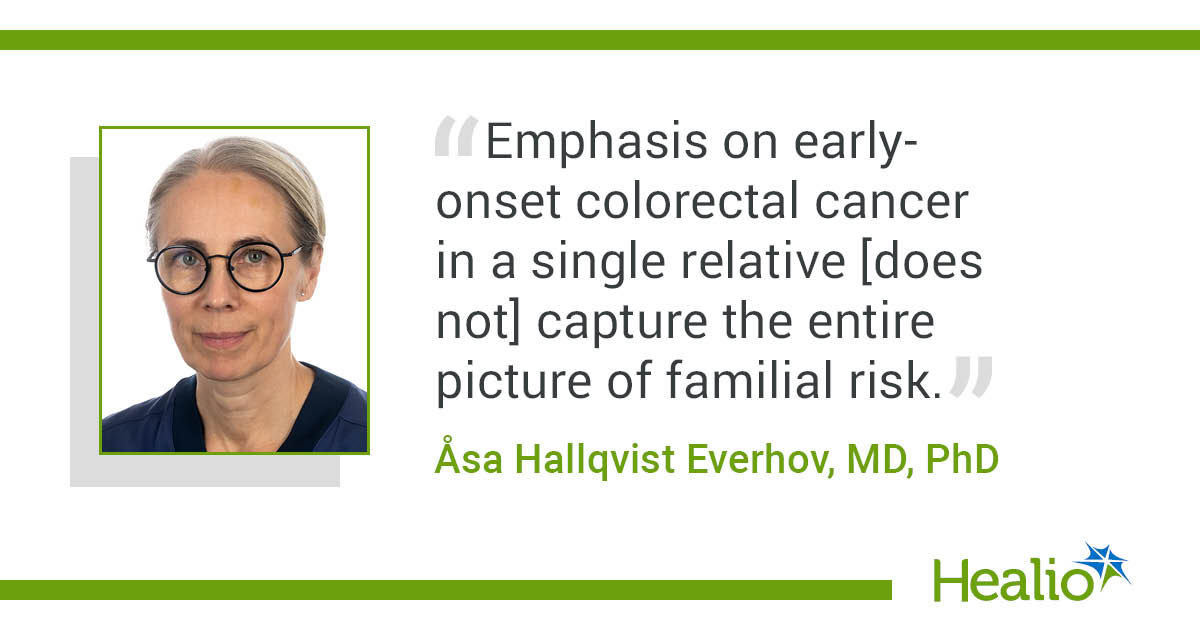
“The current emphasis on early-onset colorectal cancer in a single relative does not seem to capture the entire picture of familial risk,” she added.
CRC incidence rates did not vary significantly between individuals with the same family history, regardless of whether they had IBD. However, baseline CRC incidence remained elevated among those with IBD.
“The most important next step is to determine how family history information can be combined with established risk factors, such as disease extent, inflammatory burden, primary sclerosing cholangitis and previous dysplasia, to provide a more individualized assessment of colorectal cancer risk in patients with IBD,” Everhov told Healio.
For more information:
Åsa Hallqvist Everhov, MD, PhD, can be reached at asa.hallqvist-everhov@ki.se.

Ask a clinical question and tap into Healio AI’s knowledge base.
- PubMed, enrolling/recruiting trials, guidelines
- Clinical Guidance, Healio CME, FDA news
- Healio’s exclusive daily news coverage of clinical data