November 05, 2026
3 min read

Key takeaways:
- After adjusting for contamination bias, an invitation to fecal occult blood test screening was linked to a 26% reduction in CRC mortality.
- Screening participation was associated with a 43% reduction.
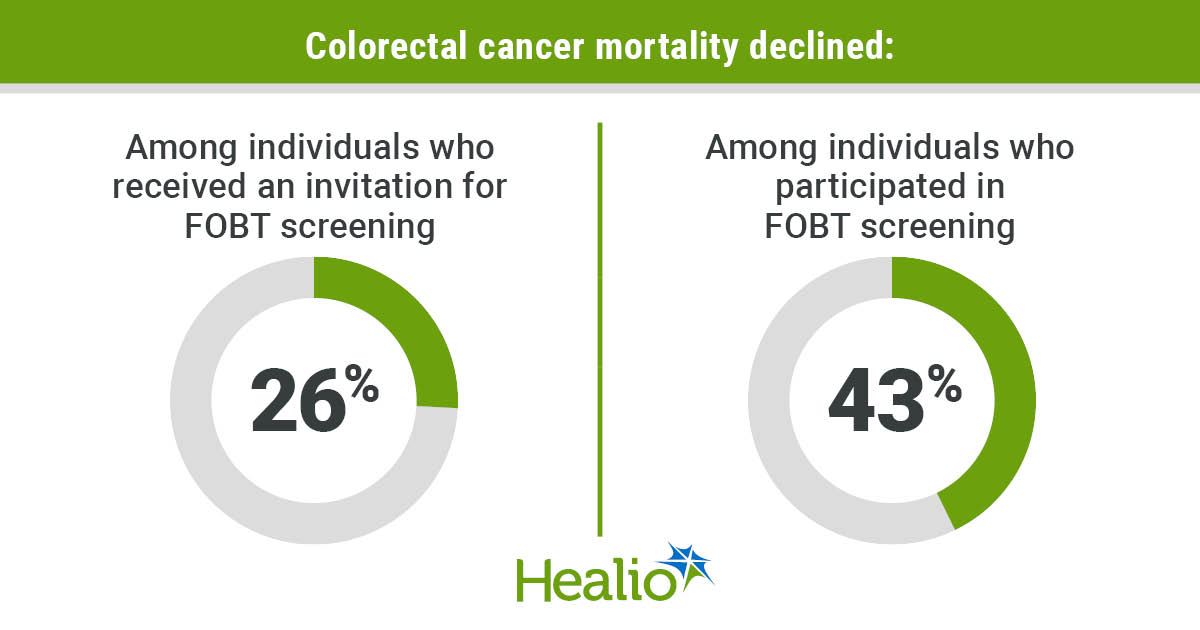
An invitation to participate in a fecal occult blood test screening program in Sweden was associated with a 26% decline in colorectal cancer mortality, which jumped to a 43% decline for participating, results of a prospective study showed.
“One of the major challenges in colorectal cancer screening is demonstrating the effectiveness of an ongoing population-based screening program,” Johannes Blom, MD, PhD, a principal researcher who specializes in cancer prevention and screening at Karolinska Institutet, told Healio. “Randomized trials conducted several decades ago showed that fecal occult blood test screening can reduce colorectal cancer mortality, but evaluating contemporary screening programs is much more difficult because suitable control groups are often lacking.”

Data derived from Blom J, et al. JAMA Netw Open. 2026;doi:10.1001/jamanetworkopen.2026.29856.
Link between CRC screening, mortality
In 2024, Blom and colleagues published an analysis of a Swedish program that invited residents of the country’s Stockholm-Gotland region to fecal occult blood test (FOBT) screening. They observed a 14% decline in CRC mortality among invitees.

Johannes Blom
“However, we suspected that this [analysis] underestimated the true effectiveness of screening, because many individuals in the control group were eventually invited to screening,” Blom said.
Additionally, the initial analysis included deaths caused by CRC diagnosed years after screening invitations stopped, according to Blom.
“We therefore wanted to develop a method that could address these challenges and provide a more accurate estimate of the association between screening and colorectal cancer mortality,” he said.
In a prospective cohort study, the researchers adjusted for CRC deaths associated with diagnosis occurring more than 2 years after screening invitations stopped. They also excluded individuals in the control group who had received an invitation to screening.
“[This] method also made it possible to evaluate the association between actual participation in screening and colorectal cancer mortality,” Blom said.
The researchers included an additional 40 deaths from a national Swedish database in the 2026 study, but otherwise used the same data as the 2024 publication.
More than 375,000 individuals aged 60 to 69 years were randomly assigned by birth year to a study group (n = 203,692; 48.8% men; mean age at start of follow-up, 63.6 years), which received an invitation to FOBT screening from 2008 to 2012, or a control group (n = 172,819; 49% men; mean age at start of follow-up, 62.8 years), which received no screening invitation or an invitation between 2013 and 2015.
‘Substantial impact’ of participation
Overall, 1,668 CRC-related deaths occurred during 14 years of follow-up: 856 in the study group and 812 in the control group.
After adjustment for deaths related to CRC diagnosed more than 2 years after invitations ceased in the study group, CRC mortality declined 19% (RR = 0.81; 95% CI, 0.69-0.94).
When researchers also excluded deaths among screening invitees in the control group, they observed a 26% decrease in mortality (RR = 0.74; 95% CI, 0.58-0.94).
“These findings suggest that the benefits of organized colorectal cancer screening may be substantially underestimated when contamination is not adequately addressed,” Blom said.
Blom called attention to the marked effect of FOBT participation on mortality. When nonadherence in the study group and screening participation in the control group were accounted for, mortality fell 43% (RR = 0.57; 95% CI, 0.4-0.8).
“Even the best screening program can only prevent deaths among people who actually take part,” he said. “Efforts to improve adherence to screening invitations, simplify testing procedures and reduce barriers to participation are therefore likely to have a substantial impact.”
Study limitations include residual confounding stemming from merging data on covariates — age and follow-up time — into broader intervals.
“We believe there is a need for additional research on methods to evaluate ongoing screening programs, because many countries face similar challenges regarding contamination, nonadherence and the lack of truly unexposed control groups,” Blom told Healio.
For more information:
Johannes Blom, MD, PhD, associate professor in the department of clinical science and education at Karolinska Institutet, can be reached at johannes.blom@ki.se.
Perspective

This study proposes an updated methodological framework to estimate the association of invitation to and participation in fecal occult blood screening — guaiac FOBT and fecal immunochemical test — with reductions in CRC mortality, building on Blom and colleagues’ 2024 study.
In particular, the authors introduced a time limit for defining screening exposure, adjusting for study group deaths when CRC was diagnosed more than 2 years after the person’s last screening invitation, in line with the biennial invitation interval. After adjustment for these nonexposed cases in the study group, the estimated risk ratio corresponded to a 19% reduction in incidence-based CRC mortality.
The authors also adjusted for contamination in the control group (individuals who were eventually invited to screen and thus not truly unexposed). By assessing actual exposure rather than the original group assignment, the estimated effect of invitation to screening was a 26% reduction in CRC mortality.
The authors further adjusted for nonparticipants (those who were invited in the last screening round preceding a CRC diagnosis, but did not participate), yielding a larger estimated reduction to 30% when adjusted for participation in the study group, a 38% reduction when adjusted for participation in the control group and a 43% reduction with crude adjustment of the residual unexposed deaths.
These findings underscore the importance of screening uptake and participation in stool-based CRC screening in real-world practice. Impressively, there is more than a 25% reduction in CRC deaths associated with invitation to screen, and more than a 40% reduction in estimated mortality from CRC with participation in screening.
Utilizing broadly mailed FOBT/FIT initiatives for patient screening has the potential to reduce mortality on a population level, and efforts to encourage completion of FOBT/FIT tests could prevent substantial CRC mortality in clinical practice.
Arielle Elmaleh-Sachs, MD, MS
Disclosures: Elmaleh-Sachs reports no relevant financial disclosures.

Ask a clinical question and tap into Healio AI’s knowledge base.
- PubMed, enrolling/recruiting trials, guidelines
- Clinical Guidance, Healio CME, FDA news
- Healio’s exclusive daily news coverage of clinical data