November 09, 2026
4 min read

Key takeaways:
- About half of survivors of obesity-associated cancers received clinician counseling about losing weight.
- Survivors appeared much more responsive to clinician counseling about weight loss than other adults.
Clinician counseling is an underutilized but potentially effective strategy for motivating survivors of obesity-associated cancers to try to lose weight, cross-sectional study findings suggest.
An analysis of more than 7 years of national survey data found that survivors of obesity-associated cancers are no more likely than adults with obesity but no cancer history to receive clinician counseling for weight loss, exercise or reducing fat or calorie intake.

Data derived from Howard R, et al. JAMA Netw Open. 2026;doi:10.1001/jamanetworkopen.2026.33391.
However, when clinicians provide this counseling, it appears to make a much bigger difference among survivors of obesity-related cancer than among comparator adults.

Ryan Howard
“The findings illustrate a missed opportunity,” lead author Ryan Howard, MD, MS, DABOM, assistant professor of surgery in the division of minimally invasive surgery, a bariatric surgeon and an obesity medicine specialist at University of Michigan, told Healio. “We should be systematically addressing this modifiable risk factor among cancer survivors. We’re not doing that about half the time, yet our data show it could make a real difference.”
‘Not standardized’
An estimated two-thirds of the 18 million cancer survivors in the U.S. have overweight or obesity, according to study background.
Obesity is associated with greater risk for cancer recurrence, cancer-associated or all-cause mortality, and secondary primary malignancies, yet it often is unaddressed during survivorship, Howard said.
“One of the most impressive success stories in cancer care is the work that has gone into making discussions about smoking and cessation counseling a standardized component,” Howard said. “Given obesity arguably competes with smoking in terms of being a modifiable risk factor, we should treat it no differently. Unfortunately, it is not standardized in the same way.”
Howard and colleagues aimed to examine how often survivors of obesity-associated cancers receive clinician counseling, the extent to which counseling may influence weight loss attempts among this population, and whether the impact of counseling differs between survivors and the general population.
They aimed to answer those questions using data from the National Health and Nutrition Examination Survey.
Their sample included 7,754 adults aged 20 years or older who participated in the survey during at least one of three cycles between January 2013 and March 2020. All individuals had obesity.
The cohort included 315 individuals (median age, 66 years; 80.3% women) who reported a prior diagnosis of an obesity-associated cancer.
The remaining 7,439 adults (median age, 50 years; 55.1% women) represented a comparator group with no history of obesity-associated cancer.
The proportion of individuals who attempted weight loss in the prior 12 months — as assessed by a direct survey question — served as the primary outcome. A second survey question asked whether respondents had been advised by a doctor or health professional in the past 12 months to control their weight or lose weight, allowing investigators to examine the frequency and impact of clinician counseling.
‘Move the needle’
Results showed no significant differences in the percentages of survivors of obesity-associated cancers vs. adults in the comparator group who received counseling about an overweight diagnosis (72% vs. 71.8%), the need to lose weight (51.1% vs. 51.8%), the need to exercise (58.5% vs. 56.8%), or the need to reduce fat or calorie intake (44.3% vs. 46.4%).
Logistical barriers can play a role, Howard said, noting some clinicians may not understand current anti-obesity therapies, who is eligible for them, or to whom patients should be referred.
Fragmentation of survivorship care also contributes.
“A considerable percentage of cancer clinicians are willing to do this work, but they’re not sure if a primary care physician or other clinician is already doing it,” Howard said. “There is a willingness to own it, but there is confusion about who actually does own it.”
A lower percentage of survivors than comparator adults indicated they attempted weight loss in the past 12 months (47.9% vs. 59.6%). However, the impact of clinician counseling on weight loss attempts appeared considerably stronger among survivors.
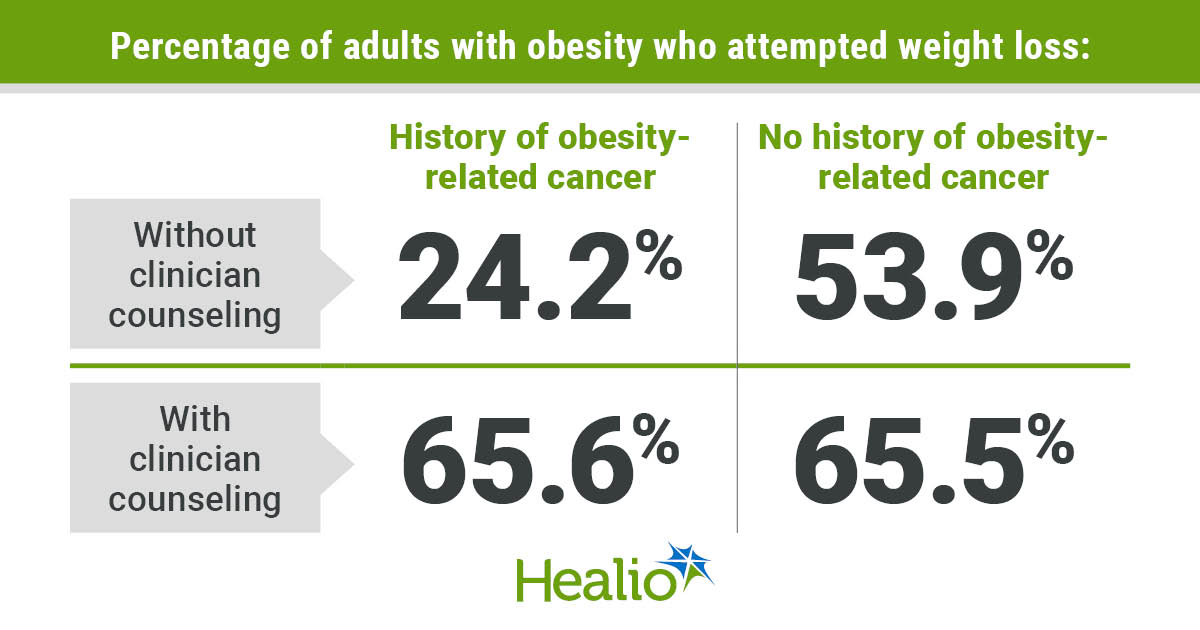
In that group, 65.6% of those who received counseling reported attempted weight loss, compared with 24.2% of those who did not (difference, 41.4 percentage points). In contrast, 65.5% of adults in the comparator group who received clinician counseling reported attempted weight loss, compared with 53.9% of those who did not receive counseling (difference, 11.6 percentage points).
“Helping any patient with weight loss is really hard, and cancer survivors already have a lot of competing health priorities,” Howard said. “But these findings show, when we take the time, we can move the needle in a big way.”
‘A teachable moment’
Limitations of the survey data precluded researchers from evaluating whether weight loss attempts in their study cohort proved successful.
However, results of two trials have demonstrated that connecting people with cancer to evidence-based obesity care is effective, Howard said.
The CHALLENGE trial showed structured exercise after surgery and adjuvant chemotherapy reduced risk for recurrence and death among patients with colon cancer. The BWEL trial showed a telephone-based weight loss intervention helped women with breast cancer and obesity lose nearly 5% of their body weight.
Howard — who co-authored a viewpoint published this year in JAMA Oncology about the importance of embracing effective obesity therapies to improve cancer treatment and survivorship — emphasized every health system can either provide this type of care or connect patients with appropriate resources.
“What’s missing is taking that first step so it becomes standard to talk with patients about different options for weight loss or refer them to an obesity management program,” Howard said. “We don’t have to reinvent care for every patient. If a patient has a diagnosis of obesity, we name it, we talk to them about it and we act on it.”
The key is to frame the conversation appropriately, Howard added.
“Many patients with obesity are used to hearing clinicians talk to them about losing weight, and they know it is a hard change to make, but a cancer diagnosis turns this into a teachable moment,” he said. “If this is framed as a potential preventive measure — emphasizing that this can prevent cancer from coming back and increase their chances for a better outcome — patients really get engaged with what oncologists are recommending.”
For more information:
Ryan Howard, MD, MS, DABOM, can be reached at rhow@med.umich.edu.

Ask a clinical question and tap into Healio AI’s knowledge base.
- PubMed, enrolling/recruiting trials, guidelines
- Clinical Guidance, Healio CME, FDA news
- Healio’s exclusive daily news coverage of clinical data