November 09, 2026
2 min read
Key takeaways:
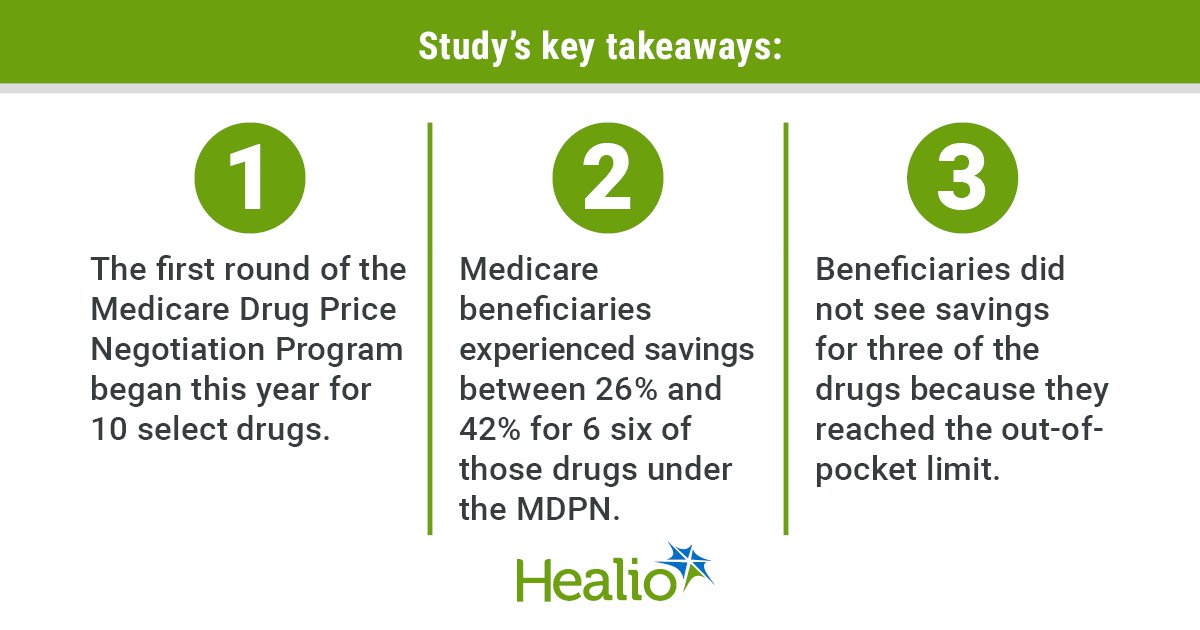
- Medicare enrollees have saved between 26% and 42% on certain Medicare Part D drugs already this year.
- Ten total drugs were selected for the first round of the program, which began at the start of 2026.
Patients enrolled in Medicare have seen savings on some out-of-pocket prescription costs for moderately priced drugs under the Medicare Drug Price Negotiation Program, or MDPNP, according to a new study.
Other more highly priced drugs, however, did not result in significant savings for patients under the MDPNP.

The study, conducted by researchers at the Vanderbilt University School of Medicine, took a closer look at the impact of the MDPNP, which was established in 2022 as part of the Inflation Reduction Act (IRA). The act chose 10 drugs from Medicare Part D to participate in the program, and Maximum Fair Prices (MFPs) were negotiated ahead of the program’s start at the beginning of 2026. The study compared 2025 point-of-sale prices with the 2026 MFPs for nine of the 10 drugs to determine the savings that beneficiaries received this year. (Insulin was omitted from the analysis, researchers said, because of the IRA’s $35 monthly cost-sharing limit.)
The study found that patients saw significant savings for six of the nine drugs, while the other three did not account for any additional savings.
Medicare beneficiaries taking the highest priced drugs — Stelara (ustekinumab, Janssen), Imbruvica (ibrutinib, Pharmacyclics) and Enbrel (etanercept, Immunex) — did not see additional savings because the maximum annual out-of-pocket limit of $2,100 was reached.
“The Part D out-of-pocket spending cap began in 2025 while the negotiated prices took effect in 2026,” Grace Castle, one of the study’s authors and a PhD student at the Vanderbilt University Medical Center, told Healio. “Because of this sequence, Part D beneficiaries with the highest spending experience savings from the out-of-pocket cap but not directly from the negotiation program. Medicare beneficiaries who spend less than $2,100 in 2026 can experience direct savings from the negotiated prices, especially if their Part D plan employs coinsurance.”
Where beneficiaries saw the most savings was from drugs whose list prices were under the out-of-pocket limit: Entresto (sacubitril/valsartan, Novartis), Jardiance (empagliflozin, Boehringer Ingelheim), Eliquis (apixaban, Bristol Myers Squibb), Farxiga (dapagliflozin, AstraZeneca), Xarelto (rivaroxaban, Janssen) and Januvia (sitagliptin, Merck). These savings were between 26% and 42% compared with 2025 prices.
Castle and her team noted that beneficiaries do not need to do anything to achieve these savings.
“The program lowered Medicare reimbursement of these therapies, so any change to patient out-of-pocket cost will automatically flow through their insurance plan design,” she said. “If they pay for prescription drugs with a copay, their out-of-pocket cost is not likely to change, but if they pay with coinsurance, they will likely pay less in 2026 compared with 2025 for these drugs.”
Sources/Disclosures
Source:
Castle G, et al. Ann Intern Med. 2026;doi:10.7326/ANNALS-26-02703.
Disclosures:
Castle reports previously working at CivicaScript, a nonprofit generic and biosimilar manufacturer, and Trinity Life Sciences, a global life sciences consultancy. Please see the study for all other authors’ relevant financial disclosures.

Ask a clinical question and tap into Healio AI’s knowledge base.
- PubMed, enrolling/recruiting trials, guidelines
- Clinical Guidance, Healio CME, FDA news
- Healio’s exclusive daily news coverage of clinical data