
Image
Dialogue
Ashley is in her kitchen. She grabs a glass of water and takes her asthma medicine.
Ashley texts her friend Sarah: “Be down in a sec!”
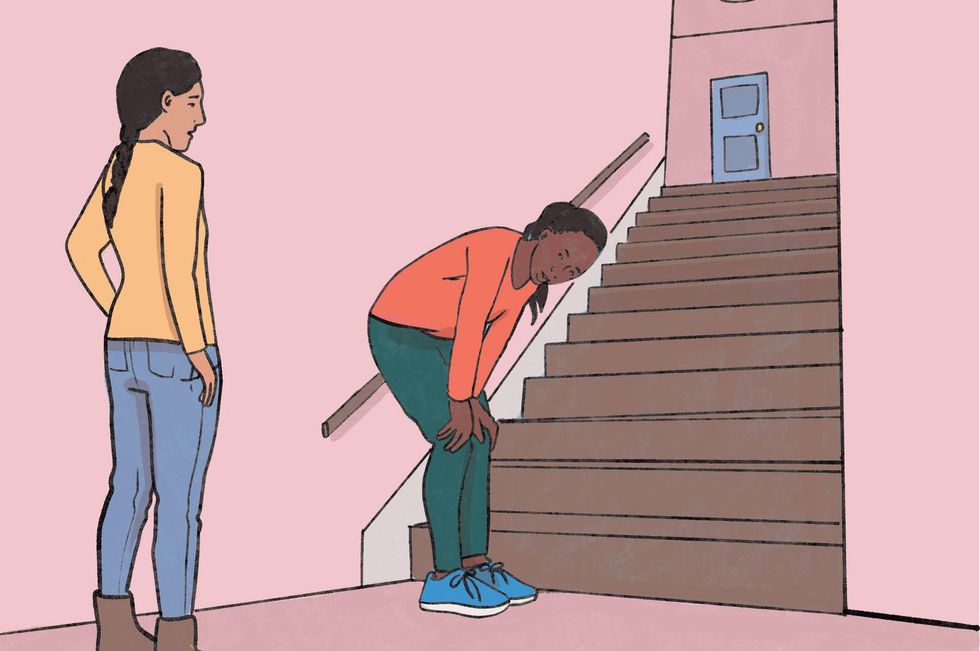
She shuts her apartment door then heads down the stairs. Her friend Sarah is waiting at the bottom and sees her pause to catch her breath.
Sarah: “Are you okay?”
Ashley: “Yeah. I’ve just been getting short of breath on these stairs. I hope they fix the elevator soon!”
Ashley pulls an inhaler out of her purse and uses it.
Sarah: “Are you still on that new medication?”
Ashley: “I am, but I’m still feeling symptoms sometimes. I woke up with a little chest tightness and was wheezing last night.”
Ashley grabs her phone and dials her doctor’s office.
Sarah: “You should probably get that checked out.”
Ashley: “You’re right. Let me call my pulmonologist real quick before we head to lunch.”
Super: The next day …
Ashley sits in the specialist’s office while the doctor reviews her chart and listens to her lungs.
Doctor: “Tell me what’s been going on.”
Ashley: “I take my medication every day, but I’m still using my quick-relief inhaler a few times a week.”
The doctor points to a simple poster or tablet showing healthy airways next to inflamed airways (red, narrowed airway). Ashley listens attentively.
Doctor: “Your asthma may still be uncontrolled. One possible reason is excessive type 2 inflammation in your airways. The good news is there are additional options for us to try.”
Doctor and Ashley are talking.
Ashley: “So, there are other options?”
Doctor: “Yes, there are! Our goals are fewer flare-ups, less need for oral steroids, better lung function, and a better quality of life.”
Doctor is talking to Ashley, she nods in agreement throughout.
The doctor hands Ashley a brochure titled “Advanced Asthma Treatment Options”
Ashley: “That sounds good. What can we change?”
Doctor: “Do you notice your symptoms are worse around things like pollen, pets, smoke or dust?”
Ashley: “I do think I feel it more when the trees in my neighborhood are in bloom.”
Doctor: “That’s helpful. Allergens and environmental triggers can make symptoms worse. We’ll work on identifying and managing those triggers, and I’ll review your current bronchodilator and anti-inflammatory medications to see if any adjustments could help.”
Doctor: “We may also consider whether a biologic is right for you to help target the inflammation.”
The doctor writes “well-tolerated exercise” on a notepad for Ashley to take home.
Ashley: “Are there any lifestyle changes that can help?”
Doctor: “Until we get your asthma under control, be sure to do some light exercise. Once it’s under control, you can switch to 150 minutes a week of moderate-intensity aerobic activity, like brisk walking, as long as you’re tolerating it well.”
Ashley smiles and waves goodbye to the doctor as she heads out the door.
Ashley: “I’m so glad I came in. I didn’t realize there were still options to help get my asthma under control.”
For more information, please visit HealthyWomen.org/asthma.
This resource was created with support from Sanofi and Regeneron.