November 11, 2026
5 min read

Key takeaways:
- Treatment options remain limited for pediatric MASLD, a condition “as common as asthma.”
- Early data are promising, but clinical trials are needed before adult MASH therapies can be approved for use in children.
The recent FDA approvals of pharmacologic therapies for metabolic dysfunction-associated steatohepatitis were “breakthrough moments in history” for a disease whose management had mostly relied on lifestyle interventions.
However, the two drugs that drastically changed the treatment of MASH in adults — resmetirom (Rezdiffra, Madrigal Pharmaceuticals) and semaglutide (Wegovy, Novo Nordisk) — have not been approved for the treatment of MASH among patients aged younger than 18 years.

“I don’t think people understand how common [pediatric metabolic dysfunction–associated steatotic liver disease] is,” Jennifer Panganiban, MD, gastroenterologist and director of the MASLD program at Children’s Hospital of Philadelphia, told Healio. “It’s as common as asthma, and people are shocked when they hear that in clinic.”
The global prevalence of pediatric MASLD is estimated to be roughly 13% among children and adolescents, according to data published in World Journal of Pediatrics. Nearly half (47%) of children with obesity have comorbid fatty liver disease.
Pediatric MASLD can compromise children’s liver health.
“Advanced fibrosis is already present in approximately 10% to 15% of children with MASH at the time of diagnosis,” Panganiban said.
The current standard of care, centered on lifestyle intervention, is often not effective for many children with MASLD. In a 2025 study of 440 children with biopsy-confirmed MASLD receiving standard clinical care, 22% demonstrated improvement after 1 year, which increased to 31% after 2 years. At the same time, approximately 20% experienced worsening liver disease despite standard-of-care management, underscoring the need for more effective therapeutic options.
‘Promising’ results
The health risks and treatment challenges associated with pediatric MASLD and MASH highlight the need for randomized clinical trials evaluating the efficacy of pharmacologic therapies in young patients, according to Panganiban.
“After we accumulate safety data and look at [drug] interactions, we start working on trials in younger individuals,” Rohit Loomba, MD, MHSc, director of UC San Diego MASLD Research Center, told Healio. “There are discussions regarding potential studies in a pediatric population with MASH-related fibrosis, and we hope to see those in the future, develop the efficacy and safety [data] in that population, and potentially utilize those medications.”
Several GLP-1 receptor agonists, including semaglutide, tirzepatide, liraglutide, dulaglutide and exenatide, have pediatric approval for obesity and type 2 diabetes.
Researchers have conducted retrospective studies to evaluate the impact of GLP-1s on markers of liver health in children with FDA-approved indications for GLP-1 use, and the results appear “promising,” according to Loomba.
One study, published in Journal of Pediatric Gastroenterology and Nutrition, included children diagnosed with MASLD (mean age, 15 years; 64% boys; 55% white) who were prescribed a GLP-1 at Children’s Hospital of Philadelphia.
“We looked at 42 patients that met the official diagnosis [criteria] for pediatric MASLD based on hepatic imaging, as well as cardiometabolic risk factors,” Panganiban, one of the study investigators, said.
Results showed alanine aminotransferase levels improved by a mean 56 U/L at 6 months (P = .04) and by 37 U/L at end of treatment (P = .004). The effect on ALT levels was greater in children with type 2 diabetes, compared with those with obesity. The researchers also observed improvements in aspartate aminotransferase, gamma-glutamyl transpeptidase, HbA1c and triglycerides among children treated with a GLP-1.
“All the available data from GLP-1 receptor agonist trials in obesity and type 2 diabetes point to safe use and meaningful improvements in weight and BMI, but these studies were not designed to assess liver outcomes,” Panganiban said. “That gap highlights the urgent need for dedicated pediatric MASLD trials.”
As a follow-up to those encouraging findings, Panganiban noted that her team has been conducting a prospective, observational study of children and adolescents with MASLD. Preliminary results were presented in October at NASPGHAN Annual Meeting.
“[The results] demonstrated significant and sustained improvements in liver enzymes, with imaging changes suggesting improvements in steatohepatitis following semaglutide treatment,” she said. “ Notably, these improvements were observed as early as 3 months and continued through 12 months of follow-up, providing further evidence of the potential role of GLP-1 receptor agonists in treating pediatric MASLD.”
Panganiban and colleagues also presented promising data on semaglutide at The Liver Meeting this month.
In a retrospective study of 145 children with MASLD from 2023 to 2026, 93% of those who received semaglutide achieved at least 30% relative fat fraction reduction compared with 25% who did not receive the drug.
“We show that semaglutide was associated with significantly higher improvement of steatosis, NAFLD Activity Score and MASH resolution, without worsening of fibrosis per biopsy, compared with contemporaneous controls,” Panganiban said.
A phase 2 trial of resmetirom, which is approved to treat MASH in adults, is also under way. The multicenter, open-label study is evaluating the safety, pharmacokinetics and pharmacodynamics of the drug among children aged 6 to 17 years with MASH with stage F1 to F3 fibrosis.
Panganiban called the research “exciting” progress.
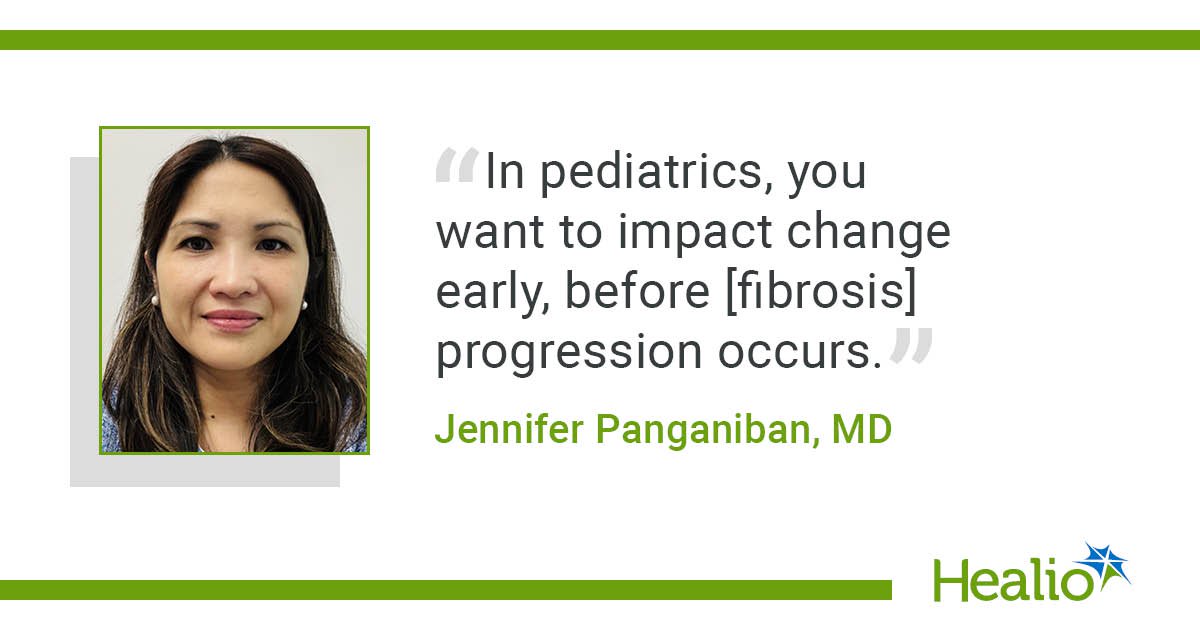
“In pediatrics, you want to impact change early, before [fibrosis] progression occurs,” she said.
‘Core treatment’
Should pharmacologic therapies be approved to treat pediatric MASLD and MASH, Loomba emphasized the importance of identifying patients’ individual risk and developing tailored treatment plans.
“The majority of individuals with MASLD in the pediatric age group — younger than 18 years of age — will not have significant fibrosis, which is stage two, stage three or stage four,” Loomba said.
He added that the focus should be on risk reduction in patients with MASLD via diabetes prevention and early obesity management.
“Focusing on lifestyle intervention in those who have earlier disease and do not have fibrosis yet is important, so [patients] no longer require pharmacologic therapies in the future,” Loomba said.
Panganiban emphasized that lifestyle therapy, which diverges from adult therapy in several key ways, remains the “core treatment” for pediatric MASLD and MASH.
Critically, lifestyle therapy for pediatric liver disease must include the entire family to be successful.
“Lifestyle is not just about nutrition and physical activity, but includes sleep, screen and high-risk behaviors, especially in children,” she said.
Research needs for pediatric MASH and MASLD extend beyond clinical trials, particularly regarding identification of individual risk and disease stages.
“One of the major challenges in pediatric MASLD is the lack of accurate, noninvasive tools for risk stratification,” Panganiban said. “Compared with adults, we have far fewer tools to identify which children are at greatest risk for fibrosis progression and adverse liver outcomes, highlighting a critical unmet need in the field.”
According to Loomba, developing a better understanding of disease progression in pediatric patients is critical. Specifically, he emphasized the need to investigate the length of time it takes for children to progress to subsequent stages of fibrosis, putting them at greater risk for advanced liver disease.
“The accelerated approvals of resmetirom in 2024 and Wegovy in 2025 for the treatment of noncirrhotic MASH with F2/F3 fibrosis were breakthrough moments in history,” Panganiban told Healio. “For the first time we had FDA-approved medications for treatment of MASH in adults.
“Hopefully this serves as a catalyst, paving the way for pediatric trials in the near future.”
For more information:
Rohit Loomba, MD, MHSc, is professor of medicine and chief of gastroenterology and hepatology at UC San Diego School of Medicine. He can be reached at gastroenterology@healio.com.
Jennifer Panganiban, MD, is associate professor of clinical pediatrics at University of Pennsylvania Perelman School of Medicine. She can be reached at panganibaj@chop.edu.
Sources/Disclosures
Source:
Healio Interviews
References:
Disclosures:
Loomba reports consulting roles with and/or institutional research support from 89bio, Altimmune, Arrowhead Pharmaceuticals, AstraZeneca, Bausch Health, Boehringer Ingelheim, Eccogene, Eli Lilly & Co., Gilead Sciences, GSK, Hanmi, Hepta Bio, Inipharm, Insitro, Inventiva, Ionis, Kriya Therapeutics, Madrigal Pharmaceuticals, MetaVi, Novo Nordisk, Roche, Sagimet Biosciences, Source Bio, Takeda Pharmaceuticals, Tensor Bio and Viking Therapeutics. He also cofounded LipoNexus. Panganiban reports a past advisory role with Madrigal and serving as a key opinion leader for Novo Nordisk.

Ask a clinical question and tap into Healio AI’s knowledge base.
- PubMed, enrolling/recruiting trials, guidelines
- Clinical Guidance, Healio CME, FDA news
- Healio’s exclusive daily news coverage of clinical data