November 12, 2026
3 min read

Key takeaways:
- A CRISPR-Cas9 gene-editing therapy lowered triglycerides at 30 days in patients with severe hypertriglyceridemia.
- There were no serious adverse events related to the therapy.
CHICAGO — A gene-editing therapy targeting hepatic ANGPTL3 lowered triglycerides in patients with severe hypertriglyceridemia, according to results of a phase 1b study presented at the American Heart Association Scientific Sessions.
Ashish Sarraju, MD, cardiologist in the section of preventive cardiology in the Tomsich Family Department of Cardiovascular Medicine of The Sydell and Arnold Miller Family Heart, Vascular & Thoracic Institute, Cleveland Clinic, presented the results of the study of 10 patients (median age, 56.5 years; 60% men; median triglycerides, 1,067.7 mg/dL) who received IV administration of CTX310 (CRISPR Therapeutics), a single-dose CRISPR-Cas9 gene-editing therapy. Patients received 40 mg if their body weight was 85 kg or less or 50 mg if their body weight was more than 85 kg.

Data derived from Sarraju A, et al. LBS.05. New frontiers in cardiometabolic risk reduction. Presented at: American Heart Association Scientific Sessions; Nov. 6-9, 2026; Chicago.
‘A new frontier’
“So far, the safety and efficacy profile is promising and [CTX310] represents a new frontier for drug development for severe hypertriglyceridemia,” Sarraju said during a presentation.
CTX310 is not yet approved for commercial use in the United States. A once-monthly injection, olezarsen (Tryngolza, Ionis), is approved for patients with severe hypertriglyceridemia, and a once per 3 months injection, plozasiran (Redemplo, Arrowhead), is approved for patients with familial chylomicronemia syndrome and is being considered by the FDA for patients with severe hypertriglyceridemia.
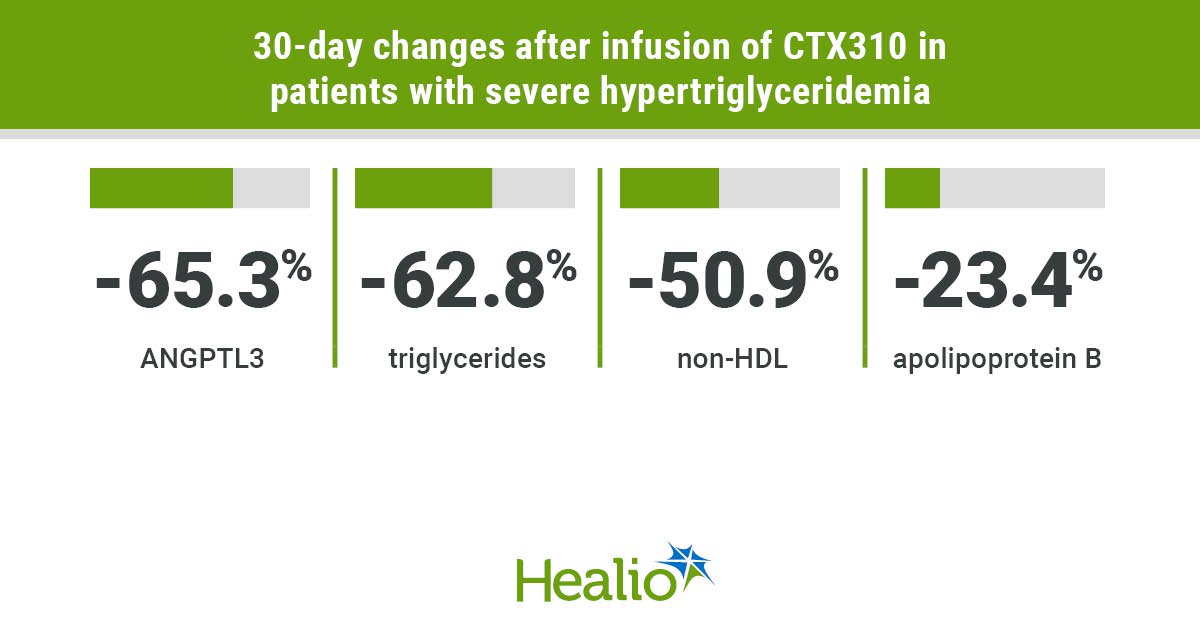
At 30 days, the median percent change was –65.3% for ANGPTL3, –62.8% for triglycerides, –60.5% for directly measured serum triglycerides, –50.9% for non-HDL, –16.4% for LDL and –23.4% for apolipoprotein B, Sarraju said.
One patient was a nonresponder and had an increase in ANGPTL3 of 7.2% at 30 days, but five had a decrease of more than 80% and the other four had drops ranging from 46.5% to 73.2%, he said.
Triglycerides decreased by 28.2% in the nonresponder but by more than 80% in three respondents, with the others having a decline of 42.4% to 70.8%, he said.
The 30-day absolute change from baseline in triglycerides ranged from a drop of 299.4 mg/dL to a drop of 1,971.6 mg/dL, according to the researchers.
There were no serious adverse events related to CTX310, and of the four adverse events reported, three were grade 1, while the grade 2 adverse event was an infusion-related reaction of mild back pain in a patient with a history of back pain, Sarraju said.

Ashish Sarraju
“I think severe hypertriglyceridemia is generally a challenging condition to treat in the lipid disorder world, because of, until recently, a lack of proven therapies that can reduce triglycerides and also reduce acute pancreatitis, but also because these patients have concurrent cardiovascular risk,” Sarraju told Healio. “And so the ability to offer somebody a one-time treatment to mitigate their risk for severe triglyceride elevations, I can imagine that being quite compelling to a lot of individuals. I don’t think this is meant to replace all the other therapies. I think the idea here is for us to grow our armamentarium with different types of agents, different durations of actions and different tolerability profiles, so you can fit the correct therapy to the correct patient at the correct time. So I think if the evidence for efficacy and safety bears out in larger trials, and this does become available, I think this would be a very compelling offer for patients with extremely high triglycerides in terms of being a one-time therapy, not having to take repeat therapies, and then promoting shared decision-making now with an armamentarium that’s much broader than what we had 20 years ago.”
‘An opportunity to individualize treatment’

Vera A. Bittner
“We just witnessed a first: a gene-editing study in severe hypertriglyceridemia that led to sustained reductions in triglycerides and related lipid compounds,” Vera A. Bittner, MD, MSPH, FAHA, professor of medicine and Endowed Scholar in Cardiovascular Disease Prevention at the University of Alabama at Birmingham, said in a discussant presentation. “It’s a great time to be a preventive cardiologist or clinical lipidologist because we now have an opportunity to individualize treatment for each patient based on underlying pathophysiology risk, and also based on patient preferences for dosing frequency or adverse effects. But in order to implement such a strategy successfully, we need to be absolutely sure that we preserve these treatments for people who have truly persistent severe hypertriglyceridemia, so recommendations about lifestyle and management of secondary causes will not change. I think we need to get much better at phenotyping at the point of care.”
For more information:
Ashish Sarraju, MD, can be reached at cardiology@healio.com.
Sources/Disclosures
Source:
Sarraju A, et al. LBS.05. New frontiers in cardiometabolic risk reduction. Presented at: American Heart Association Scientific Sessions; Nov. 6-9, 2026; Chicago.
Disclosures:
Bittner reports serving as a site principal investigator for trials sponsored by Amgen and Novartis and serving on a data safety monitoring board for Eli Lilly and Verve Therapeutics. Sarraju reports serving as a consultant for or conducting trial leadership activities for Arrowhead, AstraZeneca, CRISPR Therapeutics, Ionis, Kalexo, Kardigan, Kylonova, Mineralys, NewAmsterdam Pharma, Novartis and vTv Therapeutics. The study was funded by CRISPR Therapeutics.

Ask a clinical question and tap into Healio AI’s knowledge base.
- PubMed, enrolling/recruiting trials, guidelines
- Clinical Guidance, Healio CME, FDA news
- Healio’s exclusive daily news coverage of clinical data