November 12, 2026
6 min read
Key takeaways:
- Together, the periodic fasting-mimicking and longevity dietary patterns create a “scientific diet” working for patients on a cellular level.
- An expert explained how the combination creates an opportunity.
ORLANDO — A scientific diet joining two popular patterns could be helpful for longevity, according to a speaker at the American College of Lifestyle Medicine annual meeting.
Valter Longo, PhD, the Edna Jones Professor of Gerontology and a professor of biological science at the University of Southern California Leonard Davis School of Gerontology, offered a presentation on the interconnected issues of diet, longevity and disease.

Healio spoke with Longo, who is also the director of the USC Longevity Institute, to learn more about the two diets he focused on, who benefits the most from them and more.
Healio: Why did you decide to present on this topic? Why is it important for healthcare providers to know about?
Longo: We’ve been working on this topic for 30 years, and we’re trying to convince everybody — me and many others in the field of aging and longevity — that medicine should focus on longevity first. This idea is now something that is slowly getting out there. I’m trying to also present interventions that are feasible and clinically proven to be effective, or on their way to being proven to be effective.
Healio: You discussed the periodic fasting–mimicking diet and the everyday low–protein plus moderate methionine-supplemented longevity diet. What does the research say on these dietary patterns?
Longo: The periodic fasting-mimicking diet is a diet tested in over 45 clinical trials, mostly by independent universities, and the idea is: can you mimic water-only fasting while providing a very healthy, vegan-based diet? It is a low-calorie, low-protein, low-sugar, high-fat, 100% plant-based. So, the idea there — it goes back 20 years — is that the most powerful intervention in history against aging is called calorie restriction. Calorie restriction really is something very simple: What happens if you take a person who eats normally and you reduce their calories by 25%? This has been tested in lots of clinical trials. There are very powerful effects, but also very powerful side effects. So, the fasting-mimicking diet is there to try to get the effects of the calorie restriction without the burden and the side effects.
Our question has been: What if you act for only 5 days once a month or less? Let’s say once every 3 months or once every 4 months, do you get effects that are long lasting? Many of the trials are showing exactly that. You get long-lasting effects that have much less to do with fat loss or weight loss; and more with these periods of fasting mimicking that created a reset: A metabolic reset, a stem cell reset, a cellular reprogramming reset, autophagy and microbiota — those are the ones we’ve clearly seen in animal models, but we are also observing effects in humans clinical trials consistent with those in rodents.
The everyday longevity diet is something completely different — learning from Okinawa, Japan; Loma Linda [California]; Italy, and combining it with mouse data and rat data and monkey data but also clinical trials and epidemiological analyses we have been studying the characteristics of the ideal everyday diet and the molecular mechanisms that make it effective?
First of all, let’s understand what it is about the Mediterranean diet or the Okinawa diet that has been so successful in making lots of people live to 100 and past — and very healthy, by the way — and then transform it into a mouse diet, and then go back to the human epidemiological data and test the hypothesis built by the mouse data. That’s what we did in the recent paper, showing that a low-protein, low-amino acid, low-methionine diet is great — just like calorie restriction — but it causes a lot of problems. But if you just keep it like that — like the old Okinawa diet or the old Japanese diet or the old Mediterranean diet — mice get frail. If you instead introduce modern levels of methionine, the frailty goes away, but all the beneficial effects don’t go away. We see effects on GLP-1s in mice. We see effects on a factor called [fibroblast growth factor 21 (FGF21)]. We see effects on growth hormone, which reaches very high levels, but we can keep a growth factor that is associated with aging, cancer and cancer metastasis called [insulin-like growth factor-1 (IGF-1)], lower.
The longevity diet that we described is now trying to transform the popular diets into a scientific diet that understands how each component — and even each component of the component; proteins and then methionine within proteins, protects against aging and disease. Is it simply that you need to eat plant proteins? It doesn’t look like it. It looks like you have to have the right range of methionine but a low-protein diet to get the effects.
Healio: What are the potential benefits to these diets?
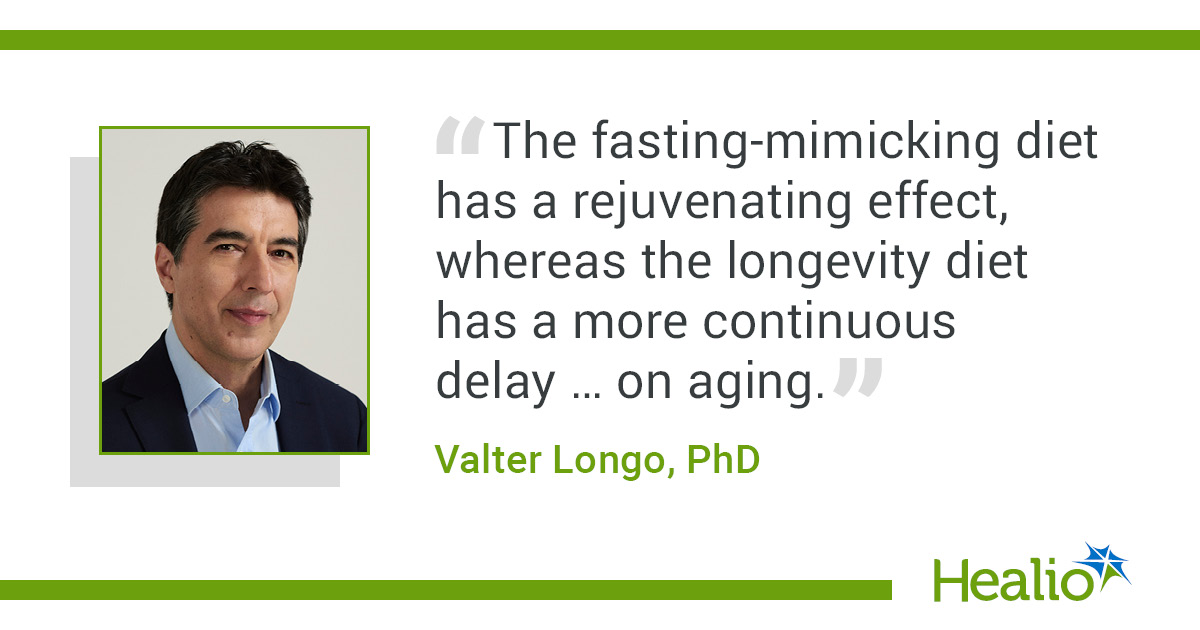
Longo: The fasting mimicking diet’s most powerful effects have to do with shrinking systems, organs and cells, and re-expanding them. It takes 5 days to strongly activate autophagy, the self-feeding process within the cell, in different system and to get the activation of stem cell and of cellular reprogramming, etc. The fasting-mimicking diet has a more rejuvenating effect, whereas the longevity diet has a more continuous delay effect on lowering biological aging and delaying the diseases associated with it.
In one case, we could show that we could damage the kidney of a rat we could damage the pancreas, the gut, or the brain of a mouse, then we start with the fasting-mimicking diet cycles, and see a reversal or a partial reversal of that damage or disease. The longevity diet doesn’t have that job; it’s more about achieving very beneficial effects by delaying aging and damage.
Healio: Are there any downsides to these diets? Any patients who should avoid them?
Longo: Yes. For the fasting mimicking diet, anybody that is underweight, pregnant, for example. But, in general, most people between 20 and 75 or 80 years can do it. After 65 or 70, probably a geriatrician should approve it after establishing the health and frailty status of someone. If there is a disease or a drug prescribed, it’s best for the nutritionist to work with the doctor to determine if it’s best to recommend the fasting-mimicking diet to these patients.
The longevity diet instead is modulated based on age and needs, so it’d be good to have a nutritionist follow a person at least initially. But it really has a lot of similarities with the Mediterranean diet or Okinawa. I would say most people can do it; but again, it’s best to talk to a nutritionist or dietitian to make sure that the person doesn’t become malnourished by making big changes to their diet and all of a sudden eating less protein or micronutrients than minimal.
Healio: What is the take-home message here?
Longo: Healthcare providers should have both in their toolkit. There are published clinical trials on Crohn’s disease as well as colitis and the fasting-mimicking diet. There are also published clinical trials on the fasting-mimicking diet and cancer and there are a number of clinical trials on diabetes, pre-diabetes, metabolic syndrome and obesity and the fasting-mimicking diet. For many, many conditions, I think that the physician should consider fasting-mimicking diet cycles together with standard of care but also to potentially reduce drug use as it has been demonstrated in diabetes studies. For example, in the Stanford trial on Crohn’s disease, the drugs plus the fasting-mimicking diet were much better in causing inflammatory bowel disease regression compared with the drugs alone. And the same was true for diabetes; almost nobody who was on drugs alone was able to reduce drug use in the long run, but in one trial, 70% of those on fasting-mimicking diet cycles reduced diabetes drug dose/number.
So, where drugs often manage the disease. The fasting-mimicking diet helps patients and doctors lower the drug use by patients. It brings them to a more healthy, more youthful state. Physicians should consider using the fasting-mimicking diet also because its safety profile is remarkable, and the efficacy profile is remarkable.
And the longevity diet, I think, should start guiding those lifestyle doctors who are looking for what the ideal characteristics of an everyday diet are. The longevity diet is not a Mediterranean diet or Japanese diet, it’s really about a personalized diet that considers the effect of each ingredient on aging and health and not just a diet that happens to be associated with longevity in a particular region. So, for many it would recommend nuts, but many may be intolerant or allergic to different types of nuts and different people may turn to different types of nuts to get the nutrients and the beneficial effects. However, it’s a scientific diet that now has decades of safety and efficacy support from studies on the diets from which it is derived: the Mediterranean diet, Okinawa, Loma Linda, etc.
For more information:
Valter Longo, PhD, can be reached at primarycare@healio.com.
Sources/Disclosures
Source:
Healio Interviews
References:
Disclosures:
Longo reports no relevant financial disclosures.

Ask a clinical question and tap into Healio AI’s knowledge base.
- PubMed, enrolling/recruiting trials, guidelines
- Clinical Guidance, Healio CME, FDA news
- Healio’s exclusive daily news coverage of clinical data