November 13, 2026
5 min read
Key takeaways:
- An observed association reported in a study may not reflect true causal mechanisms.
- Researchers must ask the right causal question when designing a study.
Observational studies remain a valuable way to assess real-world relationships and long-term outcomes, but confounding variables, selection bias and poor design can make for spurious associations that perpetuate misinformation.
The most difficult step for researchers designing an observational study is not choosing a statistical method, Nandita Mitra, PhD, professor of biostatistics and codirector of the Center for Causal Inference at the Hospital of the University of Pennsylvania, said during a keynote presentation at the Dermatology in Pharma Educational Collaborative (DPEC).

Before analyzing any study, Mitra said, the hardest questions come first: “What are we trying to learn, and can the data we have answer that question?”
Causal inference, Mitra said, changes how people think about evidence by moving beyond observing patterns and toward understanding cause-and-effect relationships.
“If I have a headache, I take aspirin and my headache goes away an hour later, that is not a causal claim,” Mitra told Healio. “What I would have to then think about is what would have happened to me had I not taken aspirin? Would my headache still have gone away? Inference relies on these hypothetical, counterfactual situations.”
Healio spoke with Mitra about the questions researchers should ask when designing an observational study, which variables to adjust for and why, and the importance of including a credible comparison group. DPEC, hosted by Penn’s Center for Clinical Sciences in Dermatology and led by Healio Dermatology Chief Medical Editor Joel M. Gelfand, MD, MSCE, FAAD, is an academic-industry collaborative program that promotes continuing education for professionals working on clinical research.
Healio: What is a causal question?
Mitra: The causal question compares two potential outcomes for the same patient. For example, an outcome with treatment vs. an outcome without treatment. The difference between these two outcomes is the causal effect for that patient; the unobserved alternative is the counterfactual.
Most clinical questions — Does this treatment work? Does it cause harm? Would another treatment have been better? — are causal questions. The problem is we can never observe both outcomes for one person at a particular point in time.
People sometimes confuse causation with association. Often, you find there is an association or correlation between a medication and a particular outcome, but that does not necessarily mean that the medication caused that outcome.
Because we cannot observe the counterfactual, we must estimate it. We look for patients who can tell us what might have happened otherwise. The comparison group must be a credible stand-in for the missing counterfactual.
Healio: During your talk, you referred to a study that assessed whether GLP-1 receptor agonists cause hair loss , as reports of alopecia have increasingly appeared in real-world cohorts. What were you trying to convey with that example?
Mitra: I picked the topic because it is timely and relevant. The data seem to say yes. A systematic review and meta-analysis showed 40% higher odds for nonscarring alopecia with GLP-1 use. Should we believe it?
When you are conducting these types of observational studies, you cannot randomize people who receive a GLP-1 vs. those who do not just to assess hair loss. Were the patients in the comparison group comparable to begin with? Before treatment, they may differ in obesity severity, age and sex, health-seeking behaviors, healthcare use, nutritional status and use of other medications. This is confounding. Simply adjusting for all the different factors that you have collected does not necessarily mean you now have a causal effect.
Healio: What should researchers be adjusting for? What should they not be adjusting for?
Mitra: In my talk, I described what a confounder is. A confounder is a common cause of both the treatment and the outcome. People who start GLP-1s may be different from those who do not. These differences confound the association between GLP-1 use and hair loss. If you don’t adjust for confounders, you could end up with a spurious association between the treatment and the outcome. So, we do want to adjust for confounders. However, you may not have measured all confounders so your study may still be susceptible to unmeasured confounding. In addition, there are other types of variables you must think about very carefully.
There are mediators, variables that occur after treatment and are on the causal pathway to an outcome. If certain variables result from GLP-1 use, we often do not want to adjust for that if we want to estimate the total effect of GLP-1s on the outcome. Weight loss, for example, is a mediator. If we adjust for weight loss, we are no longer estimating the total effect of GLP-1 treatment. We have changed the causal question. But we might be interested in the indirect effect of weight loss. In those cases, we might want to then conduct a different type of analysis to assess that mediated effect.
Colliders are a common effect of treatment and outcome, and we usually do not adjust for those variables. Selection bias is an example.
Healio: How can researchers avoid selection bias?
Mitra: Continuing with this example, those taking GLP-1s may be more likely to see a dermatologist. Those who have hair loss may be more likely to see a dermatologist. If you subset to investigating only patients who saw a dermatologist, that is selection bias or conditioning on a collider. By doing this, you might end up with a population of people that are not generalizable.
Importantly, a statistician cannot make these decisions in a vacuum. When we think about causality and different types of variables, that information is coming from collaboration with a domain expert. When I work on dermatology studies, it is critical that I am working very closely with a dermatologist who can help me think through all the variables, how the treatment progresses and how data are collected.
Healio: How can researchers design a fairer comparison?
Mitra: When you are thinking about, specifically, an observational study where all of these issues can come into play, clinicians will often come to me and say, I want to use these statistical methods, like propensity score weighting or instrumental variable methods, because I want to make a causal claim. What I usually say first is, “Let’s go way back in the process. Imagine the trial you wish you could run. First, what is the question you want to answer?
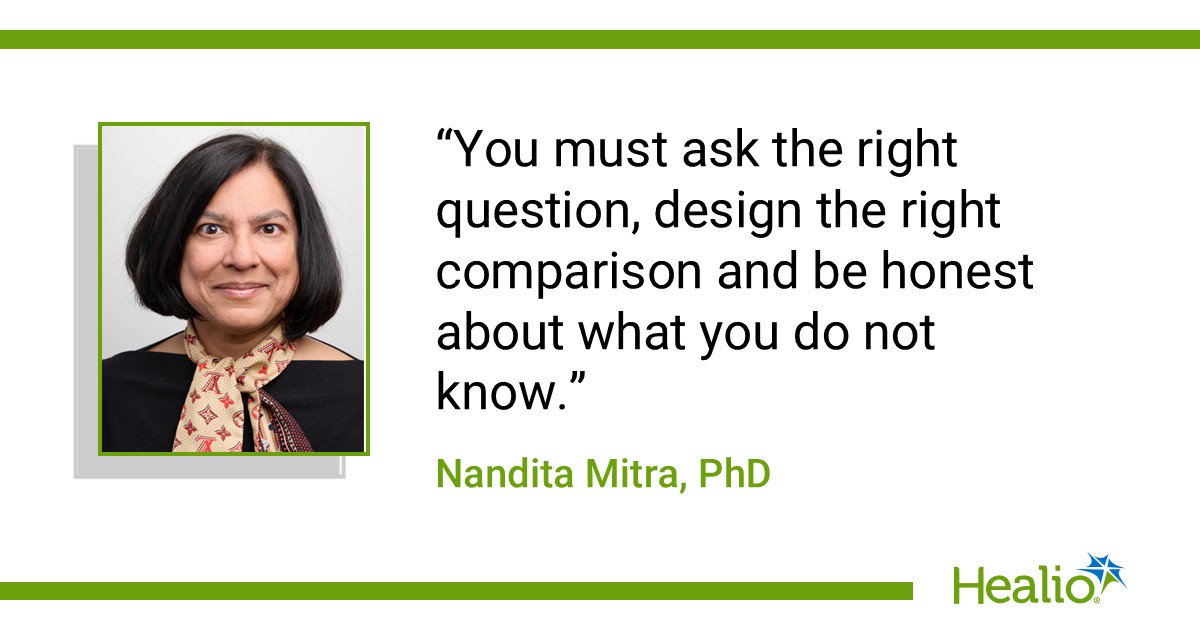
Causal inference is not a statistical method. It is a way of thinking about evidence. You must ask the right question, design the right comparison and be honest about what you do not know.
Can you answer the question that you want to answer using the data you have? Also, think very carefully about the design of the study. The next step is to think about the different causal assumptions. Do we have a clear comparator group that could be thought of as that counterfactual world? And then, we finally get to the statistical methods.
The methods have changed enormously over my career, but the questions I find myself asking have changed remarkably little.
For more information:
Nandita Mitra, PhD, is professor of biostatistics and codirector of the Center for Causal Inference at the Hospital of the University of Pennsylvania. Mitra can be reached at nanditam@pennmedicine.upenn.edu.
Sources/Disclosures
Source:
Mitra N. Causal inference in the real world: A matter of life and death. Presented at: Dermatology in Pharma Educational Collaborative; Nov. 6, 2026; Philadelphia.
References:
Disclosures:
Mitra reports no relevant financial disclosures.

Ask a clinical question and tap into Healio AI’s knowledge base.
- PubMed, enrolling/recruiting trials, guidelines
- Clinical Guidance, Healio CME, FDA news
- Healio’s exclusive daily news coverage of clinical data