November 17, 2026
7 min read

Key takeaways:
- Most users believe health information on social media is misleading, but many act on it anyway.
- Clinical visits offer a human connection that social media cannot.
Many Americans are getting information about their health from social media influencers and podcasts, whether or not they are actively looking for it.
And although most believe this information could be false or misleading, more than one-fifth say they act on it anyway, according to recent survey data (Pedroso et al).

“Every patient or parent is coming into their encounter with a self-diagnosis and preconceived ideas obtained from artificial intelligence or social media,” David R. Stukus, MD, a professor of clinical pediatrics at Nationwide Children’s Hospital who coauthored a paper on the social media health information landscape (Patrick et al), told Healio. “Unfortunately, their assessments are often incorrect, and that can lead to challenging conversations and dissatisfaction when expectations are not met.”
The phenomenon points to the deepening penetration of digital media into daily life, the increasing costs of healthcare, and a medical system leaving doctors with less time and energy for face-to-face patient interactions.

Aline F. Pedroso
“Patients are being exposed to health information from many different voices long before they ever walk into the clinic,” Aline F. Pedroso, PhD, associate research scientist at the Yale School of Medicine, told Healio. “They may spend hours each week on social media but only a few minutes with their healthcare provider every few months.”
It also means doctors have a new job: counterbalancing an online information ecosystem they may not even be aware of or have the bandwidth to keep up with.
“Clinicians need to appreciate that our patients all have access to infinite information online,” Stukus said. “We cannot and should not expect them to not look online for medical information. We can, however, help them navigate the bad and harmful information and offer perspective and options.”
Not ‘the final authority’
In a recent letter published in JAMA, Pedroso and her team reported data from the nationally representative 2024 Health Information National Trends Survey (HINTS) about how U.S. adults are navigating health information on social media.
Among the 87.8% who reported using social media (228 million people), more than one-fifth (21.6%) said they made health-related decisions based on what they saw on those platforms. Despite this, 77.7% of users reported believing that some or much of this information was false or misleading.
Those findings suggest “that people don’t have to fully trust information for it to influence their behavior,” Pedroso said. “Even if someone recognizes that information might not be completely accurate, repeated exposure can still shape how they think about their health and the choices they make.”
This dynamic may become even more sharply defined in the era of artificial intelligence, she said.
“As AI-generated content becomes more common, it will become increasingly difficult for people to distinguish between credible information and content that is entirely fabricated,” she said. “Future research needs to focus on developing strategies to promote credible health information and reduce the impact of misinformation in an increasingly AI-driven digital environment.”
Still, Pedroso stressed that even for those who use social media, it is not “the final authority.”
“They’re using it as a starting point to learn about symptoms, hear other people’s experiences or decide what questions to ask,” she said, adding, “Creating space for those conversations without judgment can help clinicians address misconceptions and guide patients toward reliable sources of information.”
Most social media users (70.2%) said they participated in online support groups for people with similar health or medical issues. Those with chronic conditions had a similar rate of social media use (85.5%) as those without and were “similarly likely … to report making health decisions based on what they saw online,” Pedroso said.
“The broader implication is that efforts to improve the quality of health information on social media shouldn’t focus only on patients with chronic diseases,” Pedroso said. “Social media is influencing health decisions across the population, making it an important target for public health communication and misinformation mitigation.”
The influence of influencers
In a recent Pew Research Center survey, 40% of U.S. adults reported getting health and wellness information from online influencers. That percentage rose to 52% among respondents aged 18 to 29 years.
Pedroso described influencers as “an important part of today’s social media landscape.”
“They’re among the most visible creators of health-related content, often reaching large audiences and shaping how people think about health, wellness and medical care,” she said.
Of those who said they get health information from influencers, 67% said they happen to come across it, whereas only one-third said they were actively looking for it.
The majority of those who got health information from influencers said it was at least “somewhat” different from that given by healthcare providers. Nearly one-fifth (18%) said it was “extremely/very” different. A larger minority (38%) said it was “not too/not at all” different.
Pew’s analysis of nearly 7,000 influencers found that fewer than half (41%) described themselves as any kind of healthcare professional. For 16%, no personal background or expertise were mentioned at all.
Stukus said that people without credentials or expertise are particularly likely to be driven by algorithms into making increasingly strong claims that may not be backed by evidence.
“They often resort to marketing tactics and fear-based messages to gain followers and make their recommendations appear more legitimate,” he said. “The more followers they gain, the bolder their claims become as they need to continue to feed the algorithm.”
In their paper on the social media health information landscape, Stukus and colleagues outlined several ways misinformation can appear: through cherry-picked data, “bold, specific” medical claims, ad hominem attacks, anecdotes and celebrity testimonials, and straw man arguments.
More than a quarter (26%) of respondents to the Pew survey said information from influencers made them “more worried” about their own health — particularly younger adults aged 18 to 29 years (36%).
Stukus said the influence of algorithms is a “slippery slope that most qualified experts recognize” — though credentials are still no guarantee against misinformation. He said experts can still fall “prey to the powerful algorithms.”

David R. Stukus
“I’m a pediatric allergist but can still read any research study, understand the methodology and results, then communicate that to a larger audience,” he said. “However, that doesn’t mean I actually … have expertise in diagnosis or management of conditions outside my area of expertise.”
Who is listening?
According to Pew, some groups were particularly likely to listen to health influencers: more than half of adults under age 50 and more than half of adults without insurance. It was also more common among Hispanic (47%), Black (44%) and Asian (48%) respondents than white respondents (35%).
Influencers were predominantly on three platforms: Instagram (86%), TikTok (62%) and YouTube (45%). People mainly reported listening to them out of a desire to make a change in their health or lifestyle, with 41% listing that as a major reason.
The results also suggest some may find online content more approachable or easier to consult than healthcare professionals: for 14%, a major reason they listened to influencers was to learn about things they do not want to ask their doctor about. This was more common among Black, Hispanic and Asian respondents (18%-19%) than white respondents (10%).
Hispanic users of social media were also particularly likely to make decisions about their health based on information from social media, according to the analysis of HINTS survey data — 70% more likely than white users.
Pedroso said several factors were likely involved in this, including “accessibility, language, cultural relevance, trust and the ease of finding communities with shared experiences.”
How to handle it
In their paper, Stukus and colleagues wrote that clinicians should assume every patient has looked up their symptoms online before their visit. Clinicians can also safely assume these patients came across non-evidence-based information along the way.
But if patients are spending hours every week on the internet, getting health information from influencers, social media, podcasts and AI — but seeing their doctor for minutes every few months — how should the field of medicine respond? What can individual doctors do?
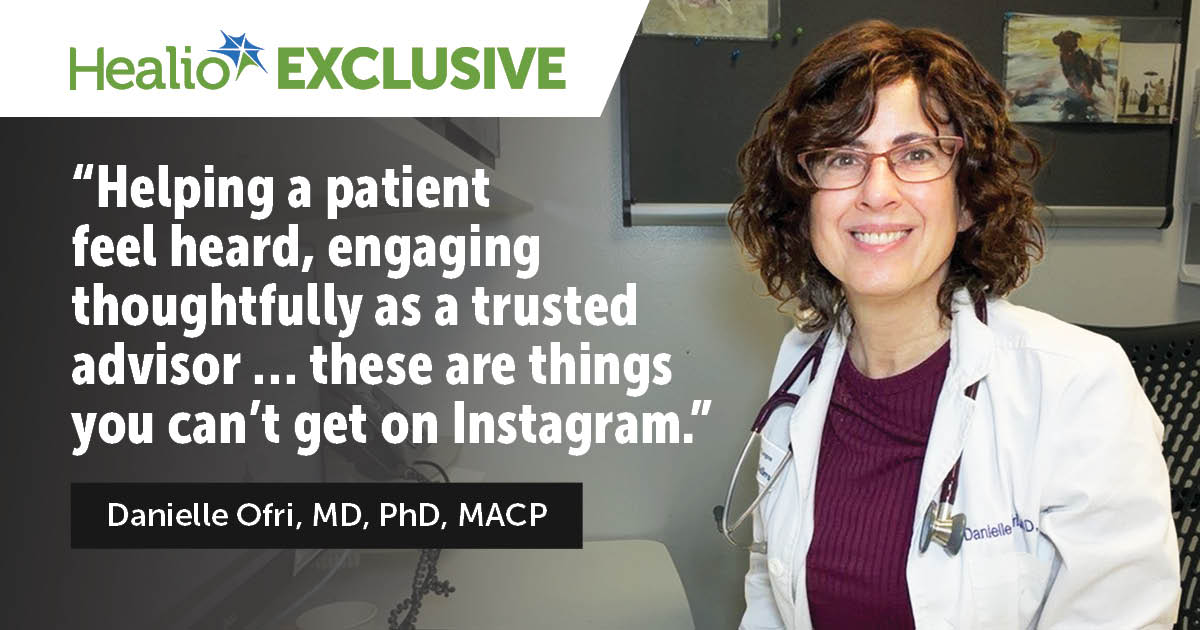
The situation presents no easy answers, Danielle Ofri, MD, PhD, MACP, clinical professor of medicine at Bellevue Hospital and NYU School of Medicine and author of several books on doctor-patient communication, told Healio.
“Solutions are tough because so many of them — ‘create your own content,’ ‘recommend trusted influencers,’ ‘respond to patients’ messages in the moment’ — just aren’t feasible for clinicians who are already spending their nights and weekends keeping up with electronic medical records,” Ofri said.
Stukus and colleagues proposed the following formula for a “conversation starter.” First, acknowledge that many patients search online for answers to medical questions and that it is not always easy to identify misinformation. Then, tell patients you want to be a “trusted resource” and encourage them to come to you with any questions, particularly if they see something different from what was discussed in the office.
Stukus added that some patients also need to be educated on the nature of the scientific process itself.
“Science is frustrating for many people, as it is not designed to offer definitive answers,” he said. “Evidence accumulates and often changes over time. That’s a good thing, but we need to communicate that so patients understand why advice may differ.”
Ofri said doctors should “lean into the human connection that our visits can offer.”
“Helping a patient feel heard, engaging thoughtfully as a trusted advisor, acting as an advocate in an unforgiving medical system — these are things you can’t get on Instagram,” she said.
“You only need one ‘follower’ to make the interaction meaningful,” Ofri said.
For more information:
Aline F. Pedroso, PhD, can be reached at aline.pedroso@yale.edu.
Sources/Disclosures
Source:
Healio Interviews
References:
Disclosures:
Ofri, Pedroso and Stukus report no relevant financial disclosures.

Ask a clinical question and tap into Healio AI’s knowledge base.
- PubMed, enrolling/recruiting trials, guidelines
- Clinical Guidance, Healio CME, FDA news
- Healio’s exclusive daily news coverage of clinical data