November 19, 2026
5 min read
Key takeaways:
- Dietary changes can make a meaningful difference in pain management.
- Michael Greger, MD, detailed evidence-based interventions for several conditions across medical specialties.
ORLANDO — Dietary changes can reduce chronic pain in a variety of conditions, one of the most prominent names in nutrition told Healio.
Michael Greger, MD, a founding member and fellow of the American College of Lifestyle Medicine (ACLM) and founder of NutritionFacts.org, will release a new book How Not to Hurt: Discover the Foods Scientifically Proven to Fight Pain, on Dec. 15.

Healio spoke with Greger at the ACLM’s annual meeting to catch up and learn more about the intersection between dietary interventions and pain management.
Healio: What are some examples of low-value or potentially harmful pain management practices that persist despite evidence of limited benefit?
Greger: We all know about the opioid epidemic: 75,000 overdose deaths annually. But what about the NSAID epidemic? NSAIDs — these nonsteroidal anti-inflammatory drugs like ibuprofen, naproxen — kill [thousands of] Americans annually from ulcers, strokes and heart attacks. Acetaminophen, considered one of the safest painkillers, is the leading cause of sudden liver failure even when taken at so-called “safe” doses following the instructions on the bottle, causes clinically significant liver damage in one in three individuals, and also can cause gastrointestinal blood loss and increase blood pressure.
Gabapentinoids, like Neurontin [gabapentin; Pfizer, Viatris] and Lyrica [pregabalin, Viatris] are prescribed heavily for a variety of pain conditions, of which they fail to meaningfully reduce pain about 90% of the time, but can cause cognitive impairment, fatigue and dizziness in up to one in six users, along with physical dependence.
Invasive surgeries and injections — there have been [at least 50] randomized control trials comparing interventional pain procedures to fake or sham procedures, the majority of which were found to be shams themselves. So, for example, arthroscopic knee surgery, rotator cuff surgery, vertebroplasty, epidural steroid injections cause more harm than good. Tennis elbow steroid injections not only worsens long-term function but quadruples the risk for the condition coming back. So, you go to your doctor, and he does something that makes something worse and quadruples the risk of it coming back? Now, that is a business model. And for those physical therapists out there who are getting all smug and thinking, “I knew that conventional pain management approaches were not science based.” They should know that therapeutic ultrasounds, lasers, infrared light, TENS [transcutaneous electrical nerve stimulation] units, kinesio taping, chiropractic and osteopathic manipulation fail to beat out sham controls in rigorous trials.
Healio: Can you share some examples of dietary interventions that have strong evidence for reducing chronic pain?
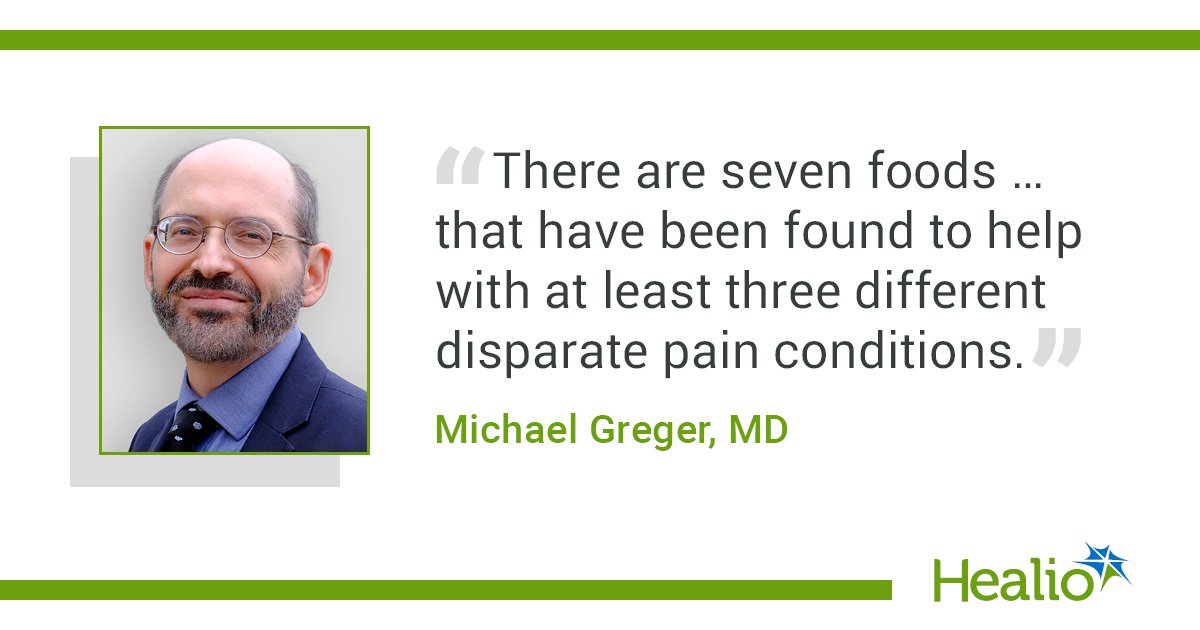
Greger: There are specific foods. There are seven foods — my so-called soothing seven — that have been found to help with at least three different disparate pain conditions, suggesting broad pain-relieving effects, all of which are plant foods. So, what about centering one’s entire diet around whole healthy plant foods found to significantly improve diabetic neuropathy, angina, claudication from peripheral artery disease, inflammatory bowel disease, rheumatoid arthritis, osteoarthritis, trigeminal neuralgia, migraine headaches, acid reflux and irritable bowel syndrome?
Healio: How do the effects of these dietary interventions compare with commonly prescribed medications?
Greger: An aged spoon of ground ginger makes 44% of migraine patients pain free within 2 hours, which is exactly the percentage that the billion-dollar prescription drug sumatriptan does, but instead of one in five drug users suffering dizziness, sedation or vertigo, there were no such side effects for those taking a ginger powder. Diabetic neuropathy, for example — one of the most frustrating conditions in all of medicine to treat; there’s very little we can offer these patients — whereas switching people to a whole-food, plant-based diet achieved complete relief of pain, severe burning, painful diabetic neuropathy in 17 out of 21 patients within days — between 4 to [16] days. So, 75% essentially cured with a safe, nontoxic treatment: a diet centered around whole-plant foods.
Healio: How much of the benefit from dietary interventions appears attributable to specific foods or nutrients as opposed to broader changes in dietary patterns or body weight?
Greger: In the famous Plants for Joints trials for both knee and hip osteoarthritis and rheumatoid arthritis, the significant improvements in joint pain, stiffness and physical function occurred independent of weight loss. And for migraine trials, portion-controlled caloric restriction — meaning weight loss alone — failed to reduce headache severity, whereas improving dietary quality — so, causing the same amount of weight loss but by switching people to a plant-based diet — succeeded in reducing headache severity.
Healio: How long might patients need to follow a dietary intervention before experiencing meaningful improvements in pain?
Greger: Well, for acute migraines, between 30 minutes and 2 hours for ginger powder. For acid reflux, within hours of switching of people between a high-fat animal meal to a low-fat plant meal can get significant reduction in esophageal acid exposure. I talked about complete relief of pain and diabetic neuropathy between 4 to [16] days. Angina, chest pain frequency dropped 90% within 24 days.
Then, in terms of things that may take weeks to help: tritium neuralgia pain scores fell from nine out of 10 to 1 out of 10 after an average of 16 days on a low saturated fat diet. Claudication, leg pain during walking, was eliminated within 26 days. And for osteoarthritis and rheumatoid arthritis, there are significant reductions in joint pain, stiffness and improvements in vitality within 1 to 2 weeks on a whole-food, plant-based diet.
In terms of things that take months: for endometriosis, an eighth of a teaspoon a day of garlic powder reduces pelvic pain from a 7 out of 10 to a 1 or 2 out of 10 within 3 months after three menstrual cycles. For cyclical mastalgia, which is breast pain associated with menstruation, there is a 70% drop in breast pain intensity over two menstrual cycles. Inflammatory bowel disease showing mucosal healing sustained clinical remission within 1 to 3 months, maintained long term.
For more information:
Michael Greger, MD, can be reached at primarycare@healio.com.
Sources/Disclosures
Source:
Healio Interviews
References:
- Adams JD, et al. Front Pharmacol. 2024;doi:10.3389/fphar.2024.1496510.
- Amirsalari S, et al. Evid Based Complement Alternat Med. 2021;doi:10.1155/2021/5547058.
- Becker DJ, et al. Am J Gastroenterol. 1989;PMID:2741888.
- Brune K, et al. Eur J Pain. 2015;doi:10.1002/ejp.621.
- Bunner AE, et al. J Headache Pain. 2014;doi:10.1186/1129-2377-15-69.
- Clinton CM, et al. Arthritis. 2015;doi:10.1155/2015/708152.
- Coombes BK, et al. JAMA. 2013;doi:10.1001/jama.2013.129.
- Crane MG, et al. J Nutritional Med. 1993;doi:10.3109/13590849409003592.
- Gupta R, et al. Eur J Prev Cardio. 2022;doi:10.1093/eurjpc/zwac112.
- Jonas WB, et al. BMJ Open. 2015;doi:10.1136/bmjopen-2015-009655.
- Maghbooli M, et al. Phytother Res. 2014;doi:10.1002/ptr.4996.
- Mitsuyama K, et al. Ailment Pharmacol Ther. 1998;doi:10.1046/j.1365-2036.1998.00432.x
- Moore A, et al. JAMA. 2014;doi:10.1001/jama.2014.6336.
- Ornish D, et al. JAMA. 1998;doi:10.1001/jama.280.23.2001.
- Shanthanna H, et al. PLoS Med. 2017;doi:10.1371/journal.pmed.1002369.
- The effects of an intensive 26-day program of diet and exercise on patients with peripheral vascular disease. https://nutritionfacts.app.box.com/s/fsfnafpymojdards1djh6wuhb5mxlhuc. Published 1982.
- Treating breast pain with diet. https://nutritionfacts.org/blog/treating-breast-pain-with-diet/. Published Nov. 7, 2013. Accessed Nov. 11, 2026.
- Vaziri F, et al. Int J Family Med. 2014;doi:10.1155/2014/174532.
- Verma N, et al. Open J Prev Med. 2013;doi:10.4236/ojpm.2013.36054.
- Walrabenstein W, et al. Osteoarthritis Cartilage. 2023;doi:10.1016/j.joca.2023.05.014.
- Walrabenstein W, et al. Rheumatology (Oxford). 2023;doi:10.1093/rheumatology/keac693. Watkins PB, et al. JAMA. 2006;doi:10.1001/jama.296.1.87.
Disclosures:
Greger reports no relevant financial disclosures.

Ask a clinical question and tap into Healio AI’s knowledge base.
- PubMed, enrolling/recruiting trials, guidelines
- Clinical Guidance, Healio CME, FDA news
- Healio’s exclusive daily news coverage of clinical data