November 20, 2026
2 min read

Key takeaways:
- Letting dinner linger too long on the table increases the risk for bacteria in your leftovers.
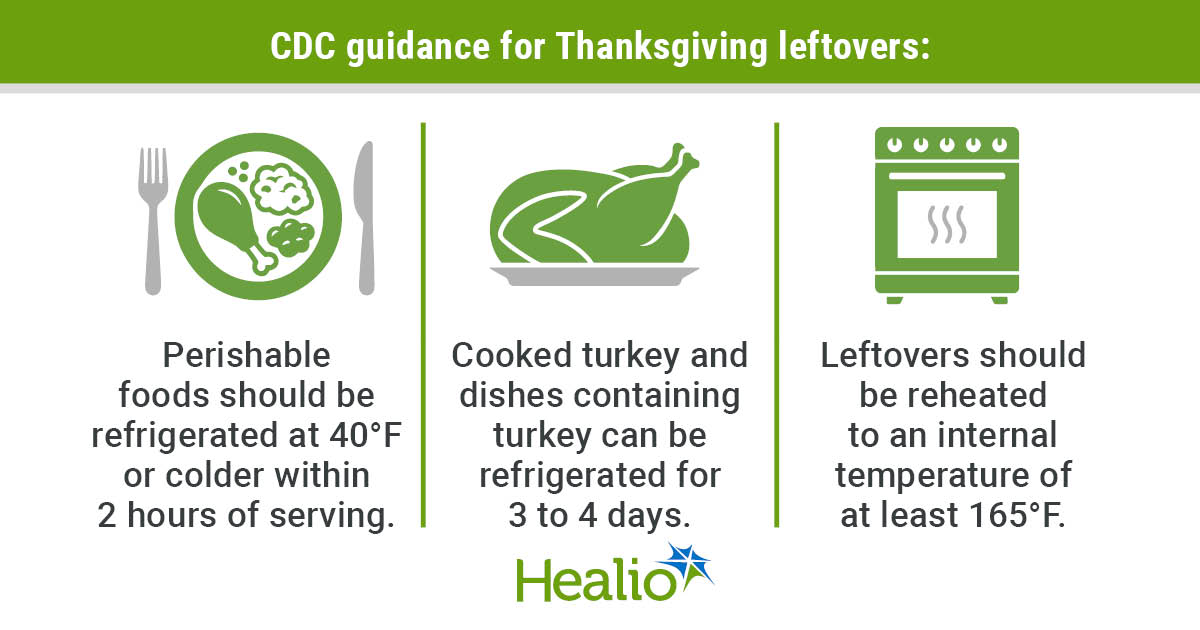
- CDC guidance says perishable foods should be refrigerated at 40°F or colder within 2 hours of serving.
Four months after Thanksgiving, chef Andrew Zimmern was still enjoying the holiday’s leftovers.
The celebrity chef had made too much stuffing for Thanksgiving dinner, so on the third day after the holiday, he transformed what remained into a savory bread pudding, baked it and tucked it into the freezer for safekeeping.

Months later, Zimmern pulled it out to accompany chicken he had grilled in his fireplace, along with some leftover gravy.
“We had a whole completely different meal,” Zimmern recalled.
For Zimmern, enjoying Thanksgiving leftovers months later begins with handling them safely the moment dinner hits the table.
Don’t let leftovers linger
William Schaffner, MD, a Healio | Infectious Disease News Editorial Board Member and professor of preventive medicine and infectious diseases at Vanderbilt University Medical Center, said the period after Thanksgiving dinner can present a food safety risk.
He said guests may become distracted by games, conversations or naps, leaving food at room temperature for longer than intended.
“I think the important thing is, after you’ve enjoyed your wonderfully cooked meal, clean up those leftovers and get them into the refrigerator as quickly as possible,” Schaffner told Healio.
According to the CDC, perishable foods should be refrigerated at 40°F or colder within 2 hours of serving, or within 1 hour when exposed to temperatures above 90°F.
Schaffner warned that reheating cannot reliably make improperly stored food safe.
“I don’t think that there’s anyone in public health who would recommend reheating food that has been left out for prolonged periods of time,” he said.
Instead, he recommended discarding food that may not have been handled safely.
“‘When in doubt, throw it out’ is the mantra,” he said.
Zimmern takes an organized approach to post-meal cleanup, assigning a small group of guests to handle leftovers while others wash dishes or prepare dessert.
“It’s always the same two or three of us every year,” Zimmern told Healio. “It’s sort of like my little leftover squad, right?”
One of his biggest concerns is how long dense portions of food can take to cool in the refrigerator.
To speed the process, he spreads leftovers into thin layers in oversized resealable bags rather than packing them into deep containers.
“My biggest concern is getting it rapidly cold,” he said.
The CDC similarly recommends dividing large portions of food into smaller pieces and refrigerating them promptly to promote faster cooling.
How long are leftovers safe?
Zimmern said leftovers typically disappear from his household within 3 days.
“You have 3 days to either eat it, toss it or repurpose it,” he said.
According to the CDC, cooked turkey and dishes containing turkey can be refrigerated for 3 to 4 days. Per the agency, leftovers should be reheated to an internal temperature of at least 165°F.
And, Zimmern added, “You don’t reheat it to warm. You reheat it to hot.”
For home cooks hoping to enjoy their Thanksgiving favorites well beyond the holiday, proper storage is essential, and leftovers intended for longer-term storage should be frozen within the recommended refrigeration window.
Of course, preserving those leftovers for another day begins with putting them away promptly.
Zimmern recommended making leftover storage part of the immediate post-meal cleanup routine rather than waiting until guests have finished dessert.
“Don’t wait till after dessert,” he said. “Dessert can wait. Dessert should wait.”
For more information
William Schaffner, MD, can be reached at william.schaffner@vumc.org.
Andrew Zimmern can be reached at infectiousdisease@healio.com.
Sources/Disclosures
Source:
Healio Interviews
Reference:
Disclosures:
Schaffner and Zimmern report no relevant financial disclosures.

Ask a clinical question and tap into Healio AI’s knowledge base.
- PubMed, enrolling/recruiting trials, guidelines
- Clinical Guidance, Healio CME, FDA news
- Healio’s exclusive daily news coverage of clinical data