
Key takeaways:
- Trials on ultraprocessed foods are often limited by their crossover design and control diets.
- Adjusting for nutritional factors like texture and high-calorie density may explain the effects of these foods.
Randomized controlled trials may not properly capture ultraprocessed foods’ health effects due to their designs and limitations, experts suggest.
In a commentary published in Science, Faidon Magkos, MSc, PhD, a professor of obesity and metabolism at University of Copenhagen in Denmark, and colleagues used five clinical trials in the United States, United Kingdom, Denmark and Japan to demonstrate their case.

The findings of these trials on ultraprocessed foods (UPFs) “have been highly publicized and widely communicated, often in ways that suggest that ultraprocessing is inherently harmful to health.”
“The design of these clinical trials, however, makes it very difficult to attribute the unfavorable effects of UPF-rich diets to ultraprocessing per se,” they wrote. “Instead, these effects are highly likely to be due to differences in traditional nutritional properties that frequently — but not uniformly — co-occur in UPFs.”
Magkos and colleagues pointed out that all the trials used a crossover design, where the study participants were randomly given UPFs and non-UPF diets in an inpatient setting, outpatient setting or “through a combination of supervised and unsupervised eating.”
“This ‘feeding’ trial design prevents confounding from varying diet adherence that occurs in ‘diet advice’ studies,” the authors wrote.
Further, Magkos and colleagues said the minimally processed diets used in the studies “might not constitute appropriate controls, as they represent interventions of equal or greater intensity than UPF-rich diets.”
They noted that the effects of UPFs in these studies are likely attributed to factors like texture and high saturated fat and salt amounts, which impact health “regardless of the degree of food processing.”
As a result of the trials’ limitations, Magkos and colleagues said there is currently “weak support for an ultraprocessing-specific effect of UPFs on body weight regulation and cardiometabolic function that is independent of established nutritional determinants.”
Healio spoke with Magkos about why nutritional variables are overlooked in these trials, how future dietary guidance could change amid weak evidence on UPFs, and more.
Healio: Why are some of these important variables like food texture overlooked in trials? And how will incorporating these variables into future studies affect the outcomes?
Magkos: Food texture, eating rate and calorie density are rarely measured because most nutrition trials are designed around nutrient content and nutritional composition of the diet, not the physical properties of foods (which is yet another important dimension of the diet, affected by multiple factors including preparation and cooking methods and level of food processing — but not necessarily “ultraprocessing”). Yet these variables strongly influence ad libitum energy intake and can fully account for the differences attributed to UPFs in these randomized trials. Incorporating them into future studies will allow us to separate the effects of ultraprocessing from the effects of energy density, texture, fiber and sodium contents, and so on — revealing whether ultraprocessing itself has any independent physiological impact. For the time being, this does not appear to be the case.
Healio: If ultraprocessing is not the primary driver of negative health outcomes, what could explain the consistently observed associations between high UPF consumption and poor outcomes?
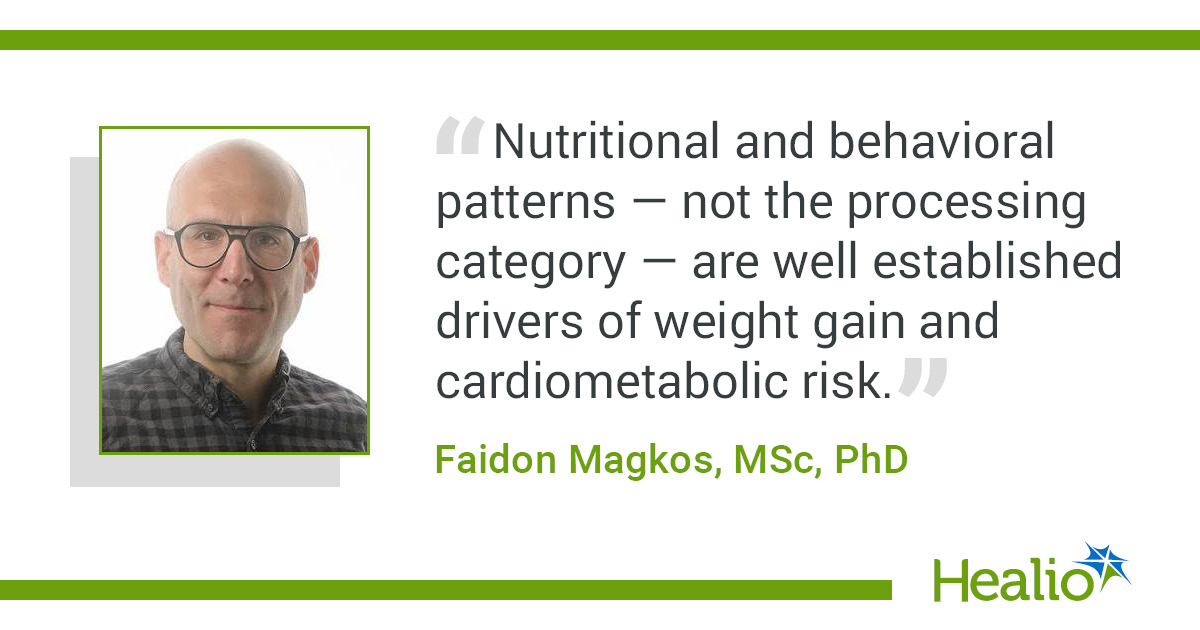
Magkos: High UPF intake often co-occurs with diets that are calorie dense, low in fiber and protein, high in sodium and saturated fat, and dominated by soft, rapidly consumed foods. These nutritional and behavioral patterns — not the processing category — are well established drivers of weight gain and cardiometabolic risk. Observational studies capture these co-occurring features, so UPF intake becomes a proxy for overall dietary quality and eating behaviors rather than a causal driver in its own right.
Healio: If future research shows that ultraprocessing itself has little effect on health, how would that change current dietary recommendations?
Magkos: Most current dietary guidelines do not use UPF classifications, and rightfully so. However, they do suggest prioritizing whole and minimally processed foods whenever possible, and this recommendation should not change. Recommendations already emphasize nutritional quality — fiber, whole grains, unsaturated fats, lower sodium and limiting energy dense, nutrient poor foods. If future research confirms that ultraprocessing per se has little independent effect on health, it would reinforce the value of sticking with these established principles rather than adopting processing-based frameworks like NOVA. It would also help prevent well-intentioned but misleading messages that lump nutritionally sound foods together with clearly unhealthy ones. Recommendations should become more precise — encouraging people to choose foods that promote satiety, slow eating and lower energy density, regardless of whether they come with an “ultraprocessing” label.
Healio: What advice should PCPs give to patients who are confused by conflicting messages about processed foods?
Magkos: Tell patients that the goal is not to avoid all UPFs but to prioritize foods that are higher in fiber and protein, lower in energy density and harder in texture so they are slower to eat. Emphasize that texture, calorie density, and nutritional quality matter far more for weight and metabolic health than whether a food is classified as “ultraprocessed.” This reframes the conversation in practical, achievable terms and avoids the confusion created by broad processing labels.
For more information:
Faidon Magkos, MSc, PhD, can be reached at primarycare@healio.com.
Sources/Disclosures
Source:
Healio Interviews
References:
Disclosures:
Magkos reports receiving support from Arla Food for Health, Independent Research Fund Denmark, Novo Nordisk Foundation, and Sino-Danish Center for Education and Research. Please see the study for all other authors’ relevant financial disclosures.

Ask a clinical question and tap into Healio AI’s knowledge base.
- PubMed, enrolling/recruiting trials, guidelines
- Clinical Guidance, Healio CME, FDA news
- Healio’s exclusive daily news coverage of clinical data