

Key takeaways:
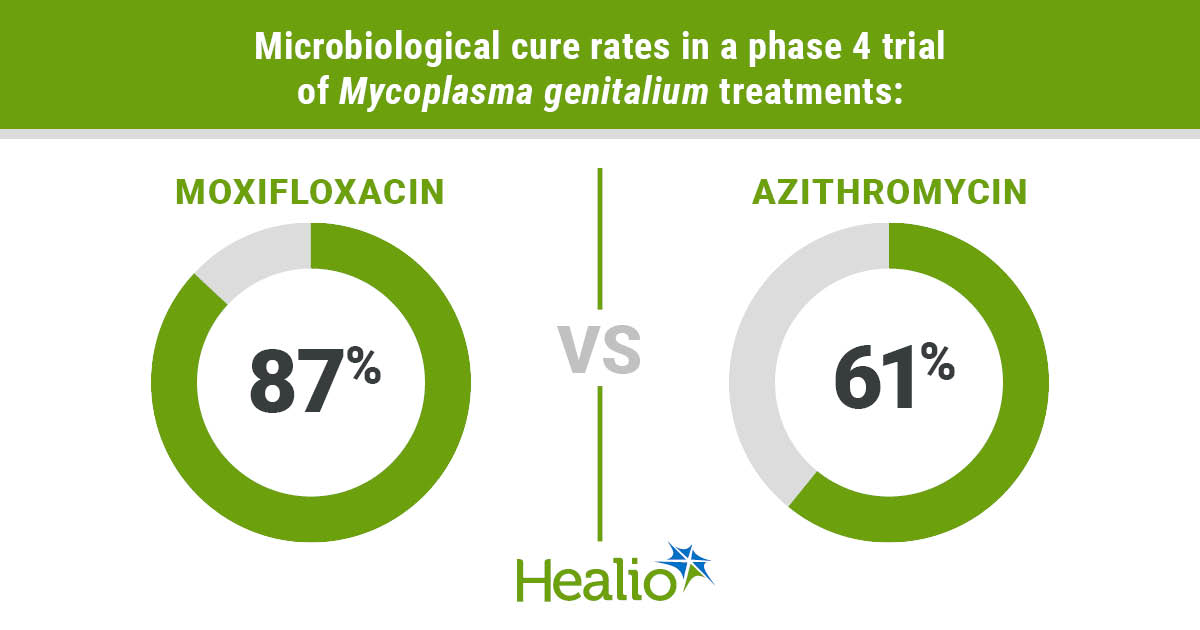
- A phase 4 trial demonstrated an 87% cure rate for moxifloxacin in treating Mycoplasma genitalium.
- A researcher said it is “not surprising” moxifloxacin performed better than azithromycin.
A study that compared the efficacy of moxifloxacin vs. azithromycin in treating Mycoplasma genitalium — an STI with a rising resistance to antibiotics — showed that moxifloxacin was the clear winner.
In the phase 4 randomized trial, a 10-day regimen of moxifloxacin yielded a significantly higher microbiologic cure rate compared with a 6-day regimen of azithromycin (87% vs. 61.2%; absolute risk difference, 25.8%; 95% CI, 16.5%-35.2%), supporting moxifloxacin as an empiric first-line treatment.

Data derived from Rossotti R, et al. Clin Infect Dis. 2026;doi:10.1093/cid/ciag317.
The study pointed out, however, that azithromycin “showed comparable efficacy” among heterosexual participants.
“It is not surprising that moxifloxacin performs better than azithromycin in a population largely composed of” gay, bisexual and other men who have sex with men (MSM), the study’s lead author, Roberto Rossotti, MD, associate professor of infectious diseases at University of Verona in Italy, told Healio. “But it is surprising that this performance is comparable to that observed with the resistance-guided approach, saving 4 days of treatment and one class of antibiotics.”
M. genitalium is a common STI that causes a burning while urinating and discharge from the vagina or penis, according to the CDC.
eatment has become tricky due to a macrolide resistance to azithromycin, once a first-line treatment, with resistance rising from 10% before 2010 to 51% in 2016-2017, researchers reported.
Rossotti and colleagues conducted the trial in a tertiary care hospital located in Milan from January 2018 to June 2024. They randomly assigned 358 patients (median age, 36 years; 96.6% men; 94.1% gay, bisexual and other MSM; 5.9% heterosexual) to moxifloxacin (53.9%; n = 193) or azithromycin (46.1%; n = 165). Moxifloxacin was administered as a once-daily 400 mg dose for 10 days, whereas azithromycin was given as a 500 mg daily dose for 6 days.
In addition to the main finding, the study showed a success rate of moxifloxacin in retreatment. Specifically, 96.8% of participants (30 out of 31) who failed an initial round of azithromycin were cured with moxifloxacin, whereas a second round of azithromycin only cured 60% of individuals (nine out of 15; P = .003).
The study also found that co-administering doxycycline did not enhance treatment outcomes in either group.
“A 10-day course of moxifloxacin may achieve 90% microbiologic success even if a resistance test is not available,” Rossotti said.
M. genitalium is a leading cause of non-gonococcal urethritis in men and linked to cervicitis in women, the CDC reported.
Meanwhile, Rossotti said the study gives clinicians hope in treating the stubborn infection. “We may be reassured about the everyday clinical management of (M. genitalium) based on a relatively short course of quinolone therapy alone,” he said.
For more information:
Roberto Rossotti, MD, can be reached at infectiousdisease@healio.com.
Perspective

Management of M. genitalium remains challenging for many reasons, including limited access to macrolide resistance testing despite a high prevalence of resistant infections. The results of this study comparing monotherapy for M. genitalium with azithromycin vs. moxifloxacin illustrate the consequences of this prevalence; rates of azithromycin treatment failure roughly correspond to reported rates of macrolide resistance in Europe.
U.S. and U.K. guidelines only recommend azithromycin use when M. genitalium susceptibility is confirmed, and after a preceding week of doxycycline. This strategy enables successful use of azithromycin in M. genitalium treatment while avoiding de novo resistance, and stewards moxifloxacin, currently the only other widely available therapy for this infection in the U.S. Where resistance testing is not available, sequential therapy with doxycycline and moxifloxacin remains the standard for patients who are not pregnant.
The utility of doxycycline (and other agents) as a part of moxifloxacin-based M. genitalium regimens merits further study, especially as rates of quinolone resistance rise. The relatively small number of patients receiving doxycycline in this study limits conclusions as to its role (or lack thereof) alongside moxifloxacin. Future efforts to improve M. genitalium therapy need to address access to macrolide (and potentially fluoroquinolone) resistance testing and rigorously compare treatment strategies that minimize antibiotic exposure and steward available agents without sacrificing efficacy.
Jacob McLean, DO
Disclosures: McLean reports no relevant financial disclosures.

Ask a clinical question and tap into Healio AI’s knowledge base.
- PubMed, enrolling/recruiting trials, guidelines
- Clinical Guidance, Healio CME, FDA news
- Healio’s exclusive daily news coverage of clinical data