
Key takeaways:
- Individuals who drank one sugar-sweetened beverage per day had increased risk for hepatocellular carcinoma and intrahepatic cholangiocarcinoma.
- Artificially sweetened beverages did not increase risk.
Consuming sugar-sweetened beverages may significantly increase the risk for specific types of liver cancer.
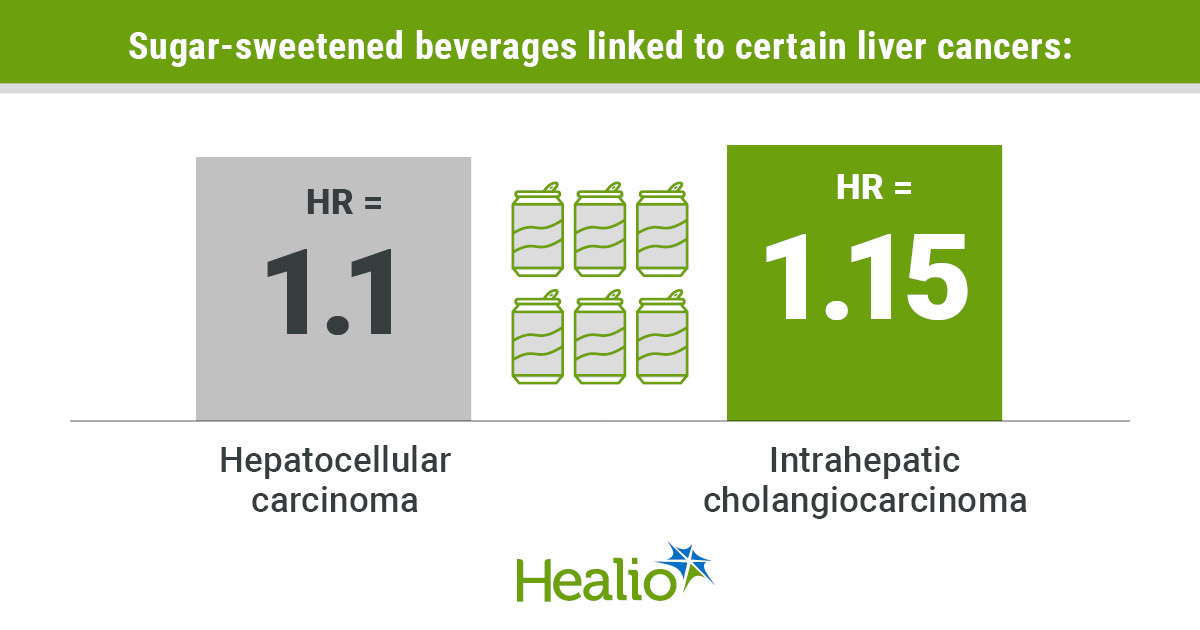
A pooled analysis including more than a million individuals found those who drank one sugar-sweetened beverage per day had a 10% greater risk for hepatocellular carcinoma and 15% greater risk for intrahepatic cholangiocarcinoma (ICC).

Data derived from Watling CZ, et al. JAMA Netw Open. 2026;doi:10.1001/jamanetworkopen.2026.17754.
Artificially sweetened beverages did not significantly increase the risk for any form of liver cancer.
“The overall evidence for an association in humans between artificially sweetened beverages and liver cancer, and more specifically aspartame and HCC, is not strongly supported by these analyses,” Cody Z. Watling, DPhil, postdoctoral fellow in the division of cancer epidemiology and genetics at NCI, and colleagues wrote. “Based on this study and prior research associating sugar-sweetened beverages with adverse outcomes, individuals may benefit from reducing their intake of sugar-sweetened beverages.”
Unknown risk factor?
Global liver cancer diagnoses are projected to increase 55% by 2040, according to study background.
In the U.S., more than 42,000 individuals are expected to be diagnosed in 2026, and nearly 31,000 will die from the disease, according to American Cancer Society’s Cancer Statistics 2026 report.
Common risk factors for HCC, the most diagnosed form of the disease, include chronic hepatitis B or C virus infection, excessive alcohol use, smoking, metabolic dysfunction-associated steatotic liver disease (MASLD), obesity and diabetes.
“However, an estimated 35% of HCC cases are not explained by known risk factors,” researchers wrote.
Prior studies have produced mixed results on the potential association between aspartame, an artificial sweetener, and liver cancer.
Previous research has associated sugar-sweetened beverages with multiple risk factors for liver cancer, including diabetes, MASLD and weight gain, but prospective studies have been limited in investigating the link to the malignancy itself.
“We aimed to investigate associations between intake of artificially sweetened beverages and sugar-sweetened beverages and risk of total liver cancer, HCC and ICC,” researchers wrote.
The pooled analysis of 11 prospective cohort studies included 1,518,411 participants (mean age, 57.8 years; standard deviation, 10.1; 58.2% women; mean BMI, 26.5 kg/m2, standard deviation, 5) who had no history of cancer. Enrollment across cohorts stretched from 1980 to 2009, and the overall study population had a median follow-up of 17.8 years.
Participants self-reported intake of artificially sweetened and sugar-sweetened beverages. Incident liver cancer, HCC and ICC served as the primary endpoint.
‘The largest study’
Researchers did not observe a significant association with artificially sweetened beverages and liver cancer, HCC or ICC.
“In models not adjusted for diabetes or BMI, we observed positive associations between artificially sweetened beverage consumption and liver cancer risk, but after adjustment for these confounders was made, outcomes were attenuated and there were no longer associations,” researchers wrote. “In most cohorts, participants who consumed one or more artificially sweetened beverages per day were more likely to have been diagnosed with diabetes and have a higher BMI at baseline than individuals who never or rarely consumed artificially sweetened beverages.”
Watling and colleagues did find sugar-sweetened beverages had a significant association with both HCC (HR per 1 drink/day intake = 1.1; 95% CI, 1.03-1.18) and ICC (HR per 1 beverage/day intake = 1.15; 95% CI, 1-1.32), but not overall liver cancer.
Individuals with baseline diabetes had similar risks for liver cancer regardless of their consumption of artificially sweetened and sugar-sweetened beverages.
“It remains unclear whether increased consumption of sugar-sweetened beverages contributes to increased risk of HCC independent of obesity and diabetes,” researchers wrote.
Watling and colleagues acknowledged study limitations, including self-reported consumption of artificially sweetened and sugar-sweetened beverages, and inability to stratify for underlying liver disease, including MASLD.
“To our knowledge, this is the largest study to date to assess the association of artificially sweetened beverage and sugar-sweetened beverage intake with liver cancer risk,” they wrote.
Perspective

The results were not particularly surprising, striking or unexpected, though they were drawn from a very thorough pooled analysis of studies with extended follow-up.
This pooled analysis confirmed a very mild increased risk for liver cancer associated with sugar-sweetened beverages, but it did not demonstrate a significantly increased or reduced risk for liver cancer associated with the consumption of artificially sweetened beverages.
It is difficult to determine if the risk associated with sugar-sweetened beverages is truly causal in nature or not. Given that these beverages have little to no nutritional value beyond the sugar itself, it may be wise to limit consumption.
Importantly, the risks are not nearly as striking as those of other well-established risk factors for liver cancer, including liver cirrhosis or chronic infection with viral hepatitis B or C. Vaccination for hepatitis B, screening/treatment of hepatitis C, and avoiding exposure to known liver toxins, such as alcohol or aflatoxins, remain the bedrock recommendations for liver cancer prevention.
It will be important to continue to investigate the possible associations between consumption of these beverages and other cancers or health hazards.
Ernest Hawk, MD, MPH
Disclosures: Hawk reports no relevant financial disclosures.
Sources/Disclosures
Source:
Watling CZ, et al. JAMA Netw Open. 2026;doi:10.1001/jamanetworkopen.2026.17754.
Reference:
Disclosures:
Watling reports no relevant financial disclosures. Please see the study for all other authors’ relevant financial disclosures.

Ask a clinical question and tap into Healio AI’s knowledge base.
- PubMed, enrolling/recruiting trials, guidelines
- Clinical Guidance, Healio CME, FDA news
- Healio’s exclusive daily news coverage of clinical data