
Key takeaways:
- More than 90% of clinicians agree spiritual care is critical within cancer care.
- However, twice as many clinicians never screen for spiritual distress as those who always screen for it.
Most clinicians agree that spiritual care is “essential” to taking care of patients with cancer, but only a fraction routinely screen for distress.
In a survey of nearly 700 oncologists, hematologists and palliative care clinicians, more than 90% agreed spiritual suffering can negatively affect outcomes, yet many of those respondents reported screening should not be part of their professional role, and less than 15% said they always screened for spiritual distress.

Data derived from Ripamonti CI, et al. JCO Oncol Pract. 2026;doi:10.1200/OP-25-01129.
“If the goal of treatment is healing or prolonging survival with a good quality of life, for patients who request it, spiritual care must be part of the strategy for total management of the patient’s well-being,” Carla I. Ripamonti, MD, of the department of medical and surgical specialties, radiological sciences and public health at University of Brescia in Italy, told Healio.
‘Unaddressed’ needs
Between 20% and 30% of patients with cancer experience spiritual distress, Ripamonti said.
“Although spiritual needs are studied mainly in the context of patients with advanced cancer and at the end of life, patients often develop spiritual needs upon the cancer diagnosis, with the increase in the first 6 months following diagnosis regardless of the severity of the cancer, during the course of disease and its treatments, as well during remission,” she explained.
Healio previously detailed how spiritual care can benefit patients with cancer, including helping them understand their disease and discussing topics such as death. It also can help with pain, anxiety, depression, coping, and overall well-being.
Multiple guidelines, including WHO palliative care framework, acknowledge spiritual health is a critical piece of care, according to study background.
“In a recent systematic review and expert consensus, it emerges that for patients with serious illness, spirituality is important for most of them, spiritual needs are common and spiritual care is very frequently desired by those patients,” Ripamonti said. “Moreover, in that setting, spirituality can influence medical decision-making. The provision of spiritual care in the medical care was associated with better end-of-life outcomes, while unaddressed spiritual needs can be associated with poorer patient quality of life.
“Despite these results based on highest-quality evidence, spiritual needs of patients with serious illness are still frequently unaddressed within medical care.”
Ripamonti and colleagues conducted a cross-sectional online survey from Dec. 23, 2024, to Feb. 7, 2025, to assess spiritual care from the viewpoint of clinicians from 55 countries.
The survey had 670 respondents (mean age, 47.8 years; standard deviation, 12.3; 64% women; 57% from Europe; 34% from North America).
Most respondents were oncologists/hematologists (36%) or palliative care physicians (33%), and worked at general hospitals (39%), comprehensive cancer centers (28%) or academic facilities (28%).
Perceptions, practices and barriers to providing spiritual care served as primary outcomes.
‘A public health problem’
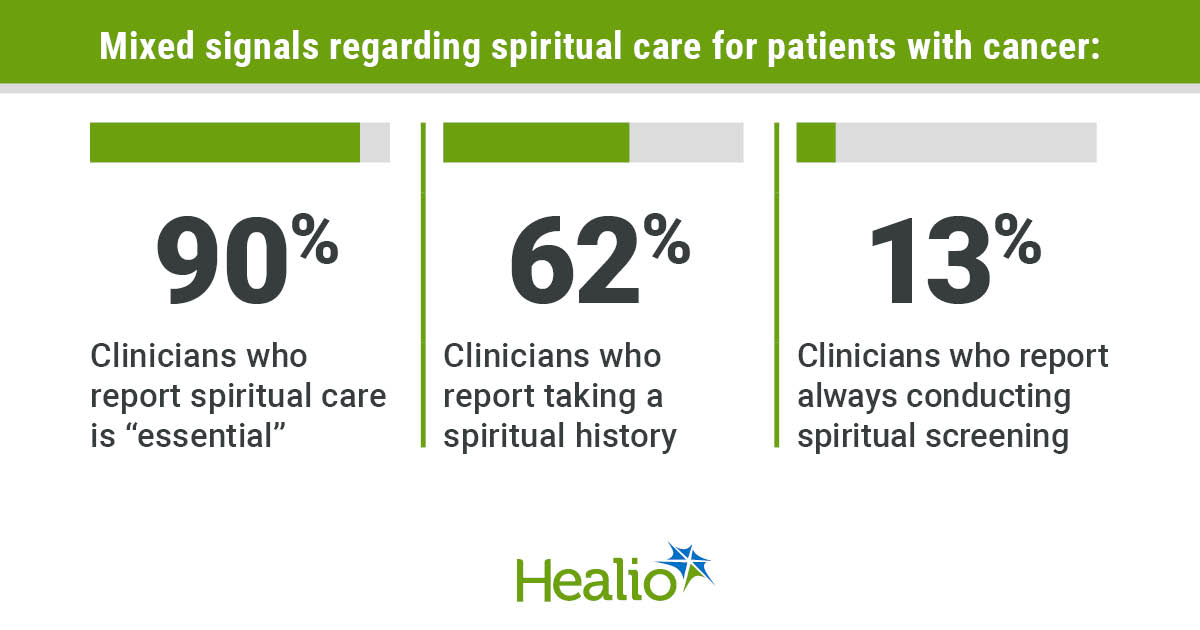
The vast majority of respondents agreed spiritual care is an “essential” part of cancer care (90%) and that spiritual distress can negatively impact a patient’s quality of life (92%). Most also agreed that taking a spiritual history shows “respect” to patients, even if clinicians do not have the same beliefs (93%), and that all clinicians who care for patients should take a spiritual history as part of a whole-person assessment and plan (75%).
These data “positively surprised us,” Ripamonti said.
However, when discussing their own professional roles, only 72% of respondents agreed they should discuss spirituality, 65% reported they should be ones conducting spiritual screening, and 62% said taking a spiritual history constituted part of their job.
“It did not surprise us that in routine clinical practice, there is still little attention to the evaluation of spiritual needs, even through simple screening by asking the patient simple questions such as, ‘Is spirituality or faith important to you in thinking about your health and illness?’ Or, ‘Do you have, or would you like to have, someone you can talk to about spiritual or faith matters?’” Ripamonti said.
Compared with palliative care physicians, oncologists had a significantly lower likelihood of reporting spiritual care as part of their professional role (adjusted OR = 0.27; 95% CI, 0.12-0.59), that they screened for spiritual distress (aOR = 0.44; 95% CI, 0.21-0.95), and that discussions about spiritual history should be part of their role (aOR = 0.37; 95% CI, 0.16-0.87).
Overall, 13% of respondents reported they “always” screened patients for spiritual needs, whereas 25% said they never did it.
Palliative care nurses had the highest rates of “always” screening (38%), then psychosocial practitioners (28%) and palliative care physicians (22%). Conversely, less than 10% of hematologists/oncologists reported “always” screening patients.
Similarly, a substantially higher rate of respondents reported “never” taking a spiritual history than “always” taking one (28% vs. 9%).
Among hematologists/oncologists, 47% reported “never” conducting a spiritual history assessment.
The most common barriers to spiritual care included lack of time (49%) and not being part of the respondents’ responsibilities (46%). Overall, 57% of hematologists/oncologists agreed spiritual care was not part of their job.
“In clinical practice, there is a gap between the spiritual needs of patients with cancer at every stage of their illness and the clinician consideration and response,” Ripamonti said.
Researchers acknowledged study limitations, including the survey being distributed through professional societies and social media, which could have limited the number of clinicians who received it.
Ripamonti emphasized the importance of training and education to increase awareness and implementation.
Most respondents reported not being trained in spiritual care, but they agreed it was “necessary” and that they would like to improve their spiritual competencies.
“Research should be based on different training methods, starting from the degree course of all medical professions and continuing in specialization schools, ensuring that health care facilities organize on-site refresher courses or encourage participation in existing training courses,” Ripamonti said.
“These unmet needs are not of secondary importance if we consider that the literature data show that spiritual health also corresponds to improved health-related quality of life and outcomes. This is becoming a public health problem.”
For more information:
Carla I. Ripamonti, MD, can be reached at carla.ripamonti@unibs.it.

Ask a clinical question and tap into Healio AI’s knowledge base.
- PubMed, enrolling/recruiting trials, guidelines
- Clinical Guidance, Healio CME, FDA news
- Healio’s exclusive daily news coverage of clinical data