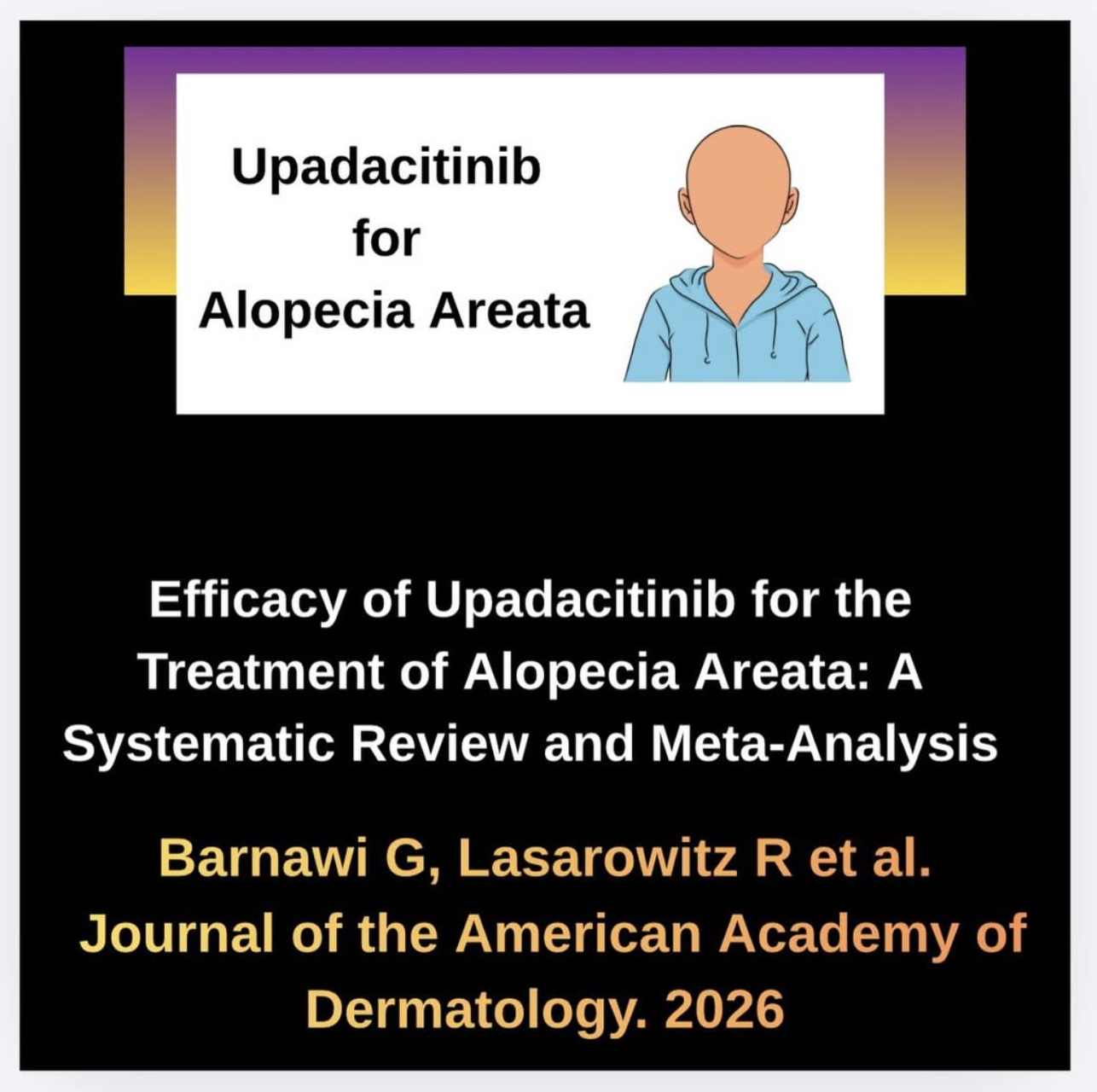
It was a great privilege to work with wonderful colleagues on a systematic review and meta-analysis assessing the efficacy upadacitinib for treating alopecia areata (AA). The study was led by Dr Ghassan Barnawi and Raquel Lazarowitz from McGill University.
We analyzed 33 studies involving 136 patients and found significant improvements in hair growth across a wide range of patient groups.
The average “baseline” SALT score was 77, reflecting severe hair loss. After treatment, patients experienced an average SALT score reduction of 68.5 points over approximately 24 weeks. Even patients with severe AA (baseline SALT >50) showed remarkable improvement, with SALT scores decreasing by nearly 80 points.
One of the most encouraging findings was the consistency of response. Adults and children responded similarly, and patients who had previously failed another JAK inhibitor achieved results comparable to JAK-naïve patients. In addition, higher doses did not appear to provide substantially greater benefit than lower doses.
Response rates were impressive: 94% achieved SALT50 and 89% reached a SALT score of 20 or less. Side effects occurred in about one-third of patients, but were generally mild and did not lead to treatment discontinuation.
While larger long-term studies are still needed, these findings suggest that upadacitinib may become an important addition to the growing list of effective treatments for alopecia areata.
Congratulations to all our group! The article is available to all online with open access publishing.
Reference
Barnawi G, Lazarowitz R, Nukaly HY, Creighton R, Ridha Z, Aldein AS, Algaidi Y, Weiss E, Litvinov IV, Donovan J. Efficacy of upadacitinib for the treatment alopecia areata: a systematic review and meta-analysis. J Am Acad Dermatol. 2026 Jun 3.