November 04, 2026
3 min read

Key takeaways:
- Pancreatic cysts with at least two worrisome features carried eightfold higher 3-year risk for neoplasia vs. those with one.
- These results highlight the importance of individualized, risk-based surveillance.
The presence of at least two “worrisome” features on pancreatic cystic lesions increases the risk for progression to cancer or high-grade dysplasia, approaching that of high-risk stigmata, according to results of a prospective cohort study.
“Pancreatic cysts are a common finding on imaging, and while most of these cysts will not go on to progress to cancer, there are cysts with worrisome and high-risk features that have a greater malignant potential,” study author Shounak Majumder, MD, associate professor of medicine at Mayo Clinic and vice chair of the pancreatic disorder section at AGA, told Healio.

Researchers estimate the prevalence of pancreatic cystic lesions to be 10% to 18% in the general population.
Early detection, accurate diagnosis and surgical resection of high-grade dysplasia and early-stage malignancy are key to improving outcomes, they wrote.

Shounak Majumder
“We don’t want to operate on everyone with a precancerous cyst because [surgery] has meaningful consequences,” Majumder said. “We also don’t want to miss the window of opportunity to intervene at an early stage in patients with cancer or advanced precancer.”
Current guidance on pancreatic cystic lesion management is largely derived from retrospective analyses, according to study background.
“There is a need for good quality, prospective evidence to support those decisions,” Majumder said.
Majumder and colleagues investigated incidence of advanced neoplasia — which includes cancer and high-grade dysplasia — among patients with pancreatic cystic lesions with worrisome or high-risk features.
High-risk stigmata included obstructive jaundice caused by a lesion in the pancreatic head, nodule or other solid components, segmental or diffuse dilation of the main pancreatic duct measuring 10 mm or more, and cytology findings indicative of high-grade dysplasia or invasive carcinoma.
Features categorized as worrisome included cysts 3 cm or larger, lesions that grew 5 mm or more in diameter in 2 years, peripancreatic lymph node enlargement, and thickened or enhancing cyst wall.
The researchers enrolled 230 adults (median age, 70 years; 50.4% women) with pancreatic cystic lesions, characterized by at least one worrisome or high-risk feature, between May 2018 and July 2024.
Thirty-two patients had lesions surgically removed within 3 months of enrollment and were included in the immediate surgery group. The remainder (n = 198) were assigned to the clinical surveillance group, which included serial imaging, clinical assessments and laboratory testing as needed.
Annual follow-up continued for 5 years, or until death, pancreatic surgery or diagnosis of high-grade dysplasia or pancreatic cancer.
Nearly all (93.4%) patients in the clinical surveillance group had at least one worrisome cystic feature, and 6.6% had one or more high-risk features. The overall survival rate reached 94.6% over median follow-up of 33.4 months, with seven deaths reported, none of which were linked to pancreatic disease.
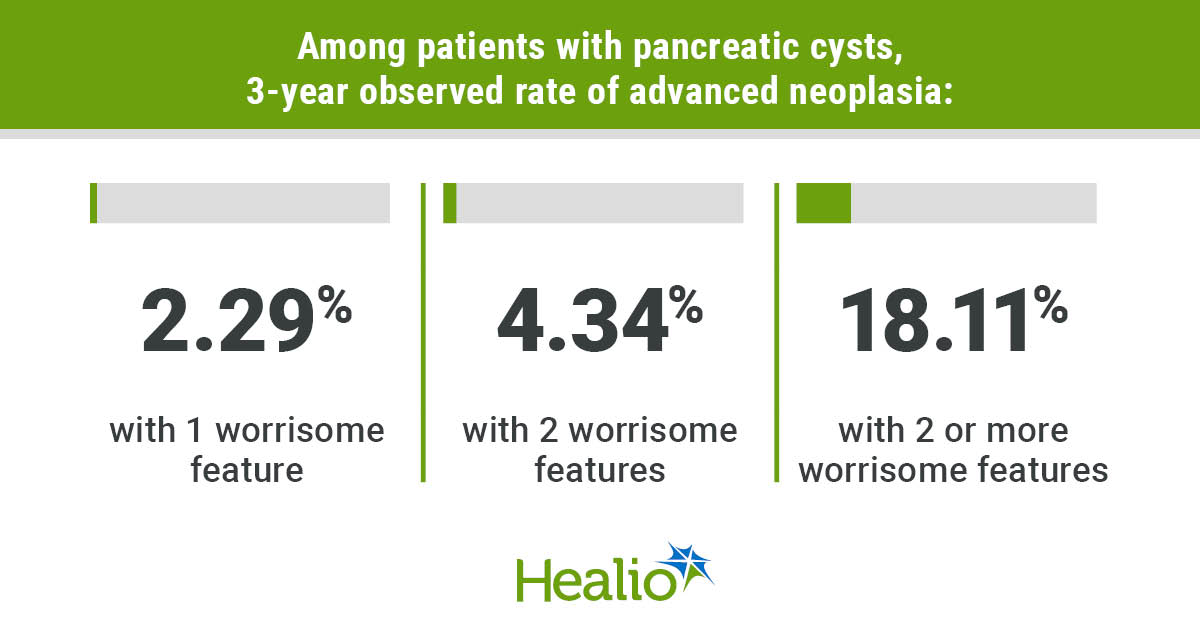
Among patients who had one worrisome feature, the 3-year observed rate of advanced neoplasia was 2.29% (95% CI, 0.57%-9.1%), which grew to 4.34% (95% CI, 1.42%-13.24%) with two worrisome features. The rate jumped to 18.11% (95% CI, 7.27%-45.14%) with more than two worrisome features.
“One worrisome feature might not be as worrisome as the word ‘worrisome’ suggests,” Majumder said. “When multiple worrisome features appear in the same patient — especially, as we have seen in this study, when there are more than two worrisome features — then the risk starts approaching that of a patient with a high-risk stigmata.”
The 3-year incidence of advanced neoplasia among individuals in the clinical surveillance group with lesions with worrisome features was 1.3 (95% CI, 0.3-5.3) per 100 patient-years, whereas those with high-risk features had a 3-year incidence of 9.1 (95% CI, 1.3-64.5).
“Pancreatic cyst management is fundamentally a cancer interception problem,” Majumder said. “We need to understand who’s at risk, what that level of risk is, how to precisely detect early stages of cancer and intervene at a time when patients can have a meaningfully better outcome.”
He emphasized the urgency of additional research on biomarker-based approaches to detect pancreatic cancer at its earliest stages and more precise stratification of malignancy risk in pancreatic cysts, particularly to identify patients most likely to progress to cancer.
“Risk-based surveillance is a path towards early detection of pancreatic cancer,” Majumder told Healio. “We need to further refine our tools for risk assessment and early detection, and we need better biomarkers that can accurately detect the earliest stages of pancreatic cancer.”
For more information:
Shounak Majumder, MD, can be reached at newsbureau@mayoclinic.edu.
Sources/Disclosures
Source:
Chhoda A, et al. Gastroenterology. 2026;doi:10.1053/j.gastro.2026.07.038.
Disclosures:
Majumder reports royalties from Mayo Clinic intellectual property licensed to Abbott Cancer Diagnostics and support from the Mayo Clinic Comprehensive Cancer Center and Centene Foundation. Please see the study for all other authors’ relevant financial disclosures.

Ask a clinical question and tap into Healio AI’s knowledge base.
- PubMed, enrolling/recruiting trials, guidelines
- Clinical Guidance, Healio CME, FDA news
- Healio’s exclusive daily news coverage of clinical data