November 04, 2026
5 min read

Key takeaways:
- Zanidatamab regimens significantly improved survival compared with trastuzumab plus chemotherapy for patients with gastroesophageal adenocarcinoma.
- Diarrhea is a common adverse event.
First-line zanidatamab-hrii plus chemotherapy, without or with tislelizumab-jsgr, extended survival 24% and 35% vs. trastuzumab plus chemotherapy for those with locally advanced or metastatic gastroesophageal adenocarcinoma.
Findings from the randomized phase 3 HERIZON-GEA-01 trial, presented at European Society for Medical Oncology Congress, showed that zanidatamab-hrii (Ziihera, Jazz Pharmaceuticals) combinations extended median OS by 3 and 8 months.


Geoffrey Y. Ku
“These results are truly ground-breaking and highlight how much the first-line treatment landscape for HER2-positive advanced gastroesophageal adenocarcinoma has evolved,” Geoffrey Y. Ku, MD, gastrointestinal oncologist at Memorial Sloan Kettering Cancer Center and co-author of the HERIZON-GEA-01 study, told Healio. “We are now seeing survival outcomes that would have been difficult to envision when trastuzumab first became the standard HER2-directed therapy in this setting 16 years ago.”
Long-term survival ‘uncommon’
The Trastuzumab for Gastric Cancer trial established trastuzumab (Herceptin, Genentech) plus chemotherapy as standard first-line treatment for HER2-positive advanced gastroesophageal adenocarcinoma in 2010, improving median OS to 13.8 months.
Recent research has shown that adding pembrolizumab (Keytruda, Merck) could extend median OS to roughly 20 months for patients with PD-L1-postive disease.
However, long-term survival remains “uncommon,” Ku said.
“HERIZON-GEA-01 was designed to determine whether zanidatamab, a bispecific HER2-directed antibody that binds to two distinct sites on HER2, could improve outcomes by providing a new HER2-targeted backbone,” he explained.
Researchers evaluated zanidatamab-hrii plus chemotherapy, with or without tislelizumab-jsgr (Tevimbra, BeOne Medicines USA), an anti-PD-L1 antibody, against trastuzumab plus chemotherapy.
They randomly assigned 914 patients 1:1:1 to receive IV zanidatamab-hrii (< 70 kg, 1,800 mg; 70 kg, 2,400 mg) every 3 weeks plus chemotherapy with (n = 302) or without (n = 304) 200 mg IV tislelizumab-jsgr every 3 weeks, or trastuzumab plus chemotherapy (n = 308).
PFS and OS served as primary endpoints.
The FDA approved zanidatamab-hrii combinations for unresectable locally advanced or metastatic HER2-positive gastroesophageal adenocarcinoma in August based on results from the first interim analysis.
‘Truly remarkable’
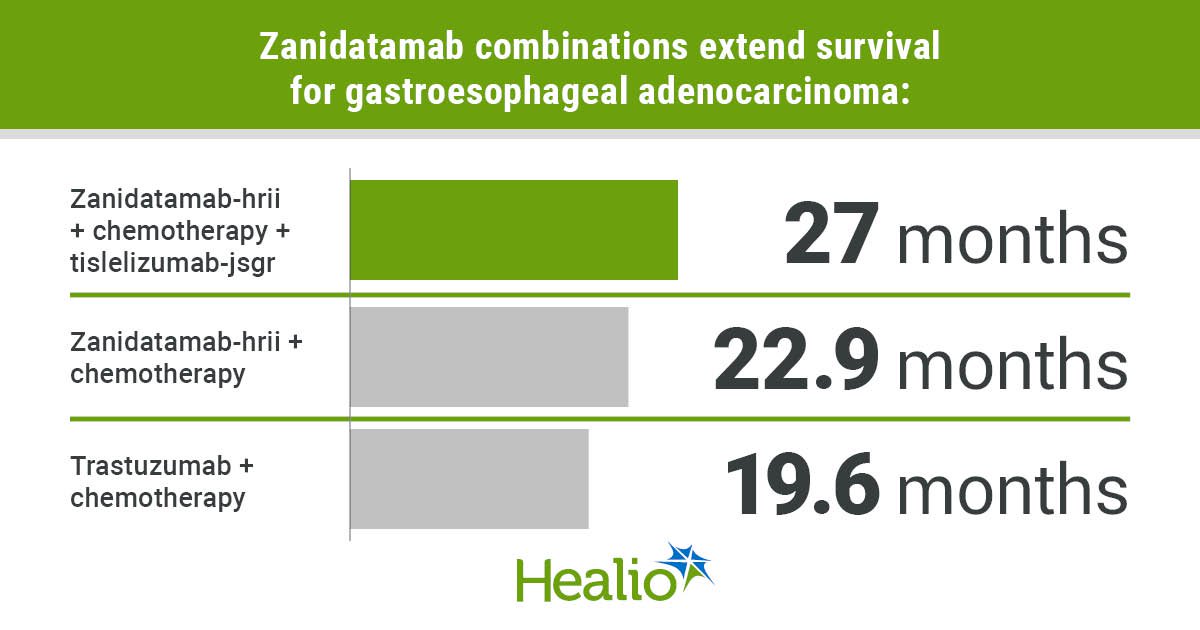
In the second and final analysis, the zanidatamab-hrii plus chemotherapy arm had significantly improved OS compared with trastuzumab (median: 22.9 months vs. 19.6 months; HR = 0.76; 95% CI, 0.62-0.93).
Researchers observed benefits across most subgroups. Notably, patients with HER2-positive IHC 3+ tumors had significant improvement (HR = 0.71; 95% CI, 0.57-0.88) but those with HER2-positive, IHC 2+/ISH+ disease did not.
“However, there were only about 50 patients with HER2-positive, IHC 2+/ISH+ tumors in each group,” Ku said. “Even small imbalances could have confounded these results.”
Patients who received tislelizumab-jsgr with zanidatamab-hrii also had significantly improved OS compared with the trastuzumab arm (median: 27 months vs. 19.6 months; HR = 0.65; 95% CI, 0.52-0.8). This translated into a 3-year OS rate of 39.8% vs. 22.9%.
“It is truly remarkable that 40% of patients were alive at 3 years, which offers unprecedented hope for our patients,” Ku said.
Ku and colleagues observed benefits across most subgroups, including among patients with PD-L1-negative (HR = 0.5; 95% CI, 0.35-0.73) and positive (HR = 0.68; 95% CI, 0.52-0.89) disease.
Ku described the PD-L1 findings as an “extremely pleasant surprise.”
The tislelizumab-jsgr arm had a “clinically meaningful” improvement in OS compared with the zanidatamab-hrii only arm (median: 27 months vs. 22.9 months; 3-year rate: 39.8% vs. 31.5%), but this failed to meet statistical significance, Ku said. However, researchers noted the study was not powered to compare those two experimental treatments.
Researchers observed similar OS rates based on PD-L1 expression, too.
“To me, these results are directionally and conceptually comparable to those seen in the KEYNOTE-811 study that showed benefit for adding pembrolizumab to trastuzumab and chemotherapy, and establishes that zanidatamab plus tislelizumab and chemotherapy should be offered to patients who are candidates for immunotherapy,” Ku said.
Compared with the trastuzumab arm, patients achieved significantly longer PFS if they received the doublet (median: 12.4 months vs. 8.3 months; HR = 0.65; 95% CI, 0.53-0.8) or triplet (median: 12.7 months; HR = 0.61; 95% CI, 0.5-0.76).
The triplet arm had the highest mean duration of treatment (64.1 weeks), followed by the doublet (52.6 weeks) and trastuzumab (42.3 weeks).
All three arms had similar rates of any grade treatment-emergent and treatment-related adverse events.
However, the triple had higher rates of grade 3 or worse treatment-related adverse events than the doublet and trastuzumab arms (72.4% vs. 59% and 59.9%).
Similarly, patients who received tislelizumab-jsgr had the highest rate of serious treatment-related adverse events (42.2% vs. 28.5% vs. 20.5%).
Any-grade diarrhea occurred in 83% of patients who received tislelizumab-jsgr and 79% who received the doublet, compared with 53.3% in the trastuzumab arm. Grade 3 or worse diarrhea followed a similar pattern (25.2% vs. 20% vs. 12.9%).
“Zanidatamab plus tislelizumab and chemotherapy led to severe grade 3/4 diarrhea in 25% of patients, despite mandatory loperamide prophylaxis for the first 7 days,” Ku said. “Thankfully, the diarrhea resolved within 3 weeks with appropriate management, and only 4% of patients had to discontinue zanidatamab because of it. Therefore, a critical issue for clinicians and patients alike in order to realize the benefits of this regimen is aggressive and comprehensive management of the diarrhea. This management involves patient and physician education, close communication and early recognition of worsening diarrhea so that additional anti-diarrhea medications, supportive treatments and appropriate delays and reductions in chemotherapy can be instituted.”
The tislelizumab-jsgr arm had the highest rate of treatment-related adverse events leading to death (2.4%), followed by trastuzumab (1.3%) and the doublet (0.3%).
The triplet also had the highest rate of treatment discontinuation due to treatment-related adverse events (44.9%), followed by the doublet (35.1%) and trastuzumab (29.1%).
“An important next step is to continue characterizing outcomes across clinically relevant patient and tumor subgroups, including by level of HER2 expression, to deepen our understanding of how patients may benefit from the two approved zanidatamab-containing regimens,” Ku said. “Biomarker analyses are underway and, as an example, it is important to understand if changes in circulating tumor DNA can predict for response or resistance.”
‘Intriguing question’
Invited discussant Maria Ignez Braghiroli, MD, physician at Cancer Institute of the State of São Paulo, said during her presentation that zanidatamab-hrii should replace trastuzumab regimens for patients with HER2-positive IHC 3+ tumors and PD-L1-negative disease, or those not eligible for immunotherapy.
For patients with HER2-positive, IHC 2+/ISH+, she said she would prefer the triplet or trastuzumab plus pembrolizumab with chemotherapy.
For those with HER2-positive IHC 3+ tumors and PD-L1-positive disease, Braghiroli would “favor” the tislelizumab-jsgr treatment though she emphasized HERIZON did not compare the data with trastuzumab plus pembrolizumab with chemotherapy.
Braghiroli noted the most “intriguing question” to arise is the value tislelizumab-jsgr adds to treatment.
“This is still not entirely defined,” she explained.
However, she too described median OS with tislelizumab-jsgr as “unprecedented,” adding that future research also should evaluate how PD-L1 fits with zanidatamab-hrii therapies.
“Should we still test it to decide what treatments to offer to the patients?” Braghiroli asked. “PD-L1 has shown a predictive value both in HER2-positive and HER2-negative disease. … I would not assume that PD-L1 is complete irrelevant overall, but for the zanidatamab combinations, it doesn’t seem to define a subgroup that benefits the most.”
For more information:
Geoffrey Y. Ku, MD, can be reached at kug@mskcc.org.
Perspective

HERIZON-GEA-01 represents a landmark, practice changing trial.
The combination of zanidatamab, tislelizumab and chemotherapy significantly improved PFS and OS over the prior standard trastuzumab and chemotherapy. A survival increment of 5 months is highly significant.
This report led to regulatory approval of the combination of zanidatamab, tislelizumab and chemotherapy as the new first line standard of care. The report at ASCO 2026 that the PFS and OS benefits were not dependent on PD-L1 status, in contrast to potential detrimental effects of pembrolizumab combined with trastuzumab and chemotherapy in PD-L1-negative patients, reinforces this new zanidatamab/tislelizumab-based treatment as the new standard first line treatment in all patients with metastatic HER2-positive esophagogastric adenocarcinoma.
At ESMO 2026data were reported on the awaited comparison of zanidatamab vs. trastuzumab plus chemotherapy in the patients not getting immunotherapy. Zanidatamab plus chemotherapy was also superior to trastuzumab chemotherapy, without immunotherapy, reinforcing the superiority of this agent over trastuzumab.
Given the improved survival with the addition of tislelizumab to zanidatamab and chemotherapy, this combination of therapy is preferred as first line treatment in all patients. Results were not unexpected given the substantial activity of zanidatamab even as a single agent.
The next step will be the evaluation of zanidatamab, tislelizumab and chemotherapy in the preoperative treatment of HER2-positive esophagogastric cancer.
David H. Ilson, MD, PhD
Disclosures: Ilson reports advisory role for BeOne.
Sources/Disclosures
Source:
Shitara K, et al. Abstract LBA79. Presented at: European Society for Medical Oncology Congress; Oct. 23-27, 2026; Madrid.
Reference:
Disclosures:
BeOne Medicines, Jazz Pharmaceuticals and Zymeworks funded the study. Ku reports advisory role, research funding and/or travel accommodations/expenses from Adaptimmune, Aduro Biotech, Astellas Pharma, AstraZeneca, Bayer, BeiGene, Bristol-Myers Squibb, CARsgen Therapeutics, Daiichi Sankyo, Gilead Sciences, ImaBiotech, Jazz Pharmaceuticals, MedImmune, Merck Sharp & Dohme, Oncolys BioPharma, Pieris Pharmaceuticals, Triumvira Immunologics and Zymeworks. Please see the study for all other authors’ relevant financial disclosures. Braghiroli reports advisory board, travel expenses, participation in medical events and/or clinical researcher for Amgen, Astellas, AstraZeneca, Bayer, BeOne, BMS, Daiichi Sankyo, Eurofarma, Exelixis, GSK, Lilly, Merck, MSD, Pfizer, Roche, Sevier and Takeda.

Ask a clinical question and tap into Healio AI’s knowledge base.
- PubMed, enrolling/recruiting trials, guidelines
- Clinical Guidance, Healio CME, FDA news
- Healio’s exclusive daily news coverage of clinical data